A Gaygency data story
The customer everyone underestimates.
One in eleven American adults. Nearly a quarter of Generation Z. And $1.4 trillion in yearly spending power that moves on principle. This is the LGBTQ+ consumer, told through numbers you can check: every figure on this page links to a live, named source.
Act I
Who they are.
Nine percent of American adults identify as lesbian, gay, bisexual, transgender, or something other than straight.[1] That is roughly one person in eleven, in any audience you will ever buy.
The number has nearly tripled since Gallup started counting in 2012, and generation explains why. Millennials identify at 14.2 percent, nearly three times the rate of Gen X.[2]
Gallup expects the national number to keep climbing as Gen Z ages in.[1] This is not a niche audience. It is the direction the market is moving.

Act II
The audience is bigger than the community.
How a brand treats LGBTQ+ people is watched well beyond the community itself. Three in five non-LGBTQ+ adults say they support the community. That is nearly 150 million Americans paying attention.[4]
Act III
Loyalty runs both ways.
The HRC Foundation and Community Marketing & Insights have tracked this community's buying behavior for three decades. The 2026 numbers are unambiguous: LGBTQ+ consumers reward the brands that show up and walk away from the brands that retreat, in almost equal measure.[3]
When brands show up
With intent
HRC Foundation / CMI, Pride in the Marketplace 2026[3]
Act IV
The retreat has a price.
Through 2025 and 2026, a wave of companies went quiet: Pride sponsorships dropped, inclusion language softened, campaigns shrank. Consumers noticed, and the response showed up in purchasing, not just opinion polls.
Act V
Wanted: representation that feels human.
Consumers are not asking for rainbow logos. They are asking for real people in real stories, and most advertising still misses the mark so completely that they do not even notice the attempts.[5]
Non-LGBTQ+ consumers who want multi-dimensional, human LGBTQ+ representation
79%
LGBTQ+ consumers who want the same
88%
Americans who say advertisers have a responsibility to give LGBTQ+ people visibility
66%
Consumers who noticed the LGBTQ+ inclusion brands put in Super Bowl ads
<40%
GLAAD & Kantar, Advertising Visibility Index (2023, the most recent published edition)[5]
What it means
Three conclusions the data insists on.
The market compounds every year
Identification more than doubles with each younger generation, and Gallup expects the national number to keep rising as Gen Z ages into adulthood. A brand that earns this community's trust now is buying loyalty in the fastest-growing segment of its future customer base.[1],[2]
Allies multiply every signal
Nearly 150 million supportive Americans watch how brands treat LGBTQ+ people. What you do for a 9 percent audience is seen by a 61 percent audience. Treating the community well is a mainstream trust signal.[1],[4]
Retreat costs more than presence
Seven in ten LGBTQ+ consumers pulled spending from companies seen as backing away, and those companies lose these customers at twice the rate of other consumers. Showing up consistently, all year, is the cheaper strategy, and it is the one consumers reward.[3]
Cite this page
The Gaygency (2026). "The LGBTQ+ Consumer: The Data Story Brands Keep Getting Wrong." https://www.thegaygency.com/lgbtq-consumer
Sources and methodology
Every figure on this page links to a named, public source. Before publishing, we verified that each source page loads and states the figure cited, in two independent passes, most recently on July 29, 2026. Where a source publishes annual editions, we cite the newest available. If you find a newer figure, tell us through the contact page and we will update the story and this date.
- 1.Gallup (2026). LGBTQ+ Identification Holds at 9% in U.S.. news.gallup.com
- 2.Gallup (2025). LGBTQ+ Identification in U.S. Rises to 9.3%. news.gallup.com
- 3.Human Rights Campaign Foundation (2026). Pride in the Marketplace 2026 consumer report (with Community Marketing & Insights). hrc.org
- 4.GLAAD (2025). Accelerating Acceptance 2025. glaad.org
- 5.GLAAD & Kantar (2023). Advertising Visibility Index. glaad.org
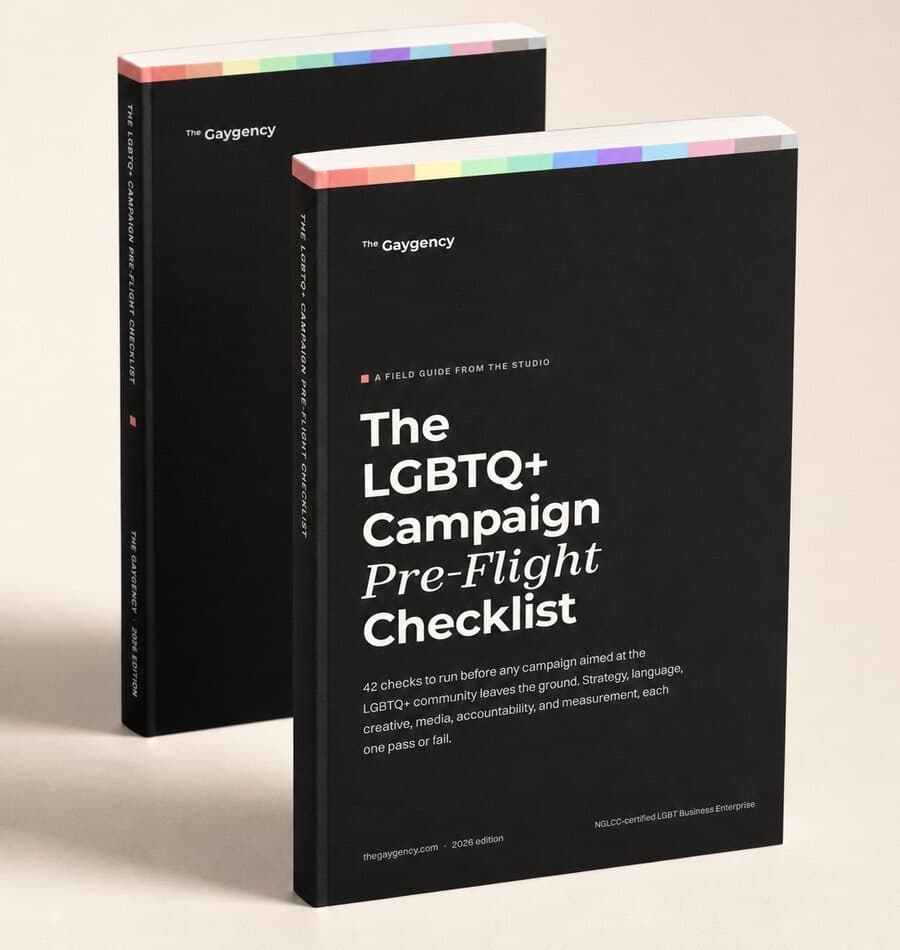
Free campaign guide
Would your campaign pass pre-flight?
These are the numbers. The checklist is the list we run over a brief before it goes live.
Delivered by email. No spam, ever.
This is the audience we know best.
The Gaygency builds year-round marketing for the community behind these numbers, with a 1M+ verified LGBTQ+ consumer dataset behind the media plan.