Consumer Data
Gen Z and LGBTQ+ Identity: What 23% Means for Your Brand
By The Gaygency · 08-24-26 · 7 min read

Gallup's latest data, from 2025 interviews, puts LGBTQ+ identification at 9% of U.S. adults overall, and at 23% among adults under 30, nearly one in four. Gallup states it plainly in its own analysis: "nearly one in four adults in that generation currently identify as something other than heterosexual." A year earlier, Gallup's 2024 wave put the overall figure at 9.3%, with Gen Z adults at 23.1%. However the number gets rounded, the story underneath it is the same: a generation is coming of age, and buying power, at a rate of LGBTQ+ identification two and a half times the national adult average.
This is not a soft trend or a single outlier poll. Gallup has tracked this number every year since 2012, through tens of thousands of phone interviews, and the figure has more than doubled over that period, from 3.5% in 2012 to around 9% today, even with the 2025 reading essentially flat. For any brand planning further out than the current fiscal year, that trajectory is a planning input, not a curiosity.
The 2025 numbers
Gallup's 2025 wave, based on interviews with more than 13,000 U.S. adults, breaks the 9% total down by identity: 5.3% of all U.S. adults identify as bisexual, 1.6% as gay, 1.4% as lesbian, 1.1% as transgender, and 0.5% as some other LGBTQ+ identity. Bisexual identification is the largest single category by a wide margin, representing well over half of everyone who identifies as LGBTQ+ at all.
That composition matters for anyone building creative or media strategy around this audience. A campaign built entirely around gay and lesbian representation is speaking past the majority of the LGBTQ+ population it is trying to reach. The largest and fastest-growing subgroup identifies as bisexual, and a strategy that does not account for that is working from an outdated picture of who the audience is.
At 5.3% of all U.S. adults, bisexual identification outnumbers the gay, lesbian, transgender, and other LGBTQ+ categories combined.
How fast this moved
Gallup's own five-year table shows the shift happening in real time. In 2020, 3.1% of U.S. adults identified as bisexual. By 2025, that number reached 5.3%, a jump of more than 70% in five years. Gay identification moved from 1.4% to 1.6% over the same period, lesbian identification from 0.7% to 1.4%, and transgender identification from 0.6% to 1.1%. Every category grew. None grew as fast as bisexual identification, and the growth in that specific category is concentrated almost entirely in younger adults.
Gallup's earlier data points confirm the pace. In 2023, the organization reported LGBTQ+ identification at 7.6% of all U.S. adults, already noting that more than one in five Gen Z adults identified as LGBTQ+ at that point. The following year, the overall number reached 9.3% and the Gen Z figure reached 23.1%, nearly one in four. That is not a generation slowly warming to a label. That is a number moving by whole percentage points within a single presidential term.
The audience did not become more visible. It became larger, and it did so inside a five-year window most brand strategies have not caught up to.
Why Gen Z women are the fastest-moving subgroup
Gallup's generational breakdowns have consistently found that women identify as LGBTQ+ at higher rates than men within every generation younger than the Baby Boomers, and the gap is widest among the youngest adults. In an earlier Gallup wave reported by NBC News, close to 30% of Gen Z women identified as LGBTQ+, most commonly as bisexual, nearly three times the rate among Gen Z men. That gap is not a rounding artifact. It shows up consistently across Gallup's survey waves, and it means that a brand's Gen Z women audience specifically skews meaningfully more LGBTQ+-identified than any other subgroup a marketing team is likely to have a persona for.
For older generations, the numbers look different by design, not by comparison. Gallup's data shows LGBTQ+ identification is far less common the older the generation: identification among Gen X adults sits around 5%, and it drops further among Baby Boomers and the Silent Generation. Gallup ties the generational gap largely to bisexual identification, which is far more common among younger adults: more than half of Gen Z and millennial LGBTQ+ people say they are bisexual, compared with fewer than one in five baby boomer LGBTQ+ adults. The generational curve is not a preference shift. It reflects who feels safe enough to answer the survey question honestly, layered on top of what each generation lived through.
Every identity category in Gallup's tracking grew between 2020 and 2025, with the fastest growth concentrated almost entirely in younger adults.
What this changes for brand strategy, starting now
A brand building for the next five to ten years of customers is building for a population where LGBTQ+ identification is not a niche segment inside Gen Z. It is a substantial and fast-growing share of it. That has three concrete implications.
First, the audience cannot be reached by interest-based ad targeting the way it once could. Meta removed detailed-interest categories including "LGBT culture" in 2022 and eliminated detailed targeting exclusions entirely by March 2025, which means platforms cannot be asked to find this audience by stated interest anymore. A first-party dataset, built and verified outside the platforms, does the targeting work interest categories used to do. Our own paid social engagements include an optional add-on built for exactly this: a proprietary dataset of 1M+ verified LGBTQ+ consumers, used to build lookalike audiences the platforms can no longer construct on their own.
Second, most brands are not equipped to act on this yet. The ANA's LGBTQ+ Marketing Inclusion Report found that a majority, 64%, of brands doing any LGBTQ+ marketing do not use a specialized agency for it (ANA, LGBTQ+ Marketing Inclusion Report, 2021). That gap between a fast-growing audience and a thin base of specialist expertise is not a permanent condition. It is a current opening for brands willing to close it early.
Third, this is a campaign strategy question before it is a creative question. A brand that treats a quarter of an entire generation as a footnote in its Gen Z persona work is planning around numbers that were already out of date two Gallup cycles ago. This belongs in the same planning conversation as any other demographic shift a business tracks: total addressable market, channel mix, and where the next five years of customers are going to come from.
A brand's Gen Z persona built without this number in it was already out of date the year it was written.
Questions worth asking before the next planning cycle
- Does our Gen Z persona work reflect that nearly one in four of that generation identifies as LGBTQ+?
- Is our targeting still built on interest categories Meta no longer offers?
- Does our creative represent bisexual identity, the largest single LGBTQ+ subgroup, or only gay and lesbian identity?
- Who owns this data internally, and is it a specialist question or a generalist assumption right now?
The measurement problem underneath the growth
A generation growing this fast creates a specific measurement problem: last year's audience research is stale faster than usual. A brand relying on a three-year-old persona deck is not looking at a slightly outdated picture. Gallup's own numbers show meaningful movement year over year, which means the useful cadence for revisiting this data is annual at minimum, not once every strategic planning cycle. Brands at an earlier stage, building their core audience definitions for the first time, have an advantage here: they can build the current numbers into the foundation instead of retrofitting an existing persona deck that was written for a different generation's numbers.
Frequently asked questions
Is the 23% figure specific to one narrow age range, or all of Gen Z?
Gallup defines Generation Z as adults born between 1997 and 2012, so the figure reflects Gen Z adults currently old enough to be surveyed, roughly ages 18 to 28 as of 2025. The number will likely shift as more of the generation reaches adulthood and gets included in the sample.
Why is bisexual identification growing faster than gay or lesbian identification?
Gallup's data does not fully explain the mechanism, but the pattern holds consistently across years and generations: bisexual identification has been the largest and fastest-growing category in every recent wave, particularly among young women. Any strategy assuming the LGBTQ+ audience is primarily gay and lesbian is working from a population that no longer matches the data.
Does this number apply the same way across every industry?
The overall rate does not change by industry, but its relevance does. Categories where Gen Z is already the primary buyer, fashion, beauty, food and beverage, entertainment, feel this shift immediately. Categories with an older core customer base will feel it on a longer timeline, as Gen Z ages into those purchase categories.
How often should this data get revisited?
At minimum annually, since Gallup's own tracking shows meaningful year-over-year movement. A persona deck or targeting strategy built on numbers from more than two years ago is very likely already behind where the actual population sits today.
Is this a reason to build LGBTQ+-specific campaigns, or just to update general-market strategy?
Both, depending on the brand and category. At minimum, general-market strategy needs to stop assuming this audience is a small footnote. Whether a brand also builds dedicated LGBTQ+-specific work is a separate decision that depends on category fit and audience overlap. A campaign strategy engagement makes that call with real data instead of a guess.
A quarter of the generation building the next decade of consumer behavior already identifies as LGBTQ+, and the trend line says that number keeps moving. Book a call and we will build the audience strategy around where the data sits now, not where it sat two Gallup cycles ago.
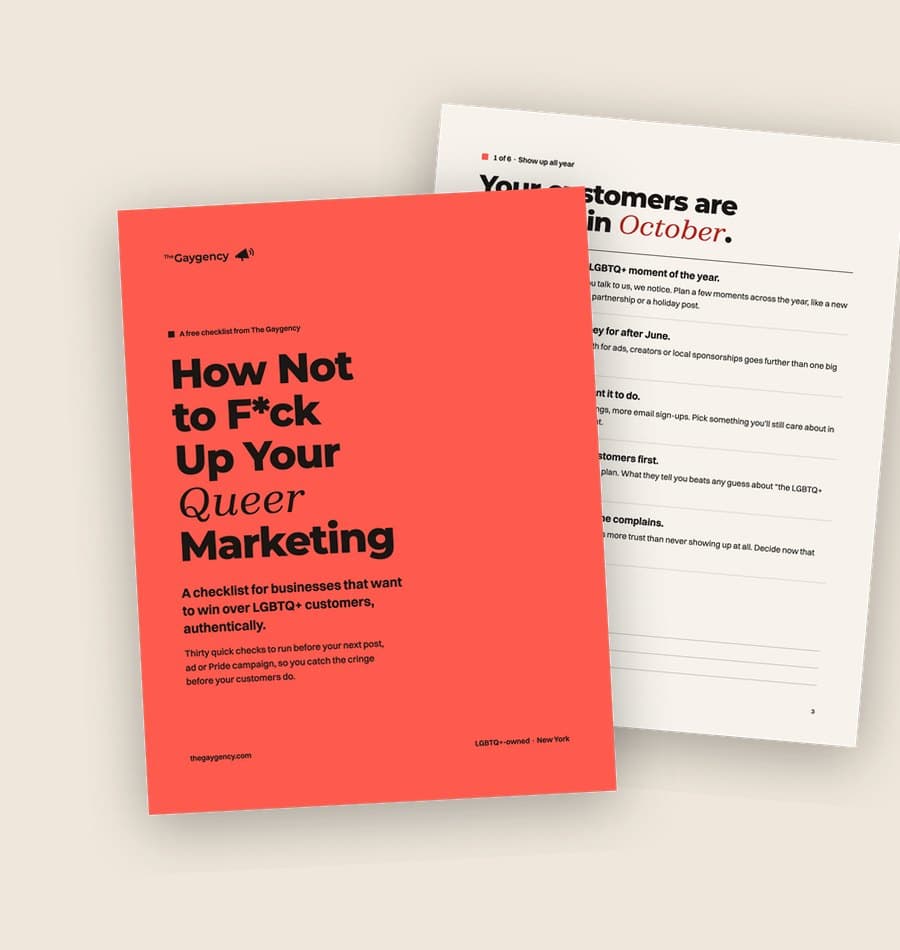
Free checklist
How not to f*ck up your queer marketing
A checklist for businesses that want to win over LGBTQ+ customers, authentically.
Thirty quick checks to run before your next post, ad or Pride campaign, so you catch the cringe before your customers do.
Delivered by email. No spam, ever.
Written by
The marketing and advertising agency for LGBTQ+ businesses and the brands that back them. Strategy, media buying, and brand systems with published results.
See the work