Social and PR
National Coming Out Day: what brands should and shouldn't do
By The Gaygency · 10-05-26 · 7 min read

National Coming Out Day falls on October 11 every year, and it marks something specific: the moment someone tells the people in their life who they are. Psychologist Robert Eichberg and activist Jean O'Leary founded it in 1988, choosing the date because it was the first anniversary of the Second National March on Washington for Lesbian and Gay Rights in 1987. The idea, rooted in the feminist principle that the personal is political, was that the most basic form of LGBTQ+ activism is simply living openly.
That origin is worth sitting with, because it's exactly where brand marketing around this day tends to misfire. Coming out is private, often difficult, and never something a company can hand out or manufacture on someone's behalf. A day built around that act calls for a narrower, more careful kind of brand participation than Pride Month does, and most calendars treat it identically.
What doesn't work
The clearest failure mode is asking customers or employees to disclose something personal in exchange for a benefit: a discount for "coming out" on social media, a contest that rewards public disclosure, or a campaign that implicitly treats visibility as an obligation rather than a choice. For a meaningful share of LGBTQ+ people, coming out means real risk, whether that's family rejection, workplace discrimination, or physical safety, and a brand mechanic that treats it as a marketing prompt ignores that risk entirely.
A quieter version of the same mistake happens internally. Featuring an employee resource group member as the face of a public campaign without genuine, specific consent, or assuming that someone already out at work is comfortable being out to your entire customer base, both cross a line that's easy to miss when the intent behind it is good.
Coming out is a decision that belongs to the person making it. The moment a brand campaign turns that decision into a mechanic, a contest entry, or a hashtag requirement, it has taken something that was never the brand's to take.
What has worked
The more durable approach treats October 11 as a day to point people toward resources and support, not a day to solicit disclosure. HRC has run its National Coming Out Project since 1996, well before most corporate marketing calendars caught up to the date, offering guides and support resources year round rather than a single campaign moment.
Two more recent examples show the same pattern from companies with a direct product connection to the day. In October 2023, Tinder partnered with the Human Rights Campaign to give users in-app access to HRC's Coming Out Center during the week of National Coming Out Day, a resource-first move rather than a content push. A year later, eharmony partnered with GLAAD on original research examining how dating apps intersect with coming out and identity disclosure, timed to both National Coming Out Day and Spirit Day. The research itself was the campaign: the two organizations found that 32% of LGBTQ+ Gen Z and Millennial survey respondents named dating apps as their third most common place to come out, after family and friends, and published the finding as a shareable report rather than a promotional asset.
Both examples work for the same reason. Neither one asked the audience to perform anything. Tinder added access to a resource that already existed. eharmony and GLAAD added a finding nobody had published before. The brand's role in both cases was to fund and distribute something useful, not to become the story.
Tinder and eharmony both stayed out of the personal moment itself, funding resources and research instead of asking anyone to perform.
Deciding between an internal event and a public campaign
Because the day centers something as personal as disclosure, the honest first question for most companies isn't "what do we post," it's "should this be public at all." An internal option, such as an employee resource group hosting a private panel, a resource fair, or simply circulating support information company-wide, lets a business mark the day meaningfully without turning any individual employee into a public example. That's frequently the better fit for companies without a direct, obvious connection to the day's meaning the way a dating platform has.
A public campaign only makes sense when there's something real behind it: a resource partnership, original research, or a product feature that genuinely helps someone in the process of coming out. Absent one of those, the safer and more credible choice is to keep the observance internal, or to skip a dedicated campaign and instead support the broader Q4 calendar's other, more visibility-appropriate dates.
One nuance most calendars miss
Not every LGBTQ+ person relates to this day as an event still ahead of them. Plenty of people have already come out, some have been out for decades, and for others the framework of a single disclosure moment doesn't map cleanly onto their own experience at all. HRC's own campaign language for the day has evolved to reflect this directly, framing the observance as being for anyone "coming out, inviting in, or just being true to yourself." Copy that assumes every LGBTQ+ person in the audience is mid-disclosure, rather than acknowledging the full range of where people stand, reads as narrower than the day is meant to be.
HRC now frames the day for anyone coming out, inviting in, or just being true to themselves, a range most brand copy still misses.
A short should and shouldn't list
Should: point people toward real support resources, whether that's HRC's Coming Out Project, The Trevor Project, or a relevant local organization. Shouldn't: ask customers to publicly disclose anything as a condition of a discount, contest entry, or engagement mechanic.
Should: let employees who are already public about their identity choose, with real consent and no pressure, whether they want to be featured. Shouldn't: assume someone out internally is comfortable being made the face of an external campaign.
Should: treat this as one of the lower-budget, higher-care days on the calendar. A thoughtful resource link does more than a produced campaign. Shouldn't: run the same rainbow creative used for Pride Month with the date simply swapped out.
Before anything goes out on October 11, ask
- Does this content ask anyone to disclose something personal, directly or implicitly?
- If an employee is featured, did they choose that themselves, with no pressure attached?
- Does this add something useful (a resource, information, support) or does it just ask for attention?
The safest and most effective move on National Coming Out Day is almost always the same one: make it easier for someone to find support, and stay out of the way of their actual decision.
Where this fits in a broader plan
National Coming Out Day is a light-touch day by design, and it pairs naturally with public relations work built around a genuine resource partnership rather than a paid media push. A well-placed pitch to a reporter covering LGBTQ+ issues, built around a real partnership or a piece of original research the way eharmony and GLAAD approached it, earns more than a standalone social post ever will. On the organic social side, the honest move is often restraint: a single, well-placed link to a resource, rather than a full content calendar built around the day.
Nonprofits and advocacy organizations have historically led on this date for good reason, since HRC's own National Coming Out Project set the template for a resource-first approach decades before most corporate marketing teams noticed the date existed. Any brand looking to participate well can learn directly from how nonprofits and community organizations have handled this day for years: point toward help, don't ask for a performance.
Frequently asked questions
Should our company post anything at all on National Coming Out Day?
Only if it adds real value, like a resource link or a genuine partnership. A post that exists purely to mark the date without offering anything useful is the exact pattern to avoid.
Is it appropriate to feature an employee who has come out at work?
Yes, if that employee explicitly wants to participate and understands exactly what being featured externally means. It is not appropriate to assume consent because someone is already out internally.
What's the difference between this day and Spirit Day, which falls a few days later?
National Coming Out Day centers the personal act of disclosure. Spirit Day, organized by GLAAD on the third Thursday of October, centers anti-bullying support for LGBTQ+ youth. They ask for different things from a brand: restraint and resource-sharing on one, visible solidarity on the other.
Can a company run a discount or promotion tied to this day?
A promotion unrelated to disclosure, timed to the date the way a brand might time any seasonal offer, is fine. A promotion that requires someone to come out publicly to receive it is the specific mistake to avoid.
How does a company know if it's ready to participate publicly at all?
If the honest answer to "what are we adding here" is nothing beyond a post, the better choice is usually a private action: an internal resource share, a donation, or simply no campaign at all.
The best move on this day is often the quietest one: point people toward real support, and let the rest of the calendar handle the bigger campaigns. Book a call if you want help deciding what, if anything, belongs on your October calendar.
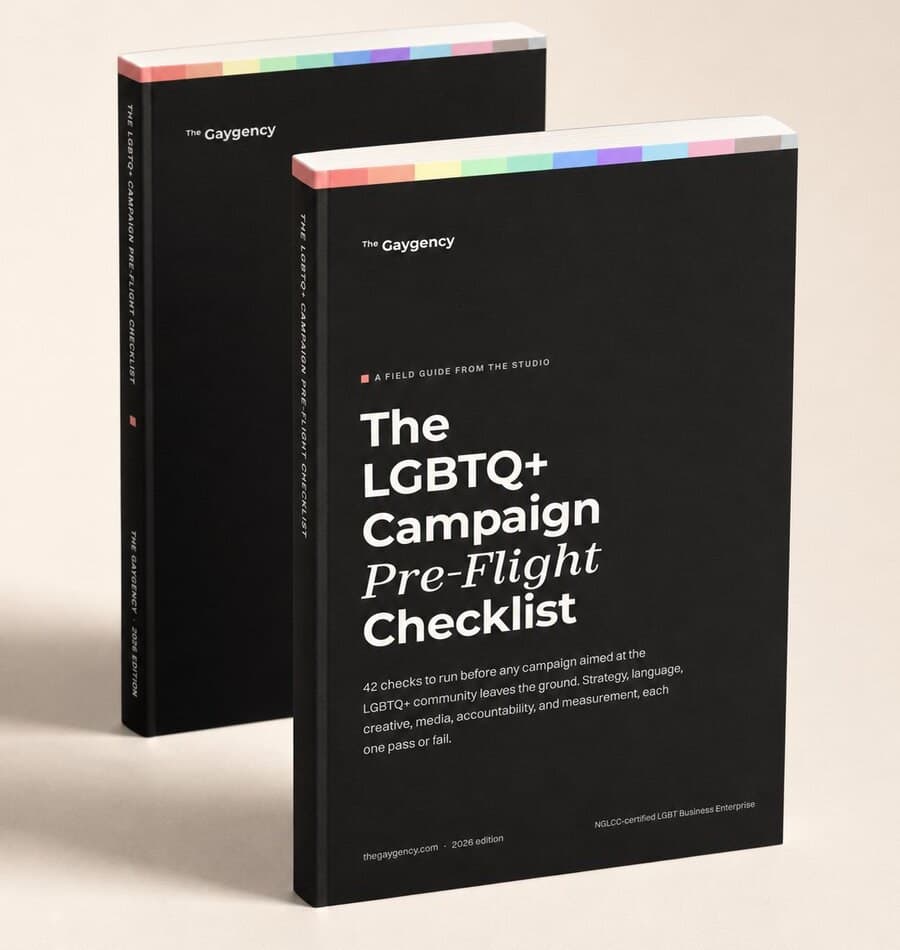
Free campaign guide
Would your campaign pass pre-flight?
The same 42 checks we run inside the studio before any campaign aimed at the LGBTQ+ community goes live.
Delivered by email. No spam, ever.
Written by
The marketing and advertising agency for LGBTQ+ businesses and the brands that back them. Strategy, media buying, and brand systems with published results.
See the work