Creative teardown
Holiday ads teardown: inclusive vs. performative
By The Gaygency · 11-12-26 · 7 min read

Holiday advertising has a specific tell that Pride advertising does not always have: it runs for months, gets revisited year after year, and gives a brand more than one chance to show whether an inclusive casting choice was a real decision or a one-week costume. Five campaigns from the past decade show both ends of that range clearly, because each one is fully documented in trade and consumer press. This is a look at what happened in each, and what it says about the difference between inclusion and decoration.
Unlike a Pride campaign, which usually lives inside a single month and gets judged on its own, a holiday campaign competes for the same shopper's attention across weeks of the busiest retail season of the year. That longer runway means a brand cannot hide an inclusive casting decision inside one quiet spot and move on. Audiences see it repeated across formats, and they see whether the brand repeats the same choice the following year. That repetition, or the lack of it, is what turns each of these five cases into a clear signal rather than a guess.
Kohl's, "Celebrating Togetherness" (2015)
Kohl's ran its #AllTogetherNow holiday campaign in November 2015, built around a single ad titled "Celebrating Togetherness" that showed an extended, multi-generational family, including a same-sex couple, preparing a holiday meal together, according to coverage from Advocate.com, Forbes, and HuffPost at the time. The couple was not the subject of the ad. They were simply part of the family being shown, alongside people of different ages and races, cooking, setting a table, and being together.
Forbes noted at the time that Kohl's ad drew a notably different reaction than earlier LGBTQ+-inclusive ads from other retailers, which had faced organized backlash campaigns. Kohl's ad landed largely as intended: a holiday ad about a family, where one of the couples in that family happened to be a same-sex couple, with no dialogue or plot point calling attention to it. That is the ad's whole strategy: representation without a spotlight on the representation.
Kohl's made the couple part of the family scene rather than the subject of the ad, and it drew none of the organized backlash earlier inclusive retail ads had faced.
Zales, holiday ad and the Valentine's Day follow-through (2016 to 2017)
Zales ran a holiday ad in November 2016 that included a lesbian couple exchanging wedding rings as part of a broader set of couples featured in the campaign. Adweek reported that the ad drew backlash from the conservative group One Million Moms, which accused Zales of "normalizing sin," and Refinery29 and Equally Wed covered the same controversy as it unfolded.
The part of this story that separates it from a typical controversy cycle is what Zales did next. Rather than pulling the ad or quietly retiring the casting, Zales brought the same couple back for its Valentine's Day campaign in February 2017, as documented by Mombian at the time. A single inclusive ad that draws backlash is a data point. A brand that reuses the same couple in its next major campaign, months later, after the backlash has already been public, is a company that made a casting decision and kept it.
"Zales' Valentine's Day ad this year includes the same two-bride couple who premiered in their winter holiday ad last November and sparked the ire of One Million Moms."
Mombian, February 2017
Hallmark and Zola, the ad that got pulled and un-pulled (2019)
This is the clearest example of the performative pattern in this list. In December 2019, Hallmark Channel pulled a set of ads for the wedding-planning site Zola that featured same-sex couples, after a complaint from One Million Moms, while leaving similar ads featuring opposite-sex couples in rotation, according to CNBC, CBC, and CBS News. Zola responded by pulling its remaining ads from the network entirely rather than accept the split treatment.
The backlash to Hallmark's decision was immediate and came from a much larger audience than the original complaint. Within days, Hallmark reversed the decision, reinstated the ads, and issued a public apology, telling CNBC it was "truly sorry" for the harm caused. The sequence matters more than either single moment: a brand treated a same-sex couple's presence in an ad as negotiable, discovered that decision cost it more support than it gained, and corrected course in public, on the record.
"After Hallmark pulled those ads, but not two featuring only opposite-sex couples, Zola pulled its remaining ads, the company said."
CBS News, December 2019
Hallmark reversed its decision within days because pulling the ads cost more support than the original complaint ever represented.
Etsy, "Gift Like You Mean It" (2020 to 2021)
Etsy's 2020 holiday campaign, "Gift Like You Mean It," included a short film called "New Guy," centered on a Black gay couple, Brandon and David, visiting family for the holidays. BET and Living Out Loud both covered the ad specifically for how it handled the story: a full narrative arc with real tension (a boyfriend meeting family for the first time) and real resolution, rather than a couple appearing briefly in a crowd shot. The University of Texas advertising program cited the wider "Gift Like You Mean It" campaign as a case study in emotionally specific holiday creative.
Etsy followed with another LGBTQ+-centered short the following year, "Meant For You," continuing the same narrative approach rather than treating 2020's inclusion as a one-time creative swing. Two consecutive years of a fully developed storyline, not a background cutaway, is the structural difference between this campaign and a token gesture.
What separated inclusion from decoration, across all five cases
- The couple carried a real storyline, not a background shot with no dialogue
- The brand kept the casting in its next campaign instead of quietly dropping it
- When a fringe group complained, the brand held its position, or corrected quickly and said so publicly
- The commitment showed up in more than one year, not a single ad cycle
Hallmark, from 2019's retreat to 2022's "The Holiday Sitter"
Hallmark's own arc is worth tracking past the 2019 controversy, because it shows a brand moving from the performative side of this list toward the genuine side over a few years. After the 2019 Zola reversal, Hallmark aired its first same-sex-inclusive holiday movie in 2020. By 2022, it released "The Holiday Sitter," its first movie built around a gay lead character, produced with a queer creative team involved behind the scenes, as GLAAD's interview with star Jonathan Bennett documented at the time.
That is not a single ad decision. It is a company changing what it greenlights, three years after treating a same-sex couple's visibility as something it could pull under pressure. Not every brand needs a redemption arc, but the difference between performative and genuine shows up in what a brand does after the first controversy, not what it does the first time.
"I feel so passionate about telling this story and I think this movie has so much heart in it."
Jonathan Bennett, star of "The Holiday Sitter," in an interview with GLAAD
Frequently asked questions
What makes a holiday ad feel performative instead of genuinely inclusive?
Based on these cases, the clearest signals are a couple used only as a decorative background element with no storyline, a casting decision that disappears the following year without explanation, and a brand that backs down the moment a fringe group complains rather than standing behind its own creative decision.
Is any LGBTQ+ representation in a holiday ad better than none?
Representation with no narrative weight, used once and never repeated, does less for a brand's credibility than a smaller, well-considered story that continues across more than one season. Kohl's and Etsy both show that the story does not need to be about identity to work. It needs a real role in the plot.
What should a brand do if a group like One Million Moms complains about an inclusive ad?
Hallmark's 2019 example is the direct lesson: pulling the ad in response to a single advocacy group's complaint caused more damage than the original ad ever would have, because the reversal signaled the casting was negotiable. Zales's decision to keep its couple in the next campaign, rather than retreat, drew far less lasting criticism.
Does inclusive casting in a holiday ad hurt sales?
None of the five campaigns in this list reported a sales decline tied to the casting decision in the press coverage available. Kohl's, Zales, and Etsy all continued or expanded the same creative direction in subsequent campaigns, which is a stronger signal of business performance than any single controversy cycle.
How far ahead should casting and creative decisions for next year's holiday campaign be made?
Etsy's and Hallmark's multi-year patterns both suggest the decision to include a specific story or couple should be made as a campaign-level creative choice during the planning phase, not adjusted reactively once the ad is already running. Reactive changes, in either direction, are what produced Hallmark's 2019 controversy in the first place.
Building a holiday campaign that holds up starts with the same brand strategy work that decides who a brand is before a single ad gets storyboarded, and leads into the campaign strategy that plans the whole season instead of one ad in isolation. Retailers and e-commerce brands building next year's holiday creative can see how we approach seasonal campaigns on our retail and local business page.
If you are planning next year's holiday campaign now, book a call before the creative gets locked.
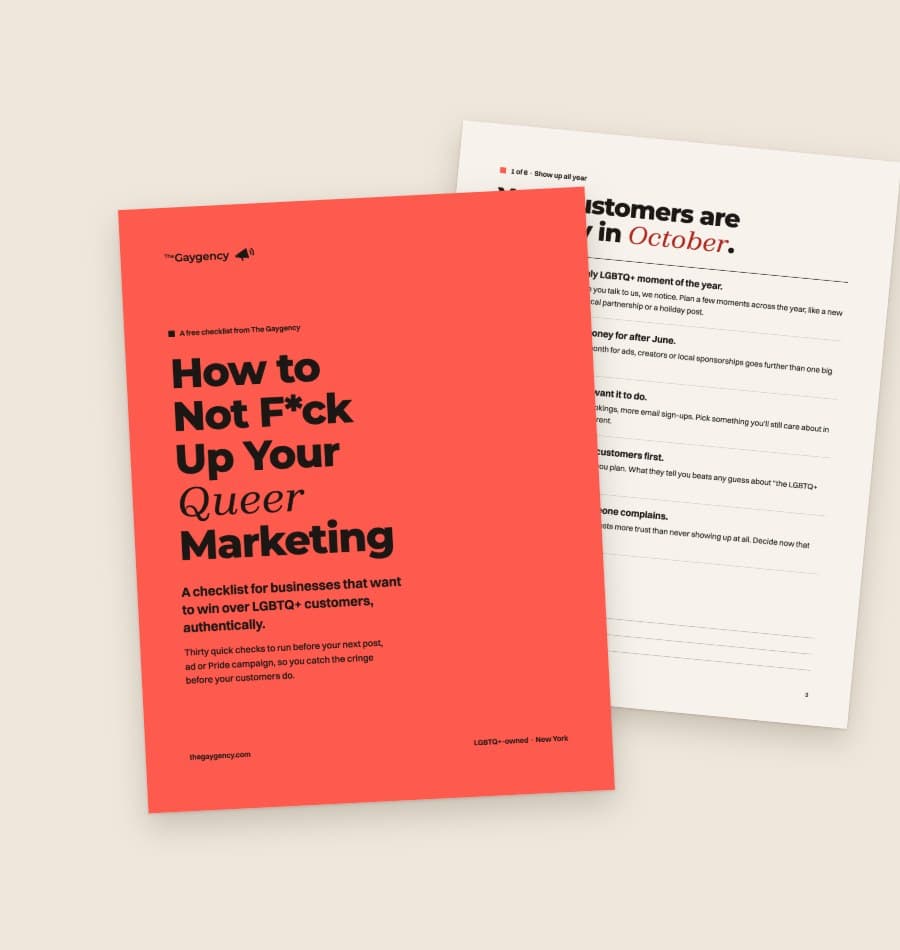
Free checklist
How to not f*ck up your queer marketing
A checklist for businesses that want to win over LGBTQ+ customers, authentically.
Thirty quick checks to run before your next post, ad or Pride campaign, so you catch the cringe before your customers do.
Delivered by email. No spam, ever.
Written by
The marketing and advertising agency for LGBTQ+ businesses and the brands that back them. Strategy, media buying, and brand systems with published results.
See the work