Media planning
12 LGBTQ+-owned media outlets to advertise in for 2027
By The Gaygency · 11-05-26 · 8 min read

LGBTQ+ media looks different than it did even two years ago. Equalpride, the publisher behind The Advocate and Out, laid off senior staff across its titles and then acquired Condé Nast's Them in February 2026, followed by further cuts at Them in April, according to The Hollywood Reporter and LGBTQ Nation. Q.Digital, which owns LGBTQ Nation and Queerty, told A Media Operator its Pride season advertising had seen one-off sponsors pull back, even as its longer-term advertiser relationships held. None of that means the category is closing. It means the smart 2027 media plan spreads across several outlets instead of betting a full year of budget on one publisher's stability.
Every outlet below was confirmed publishing and selling advertising as of this writing, checked against its own current site, recent bylines, or a published 2026 media kit. Circulation and traffic vary enormously, from national digital reach down to a single city, which is part of the point: a 2027 plan built across a few of these can layer national awareness with regional trust in a way a single buy cannot.
1. Equalpride: The Advocate, Out, Them, Pride.com
Equalpride is still the largest LGBTQ+ media portfolio in the country by title count, spanning entertainment, politics, and culture coverage across four brands, with Out Traveler and Advocate Originals rounding out the group. The 2026 layoffs and the Them acquisition thinned the newsroom, and it is fair to ask a sales rep directly about current staffing before committing a large annual budget. What has not changed is the reach: if a campaign needs to touch mainstream LGBTQ+ entertainment audiences, political news readers, and the younger, more online audience Them built under Condé Nast, this is still the portfolio that covers all three from one negotiation.
"Adding the 'Them' brand accelerates our mission and expands the ways we can champion LGBTQ+ voices year-round."
Mark Berryhill, Equalpride CEO, in The Hollywood Reporter
2. Q.Digital: LGBTQ Nation, Queerty, INTO, GayCities, Outsports
Q.Digital describes itself as LGBTQ+ owned and operated, and its five properties split cleanly by audience: LGBTQ Nation for news, Queerty for entertainment and culture, GayCities for travel, and Outsports for sports. The company sells branded content, video, live-event tie-ins, and standard programmatic and social placements, per its own media materials, with direct-sold ads and branded video making up most of its revenue. CEO Scott Gatz told A Media Operator that one-off Pride-season advertisers have thinned while longer-term partners have held steady, which is a useful signal about how this network prices and prioritizes advertisers who commit beyond June.
3. Washington Blade and Los Angeles Blade
The Washington Blade is one of the longest-running LGBTQ+ newspapers in the country, serving the DC political and policy audience specifically, with the Los Angeles Blade as its sister publication under the same ownership. Brian Pitts became publisher in June 2026, succeeding longtime publisher Lynne Brown, who remains a part owner. Both papers publish a current media kit covering print, display, app sponsorships, programmatic display, and social advertising. For any brand whose message intersects with federal policy, healthcare access, or advocacy, this is the outlet whose readers are most likely to already be paying attention to that exact conversation.
The regional papers on this list earn their rates on local trust rather than raw circulation, which is why the Bay Area Reporter has held San Francisco's official outreach designation since 2004.
4. Bay Area Reporter
Founded in 1971, the Bay Area Reporter has been in continuous publication for 55 years and is, by its own account, the highest-circulation LGBTQ+ newspaper in the country. Since 2004 it has held the official designation as San Francisco's LGBTQ Outreach Publication, voted annually by the city's Board of Supervisors, and it maintains cross-placement partnerships with several other independent Bay Area outlets. For a brand that needs credibility with San Francisco specifically, rather than the LGBTQ+ market broadly, this is the outlet with the closest institutional relationship to the city itself.
5. Dallas Voice
Dallas Voice runs a structured weekly print operation with published space-reservation deadlines and a weekly email blast that reaches more than 20,000 opted-in subscribers every Friday, alongside its OUT North Texas magazine. Texas has one of the largest LGBTQ+ populations in the country without a dominant national media presence covering it locally, which makes a well-run regional weekly like this one a meaningfully different buy than a national digital placement covering the same geography as an afterthought.
6. Philadelphia Gay News
Founded in 1976 by Mark Segal, Philadelphia Gay News is the oldest LGBT publication in the country founded as a weekly, and it remains free and distributed through vending boxes across Greater Philadelphia, Eastern Pennsylvania, South Jersey, and Delaware. That distribution footprint means a single buy here reaches three states' worth of readers in one region rather than a single city.
7. Windy City Times
Windy City Times has covered Chicago's LGBTQ+ community since 1985 and is part of Windy City Media Group, co-founded by Tracy Baim, who bought the paper in 2000. Its own advertising materials point to unusually long-term advertiser retention, which the paper attributes to the depth of its community reporting rather than discount pricing. For the Midwest, this is the legacy outlet with the deepest local trust to draw on.
Regional rate cards run a fraction of national pricing, which is how one plan can layer several of these markets for the cost of a single broad buy.
8. Watermark Out News
Serving Central Florida and Tampa Bay since 1994, Watermark Out News is one of the few dedicated regional LGBTQ+ outlets still operating at scale in Florida, a state where several other local LGBTQ+ publications have folded or consolidated over the past decade. Its long publication archive on Issuu, running past 560 editions, is a useful gauge of consistency for a market that changes quickly.
9. QNotes Carolinas
Based in Charlotte and covering the Carolinas broadly, QNotes has published for more than 35 years and runs a nonprofit-supported journalism program alongside its commercial operation. Charlotte Pride, the region's flagship LGBTQ+ organization, separately sells advertising across its own media channels, including its print magazine and the Reel Out Charlotte film festival, for 2026 and beyond. Planning the two together makes it possible to pair a regional media buy with a Pride-adjacent sponsorship in the same market.
10. GO Magazine
GO Magazine is a national digital publication built specifically for lesbian and queer women, an audience that most general LGBTQ+ outlets, which skew toward gay men's culture and news, cover less directly. It continues regular publishing through 2026, including its annual Pride issue and its "100 Women We Love" feature, and it is one of the few outlets in this list with a genuinely national digital reach concentrated on this specific readership.
11. Tagg Magazine
Tagg Magazine covers culture, news, and community for lesbians, queer women, and sapphic readers. It described itself as one of only two American print publications built specifically for that audience before going fully digital in late 2023, and it continues as a regularly updated digital outlet. Running Tagg and GO Magazine together in the same media plan is a way to get frequency within an underserved niche audience rather than reach across a broad one.
12. Erie Gay News
Erie Gay News is the smallest outlet on this list by design: a monthly print publication for Erie, Pennsylvania, still on a predictable production schedule with public deadlines and a print run distributed at local pickup locations. It is here as a category example, not a one-off recommendation: in a hyperlocal market this size, a single advertiser can represent a meaningful share of the publication's ad revenue and get real, visible placement for a fraction of what a national buy costs. Most mid-size cities and college towns have a version of this outlet, and most of them are still overlooked.
"It's fair to say that we're in the 'isn't so great' phase, but we've come off a number of years where we've been able to use those profit margins to save some money and to prepare for any of these occasions."
Scott Gatz, Q.Digital CEO, in A Media Operator, October 2025
Quick reference: who's who
- National, broad reach: Equalpride (Advocate, Out, Them), Q.Digital (LGBTQ Nation, Queerty, GayCities, Outsports)
- National, lesbian and queer women: GO Magazine, Tagg Magazine
- Regional, high circulation: Washington Blade/LA Blade, Bay Area Reporter, Windy City Times
- Regional, underserved geography: Dallas Voice, Philadelphia Gay News, Watermark Out News, QNotes Carolinas
- Hyperlocal: Erie Gay News, and the equivalent outlet in most mid-size markets
Frequently asked questions
Is it still worth advertising in legacy LGBTQ+ newspapers given circulation declines?
For outlets with a genuine regional monopoly on trust, like the Bay Area Reporter's official San Francisco designation or Philadelphia Gay News's multi-state free distribution, yes. The value is less about raw circulation and more about being the outlet a local LGBTQ+ audience already treats as credible.
Is equalpride (The Advocate, Out, Them) still a safe media buy after the 2026 layoffs?
It remains the largest LGBTQ+ media portfolio by title count and reach. Ask directly about current editorial staffing and turnaround times before committing a large annual budget, since the 2026 cuts affected both leadership and day-to-day reporting capacity.
What ad formats do most of these outlets offer?
It varies by outlet, but common formats across this list include display and banner ads, sponsored or branded content, email newsletter placements, print space in the outlets that still publish physically, and in a few cases, live-event or video sponsorships.
Should a 2027 plan start with national or regional outlets?
It depends on the goal. National outlets like Q.Digital's network build broad awareness efficiently. Regional and hyperlocal outlets build credibility with a specific market faster and usually cost less per placement, which makes them a strong complement rather than a substitute.
How much lead time do these outlets typically need for 2027 campaigns?
Most run standard advertising cycles with weekly or monthly deadlines, similar to Dallas Voice's published Monday reservation cutoffs for a Friday issue. Starting conversations in the fourth quarter of 2026 gives enough runway to secure placement, and pricing, before annual budgets lock for 2027.
Building a media plan across outlets like these is public relations and paid social work at the same time, since earned coverage and paid placement in the same publications tend to reinforce each other. Established businesses weighing where to put next year's media budget can see how we think about channel mix on our for established businesses page.
If you want help building a 2027 media plan across outlets like these, book a call.
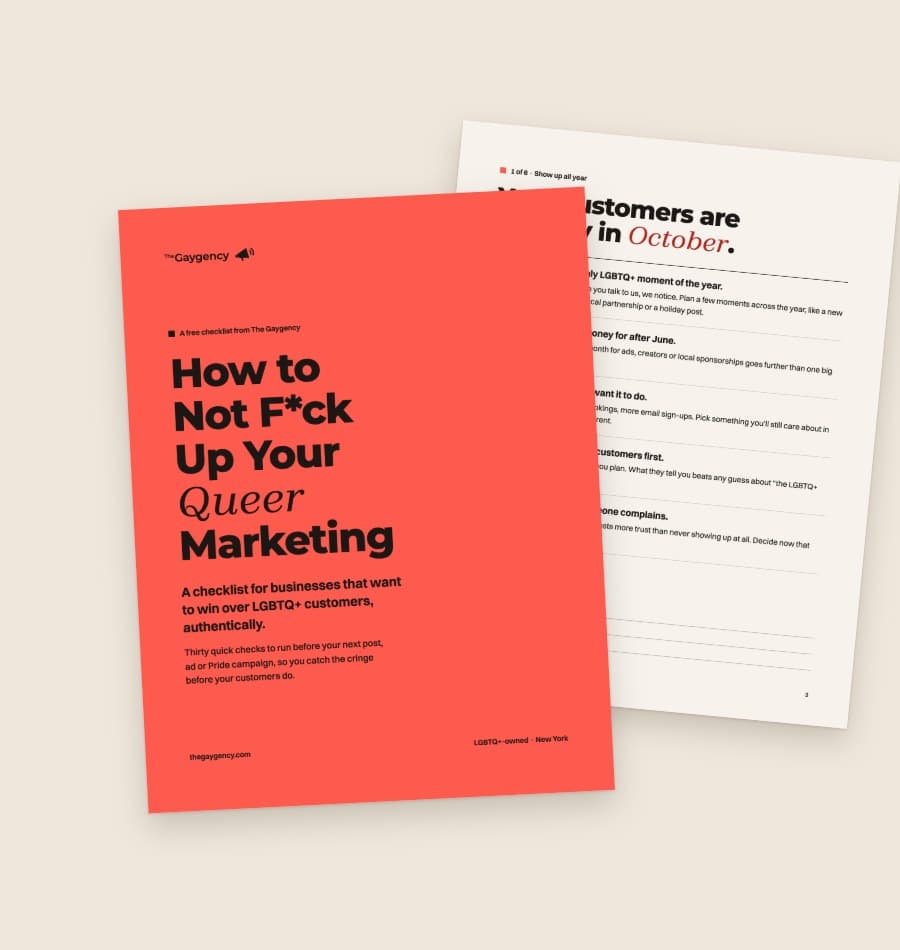
Free checklist
How to not f*ck up your queer marketing
A checklist for businesses that want to win over LGBTQ+ customers, authentically.
Thirty quick checks to run before your next post, ad or Pride campaign, so you catch the cringe before your customers do.
Delivered by email. No spam, ever.
Written by
The marketing and advertising agency for LGBTQ+ businesses and the brands that back them. Strategy, media buying, and brand systems with published results.
See the work