Seasonal guide
Trans Awareness Week: the brand playbook
By The Gaygency · 10-29-26 · 7 min read

Transgender Awareness Week runs November 13 through November 19, 2026, and leads directly into Transgender Day of Remembrance on November 20, an annual observance that honors transgender people whose lives were lost to anti-transgender violence that year, according to GLAAD. The two moments sit back to back on purpose. One is about visibility while people are still here. The other is about naming who was lost.
For most brands, the safest and most useful move during this window is quieter than a Pride campaign and more deliberate than a hashtag. This is a guide to what that looks like, grounded in the style guidance that journalists and advocacy groups publish, not in guesswork.
Transgender Day of Remembrance is a community-led mourning observance, which is why most brands' role that day is presence and funding rather than content.
Why the stakes are different this year
Trans Legislation Tracker, the nonpartisan research project run by trans lawyers and advocates, counted 804 bills introduced across state and federal legislatures in 2026 that would restrict transgender people's access to healthcare, education, identity documents, or the right to publicly exist, with 63 of those bills passed into law during the year and 136 tracked at the federal level. The American Civil Liberties Union has been running a parallel tracker of its own, mapping the same wave of state-level bills state by state.
That context matters for marketing because it changes what a public statement does. A brand that says nothing about Trans Awareness Week in a normal year reads as neutral. A brand that says nothing this year, after a record legislative session, reads differently to the people watching closely, including your own trans employees and customers. It does not mean every brand needs a public campaign. It means silence is a choice with a cost, and so is a poorly considered post. Both need to be made on purpose.
"Transgender Awareness Week is a week when transgender people and their allies take action to bring attention to the trans community by educating the public about who transgender people are, sharing stories and experiences, and advancing advocacy around issues of prejudice, discrimination, and violence that affect the transgender community."
GLAAD
Get the language right before anything else
Two style guides exist specifically so brands and journalists stop guessing: GLAAD's Media Reference Guide, now in its 11th edition, and the Trans Journalists Association's Stylebook and Coverage Guide. Both are free, both are searchable, and both are more specific than most internal brand style guides on this topic.
A few of the baseline rules that show up in both guides:
- Use "transgender" as an adjective, never "transgendered" or "transgenders" as a noun.
- Refer to someone by the name and pronouns they currently use, in every context, including when discussing their past.
- Avoid phrases like "born a man" or "born a woman." GLAAD's guidance is to describe someone as "assigned male at birth" or "assigned female at birth" only when medically relevant, and to avoid the framing entirely otherwise.
- Skip "sex change" and "pre-op" or "post-op" language. These focus on medical procedures that are private and usually irrelevant to the story or the campaign.
- Don't treat a person's transgender status as the headline of their story unless the content is specifically about that experience.
The Trans Journalists Association's guide goes further into specific coverage scenarios: crime reporting, healthcare, youth, and incarceration each have their own section, because generic advice breaks down in those contexts. If your brand is publishing anything longer than a social caption this week, including a blog post, a press release, or an internal memo that might leak, it is worth having someone check it against both guides before it goes out.
Both reference guides are free and searchable, so checking a brief against them is a process step rather than a budget question.
The line between visibility and exploitation
The test that separates a respectful Trans Awareness Week presence from an exploitative one is usually simple: who benefits, and who is doing the talking.
Signs a campaign is built to help:
- Trans employees, if any choose to participate, are compensated and credited like any other contributor, not asked to volunteer their story for exposure.
- The content amplifies trans voices and organizations rather than replacing them with a brand's own narration.
- Any donation or partnership is disclosed with a real dollar figure or a real commitment, not a vague "we support" statement.
- The messaging holds up if someone reads it in July. It is not built entirely around the week.
Signs a campaign is built to extract attention:
- A rainbow or trans-flag color palette gets applied to a product for one week with no other connection to the community.
- Stock photography stands in for real people, especially images that lean on outdated visual clichés like exaggerated makeup transitions or before-and-after framing.
- The brand's public statement is louder than its internal policy. If health insurance does not cover gender-affirming care, or if the company has no nondiscrimination policy covering gender identity, a public statement is premature.
- Trans staff find out about the campaign from the same channel as everyone else.
"At a time when transgender people have become targets of extreme political discrimination and violence, it's imperative that anyone who is interested in and invested in protecting a free society learn the facts about who trans people are."
GLAAD
The week at a glance
- Trans Awareness Week: November 13 to 19, 2026
- Transgender Day of Remembrance: November 20, 2026
- Reference before publishing: GLAAD Media Reference Guide (glaad.org/reference) and the Trans Journalists Association Stylebook (styleguide.transjournalists.org)
- Default posture if you are unsure: internal first, public only if you can back it up
A practical playbook for the week
If your company has trans employees: Ask what they want before assuming. Some want to be visible this week. Many would rather the company mark the moment without turning them into the campaign's face. Both are valid, and the only way to know is to ask privately, not in an all-hands meeting.
If you are considering a public statement: Write it, then check it against three questions. Does it name something concrete, such as a donation amount, a policy change, or a specific partner organization? Would it embarrass the company if a reporter called to verify it? Does it read the same in November as it would in March? If the answer to any of those is uncomfortable, the statement needs more work before it goes out, or it should not go out at all.
If you are not ready for a public statement: That is a legitimate answer. Internal action, such as reviewing health benefits for gender-affirming care coverage, checking nondiscrimination policy language, or supporting an employee resource group, does more for actual trans employees than a public post with nothing behind it. Quiet and substantive beats loud and hollow.
If you want to support the moment externally: Direct support to organizations led by trans people, and let them set the terms of any partnership or acknowledgment. A brand's job in that relationship is to fund and amplify, not to co-author the message.
If your industry touches healthcare, education, or public policy directly: This week means more for you than it does for a general consumer brand, given the volume of legislation moving through statehouses this year. A generic Trans Awareness Week post from a health system or a school-adjacent company invites more scrutiny than a similar post from a retailer, precisely because your policies are the ones with direct consequences. Coordinate with legal and PR before anything goes external.
Frequently asked questions
What is Transgender Awareness Week?
It is a week observed each year from November 13 through 19, dedicated to educating the public about transgender people and the issues they face, leading into Transgender Day of Remembrance on November 20, according to GLAAD.
Is Transgender Day of Remembrance the same as Transgender Day of Visibility?
No. Transgender Day of Visibility is a separate observance held every March 31 and is meant to celebrate trans people who are here now. Transgender Day of Remembrance, November 20, specifically honors transgender people whose lives were lost to anti-transgender violence.
Does every brand need to post something for Trans Awareness Week?
No. A public statement without substance behind it is often worse than no statement. Internal action and quiet, disclosed support for trans-led organizations are both legitimate ways to mark the week without a public campaign.
What language should we avoid in anything we publish?
Avoid "transgendered," "born a man/woman," "sex change," and "pre-op/post-op" language. Both GLAAD's Media Reference Guide and the Trans Journalists Association's Stylebook list specific terms to use instead, and both are free to reference before you publish.
What if our company has never addressed trans issues publicly before?
Starting during Trans Awareness Week without any internal groundwork usually reads as reactive. If you have not done the internal work yet, an honest starting point is a private review of policies and benefits this year, with a public statement considered for a future year once there is something real to point to.
Getting the tone right here is a strategy and communications problem as much as a creative one. It touches how your public relations team times and frames anything you publish, and how your broader campaign strategy accounts for a legislative and cultural climate that shifts month to month. Brand teams navigating this kind of calibrated, high-scrutiny moment are exactly who our enterprise partnership is built for.
If your team is weighing what to say, or whether to say anything at all, book a call and we will help you figure out what holds up.
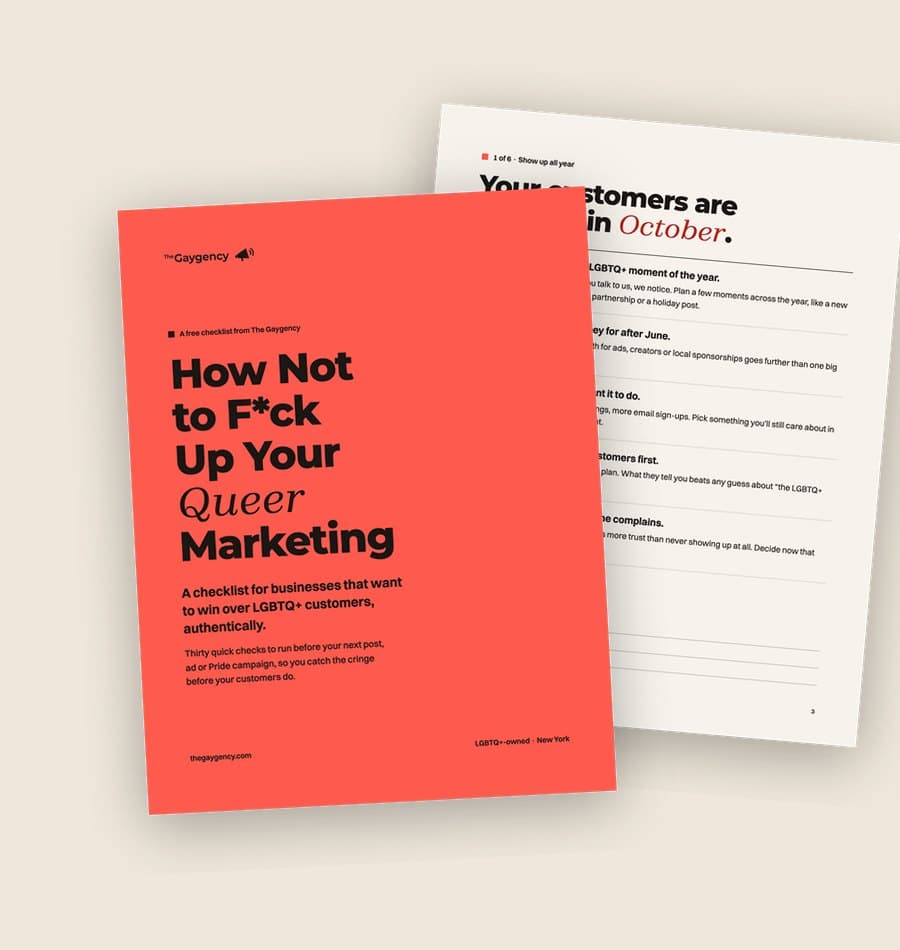
Free checklist
How not to f*ck up your queer marketing
A checklist for businesses that want to win over LGBTQ+ customers, authentically.
Thirty quick checks to run before your next post, ad or Pride campaign, so you catch the cringe before your customers do.
Delivered by email. No spam, ever.
Written by
The marketing and advertising agency for LGBTQ+ businesses and the brands that back them. Strategy, media buying, and brand systems with published results.
See the work