LGBTQ+ Marketing
Programmatic vs. direct buys in LGBTQ+ media
By The Gaygency · 10-22-26 · 7 min read

Every brand advertising to LGBTQ+ audiences eventually hits the same decision: buy directly from an LGBTQ+-owned publisher or ad network, or reach the same audience through a programmatic exchange. Neither answer is right by default. The two mechanisms trade control for scale, and the right split depends on the campaign, not on which one sounds more sophisticated.
What each one means
Direct media buying is a negotiated relationship: a brand or its agency picks a named publisher, agrees on a price and placement by insertion order, and knows exactly where the ad will run before it runs. Programmatic buying is automated: software buys and places ad space across an exchange in real time, based on targeting rules rather than a hand-picked list of sites. A private marketplace, or PMP, sits between the two: programmatic mechanics, but limited to inventory a specific publisher has made available to invited buyers, which is how a lot of LGBTQ+-owned media sells at scale without opening itself to the entire open exchange.
Programmatic is not a niche option anymore. The IAB's 2025 Digital Advertising Revenue Report found that programmatic transactions account for more than 90% of all US digital display ad spending, and Digital Applied's 2026 benchmark report puts the current figure at roughly 90% (IAB, 2025; Digital Applied, 2026). The question for a brand buying LGBTQ+ media in 2026 is not whether to use programmatic. It is when direct still earns the premium it charges.
The comparison
| Programmatic | Direct | |
|---|---|---|
| Control over placement | Set by targeting rules and inclusion or exclusion lists across an exchange; a private marketplace narrows this to invited publishers | Publisher and placement chosen by name, with content adjacency confirmed before the ad runs |
| Typical CPM | Roughly $2 to $8 for standard programmatic display (Moonsauce Agency, 2026; Stackmatix, 2026) | Roughly $20 to $50 or more for negotiated premium placements, depending on format; an Adalytics bid-data analysis found The New York Times paying $20 to $30 CPMs for placements on premium publisher sites like Vox and the Wall Street Journal |
| Minimums | Often none on self-serve demand-side platforms (AdPersonam, 2026) | Usually a negotiated insertion order with a real spending floor; Mediabodies' 2026 ad-buying guide puts realistic starting budgets for direct-sold, host-read podcast campaigns at $40,000 to $50,000, illustrating how much higher direct commitments run once a relationship is negotiated |
| Brand safety | Managed through exclusion lists, verification vendors, and PMPs; open-exchange inventory means more exposure to misplacement and fraud, with global ad fraud losses projected at $100 billion in 2026 (Juniper Research, cited by Clixtell, 2026) | Confirmed in advance; the publisher and the page are known before the campaign launches, a priority consistent with IAS's 2026 Industry Pulse Report, in which 87% of media experts surveyed called brand safety and suitability of the influencer or creator essential in digital video (IAS and YouGov, 2026) |
The gap between a $5 exchange CPM and a $30 negotiated one is the price of knowing exactly which page the ad runs on.
Where LGBTQ+ media sits on this spectrum
LGBTQ+ media runs the full range. Q.Digital, which owns LGBTQ Nation, Queerty, GayCities, Outsports, and INTO, along with distribution partnerships with AutoStraddle and PinkNews, reports a combined reach of 15 million visitors in its 2025 media kit (Q.Digital, 2025). Its media kit is explicit that all of its inventory is sold direct rather than through a private marketplace, with additional scale available through its Audience Accelerator contextual network, which is a fair example of how an LGBTQ+-owned publisher can offer both premium placements and extended reach inside one negotiated relationship.
Gay Ad Network describes its core product as an LGBTQ+ private marketplace, available since 2014 and integrated into major demand-side platforms including The Trade Desk, MediaMath, and Amobee (Gay Ad Network, company materials, 2026). That is the real middle ground in practice: programmatic mechanics and programmatic-scale buying tools, but running against inventory that is still curated by an LGBTQ+-owned network rather than the open exchange.
The platforms took away precise LGBTQ+ interest targeting. The media environment itself became the targeting.
That is not a rhetorical point. Meta removed sexual-orientation and LGBTQ-culture interest categories from its ad targeting in 2022, and eliminated detailed targeting exclusions entirely in March 2025. A brand can no longer tell Meta or most major platforms to find LGBTQ+ users directly. What is left is targeting by context: buying media where the audience already is, whether that is a direct buy on an LGBTQ+-owned publisher or a PMP built on the same inventory. This is the actual reason direct and PMP buys in this specific category have gotten more valuable over the past few years, not less, even as programmatic keeps eating the rest of digital advertising.
Direct and programmatic are not competing philosophies. They are two ways of buying the same audience, and most media plans need both.
When direct wins
Direct buying earns its premium in a few specific situations: categories where a brand-safety misstep creates real regulatory or reputational risk, like health, finance, or family-facing products; campaigns that need a guaranteed content adjacency rather than a topic match; audiences too small for programmatic's scale advantage to matter; and campaigns where an LGBTQ+-owned outlet's editorial trust is doing real work for the brand's credibility, over and above its reach. A wellness brand running its first LGBTQ+-facing campaign, for instance, usually gets more from one well-placed direct buy on a trusted publisher than from a wider, cheaper programmatic run that nobody in the audience recognizes as intentional.
An insertion order trades programmatic's flexibility for a guaranteed adjacency, which is worth the premium in health, finance, and family-facing categories.
When programmatic, or a PMP, wins
Programmatic earns its place when a campaign needs frequency and scale beyond what LGBTQ+-owned direct inventory alone can deliver, when the budget target requires a lower blended CPM than direct placements allow, when retargeting or lookalike modeling is doing real work, or when the campaign spans multiple markets and needs efficient reach rather than a handful of premium placements. A PMP built on a network like Gay Ad Network's is frequently the better version of this than the fully open exchange, because it keeps the audience specificity that made LGBTQ+ media worth buying in the first place.
A starting split for a first LGBTQ+ media campaign
- Put the introduction and trust-building budget into one or two direct or PMP placements on publishers your audience already reads.
- Put the scale and retargeting budget into programmatic, built around the audiences and creative that performed on the direct side.
- Measure both the same way, on the same dashboard, so the comparison is honest instead of two different reports that never get reconciled.
- Revisit the split every quarter. What earns direct's premium in month one is not always what earns it in month six.
Measurement is where the two approaches diverge
A direct buy usually comes with straightforward publisher-reported numbers: impressions, clicks, sometimes completion rate. Programmatic requires a brand to run its own measurement stack to make sense of exchange-level data, because no single dashboard from a DSP tells the whole story of what happened after the click. This is where measurement and analytics work matters most: a clean GA4 and conversion-tracking setup is what lets a brand compare a $25 direct CPM against a $5 programmatic CPM honestly, on revenue, instead of guessing from two incompatible reports. The paid social and paid search work we run for clients treats both channels this way, one measurement plan, wired the same way, so the direct-versus-programmatic decision is made on real numbers instead of instinct.
For established businesses whose media budget has grown past a single channel and a single vendor relationship, this is usually the point where an ad-hoc mix of direct relationships and self-serve programmatic accounts needs an actual plan behind it, not more tools.
Frequently asked questions
What is the difference between programmatic and direct media buying?
Direct buying is a negotiated relationship with a named publisher, at an agreed price and placement. Programmatic buying uses automated software to purchase ad space across an exchange in real time, based on targeting rules rather than a hand-picked publisher list.
Are LGBTQ+ audiences hard to target programmatically now?
Precise interest-based targeting has gotten harder. Meta removed LGBTQ-culture and sexual-orientation interest categories from its ad targeting in 2022, and removed detailed targeting exclusions in March 2025. Contextual targeting, buying media where the audience already reads, has become the more reliable substitute.
What is a private marketplace, or PMP?
A PMP is an invite-only programmatic marketplace where a specific publisher makes its inventory available to selected buyers, combining programmatic buying mechanics with curated, known inventory. Gay Ad Network's LGBTQ+ PMP, live on major demand-side platforms since 2014, is a working example in this category.
Is programmatic cheaper than direct LGBTQ+ media?
Usually, on a CPM basis. Standard programmatic display typically runs $2 to $8 CPM, while negotiated direct placements on premium publishers commonly run $20 to $50 or more. Direct's premium buys guaranteed placement and confirmed brand safety that open-exchange programmatic does not.
Should a small brand use direct or programmatic for LGBTQ+ outreach?
Most small brands get more from starting with one or two direct or PMP placements on a publisher their audience already trusts, then layering in programmatic for retargeting and scale once the creative and audience are proven.
If your team is trying to build a media plan that mixes both without guessing at the split, book a call and we will help you set up the measurement that makes the decision an easy one.
Free checklist
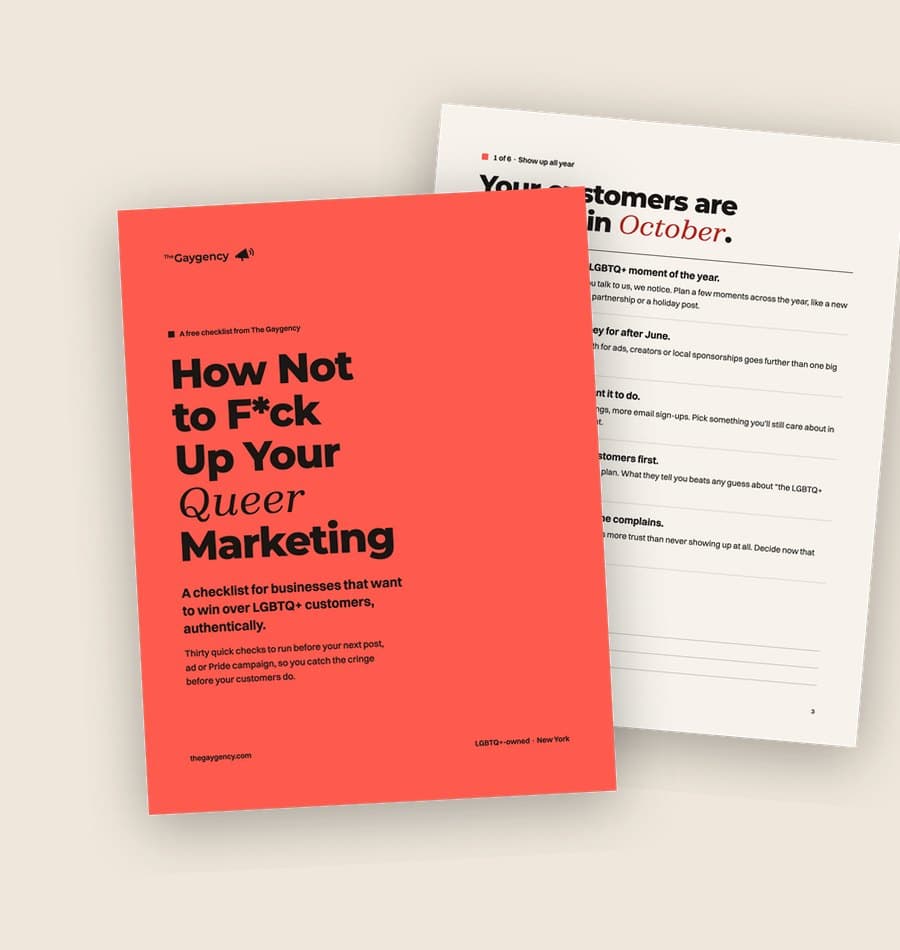
How not to f*ck up your queer marketing
A checklist for businesses that want to win over LGBTQ+ customers, authentically.
Thirty quick checks to run before your next post, ad or Pride campaign, so you catch the cringe before your customers do.
Delivered by email. No spam, ever.
Written by
The marketing and advertising agency for LGBTQ+ businesses and the brands that back them. Strategy, media buying, and brand systems with published results.
See the work