LGBTQ+ Marketing
Spirit Day: showing up against bullying without hijacking it
By The Gaygency · 10-12-26 · 8 min read

Every October, a handful of feeds turn purple for a day and then turn back. Spirit Day falls on the third Thursday of October every year, and in 2026 that is Thursday, October 15 (GLAAD, 2026). It is the largest anti-bullying campaign built around a single day, and it asks something narrower and more specific of a brand than Pride does: not a monthlong celebration, but one day of visible solidarity with LGBTQ+ young people, especially transgender and nonbinary youth, against bullying and harassment.
That narrowness is the point, and it is also the trap. Because the ask is small, a lot of brands treat it as a free logo swap: change the profile picture to purple, post a graphic, move on. Spirit Day survives being small only if the participation behind it is real. This guide is about the difference.
What Spirit Day is
Spirit Day started in 2010, created by Brittany McMillan, then a 15-year-old high school student in Canada, in response to a string of widely publicized bullying-related suicides of gay students that year, including Tyler Clementi's (GLAAD, 2026; Wikipedia, 2026). McMillan organized the first observance on Tumblr, inviting people to wear purple, a color she drew from Canada's Pink Shirt Day and from the "spirit" stripe on the pride flag. She worked with GLAAD to formalize it, and after a couple of years on shifting dates, the third-Thursday-of-October pattern was set in 2013 and has held since (Wikipedia, 2026).
GLAAD now organizes the day at scale: celebrities, news and media outlets, TV and film studios, brands, landmarks, sports leagues, tech companies, and faith groups all take a public pledge to "go purple" (GLAAD, 2026). GLAAD's own framing for 2026 is direct about why the stakes feel higher than a routine awareness day: an environment that includes book bans, bans on drag, restrictions on LGBTQ+ history in schools, and bans on gender-affirming healthcare, all of which land hardest on young people who are still working out who they are (GLAAD, 2026).
Spirit Day is not a campaign moment. It is a pledge, repeated once a year, that a specific group of young people is not on their own.
Why this is not a smaller version of Pride
Pride marketing comes with real risk calculus for a lot of companies right now. Gravity Research's 2025 Pride Pulse Poll of communications executives found that 39% of large companies planned to reduce their public Pride engagement (Gravity Research, 2025), and plenty of brands have spent the past two years recalibrating how loud they get in June.
Spirit Day does not come with the same weight, and treating it like it does is a mistake in both directions. Opposing bullying of LGBTQ+ youth is closer to universally supported than Pride's broader ask for visibility and celebration; it does not require a brand to take a side on a contested political question so much as state that kids should not be tormented for who they are. A brand nervous about Pride can usually still participate in Spirit Day without the same exposure. But the flip side is also true: because the ask is narrower, doing it badly is more obviously hollow. Nobody expects a parade float for Spirit Day. They do notice when "solidarity" turns out to be a purple square and nothing behind it.
Spirit Day is pinned to a school-year Thursday, and the bullying it opposes happens in school hallways whether or not any brand posts about it.
The media angle, if you choose to have one
Spirit Day generates real press coverage every year, and a brand does not need a splashy campaign to be part of that coverage honestly. A short statement to a reporter, a named donation, or a quote from an employee resource group leader is a legitimate press moment on a day when journalists are actively looking for companies doing something real. It is also a moment where restraint helps: a brand that has said little publicly about LGBTQ+ issues the rest of the year and suddenly pitches itself as a Spirit Day story invites the same scrutiny a June-only Pride post gets. The organizations doing the actual anti-bullying work, GLAAD and the Trevor Project among them, are better positioned to be the story's center than any single brand is, and a company that positions itself as an amplifier of their work rather than the subject of the story tends to come across better and draw less skepticism.
What hijacking it looks like
A few patterns turn Spirit Day into set dressing instead of solidarity:
Product tie-ins with no substance. A "purple collection" or a discount code timed to Spirit Day, with no connection to an anti-bullying organization, a donation, or a policy. The day becomes a sales hook wearing a cause.
Vague "be kind" messaging that erases the specific ask. Spirit Day is about bullying of LGBTQ+ youth, not bullying in general. A brand that posts "kindness matters" without naming who the day is for has found a way to look like it participated without doing so.
A single post with no internal follow-through. External purple, and no attention to whether the brand's own workplace policies, benefits, or employee resource groups reflect the same commitment. The audience that scrutinizes Pride marketing scrutinizes this too.
Undisclosed or symbolic-only donation language. "Supporting LGBTQ+ youth" with no organization named and no dollar figure disclosed reads the same way it does every other month of the year: as a claim nobody can check.
Spirit Day's real test is whether anything happens after the post goes up.
The observance began with a 15-year-old organizing on Tumblr in 2010, and its smallest unit of participation is still two people wearing purple at a kitchen table.
What showing up looks like
A few moves separate genuine participation from a stunt, and none of them require a campaign budget:
Name the day and the reason together. Say it is Spirit Day, say it is about bullying of LGBTQ+ youth, and say why that matters to your company specifically, in your own words, not a copied statement.
Attach something real. A named donation to an organization doing the work, GLAAD or the Trevor Project among the most visible, with an actual figure disclosed. If the budget is $500, say $500. Specificity is what makes a claim checkable.
Center youth voices, not the brand. The strongest Spirit Day content amplifies young people and the organizations that support them rather than making the brand the protagonist of its own solidarity post.
Make it visible inside the company too. Employee resource groups, an internal note from leadership, or a policy reminder about harassment protections. An external post with no internal counterpart is the same pattern that makes rainbow washing recognizable the rest of the year: a public face with nothing behind it.
Keep the scale proportionate. This is a one-day pledge, not a launch. A single honest post from a small business, paired with a real donation, outperforms a five-part content calendar that reads like Pride got a rebrand.
The Spirit Day self-check
- Have we named the day and who it is for, specifically?
- Is there a real donation attached, with the organization and the amount disclosed?
- Does our internal policy on harassment and bullying match the public post?
- Are we centering LGBTQ+ youth voices, or centering our own brand?
- Would this post survive being read by someone who works here?
- Is the scale of our participation proportionate to a one-day pledge, not a full campaign?
The smaller-brand version
A local business or a two-person marketing team does not need a campaign strategy session to do this well. A profile photo change to purple, one honest post naming the day and a small, disclosed donation to a group like GLAAD or the Trevor Project, and a link to the GLAAD Spirit Day pledge covers the ground that matters. The version of this that fails is not the small one. It is the one where the purple is the entire commitment.
A team of one or two people running social and PR for a small brand can plan this in under an hour: pick the donation amount ahead of time, write the post in the brand's own voice instead of a template, and schedule it to publish the morning of October 15 rather than scrambling that afternoon. None of that requires a designer, a paid boost, or a multi-platform rollout. It requires deciding, in advance, what the brand is willing to say and do, then saying exactly that and nothing more.
For brands weighing how loud to be on days like this against a broader climate of scrutiny, that calibration question does not go away after October. It is the same judgment enterprise teams navigating a louder political climate face year-round: how to show up consistently without either overreaching or disappearing. The public relations work behind a credible Spirit Day post and the organic social planning that keeps it from being a one-off both come down to the same discipline: say only what you can back up, and back up what you say.
Frequently asked questions
When is Spirit Day 2026?
Spirit Day 2026 falls on Thursday, October 15. It is observed every year on the third Thursday of October, a pattern GLAAD set in 2013 (GLAAD, 2026; Wikipedia, 2026).
What does "going purple" mean?
It started as an invitation to wear purple, a color creator Brittany McMillan drew from Canada's Pink Shirt Day and the pride flag's "spirit" stripe, as a visible sign of solidarity with LGBTQ+ youth against bullying. It has expanded into brands, media outlets, landmarks, and public figures publicly pledging support on the day (GLAAD, 2026).
Do we need a paid campaign to participate in Spirit Day?
No. Spirit Day is a one-day pledge, not a campaign moment. A single honest post naming the day, a disclosed donation to an anti-bullying or LGBTQ+ youth organization, and consistency with your internal policies covers what matters more than a multi-week content push would.
Is Spirit Day the same as Pride?
No. Pride is a broader, monthlong ask for visibility and celebration that comes with more political weight for some brands right now. Spirit Day is narrower: one day of stated opposition to bullying and harassment of LGBTQ+ young people. It generally poses less risk, which makes hollow participation more noticeable rather than less.
What if our company has never done anything for Spirit Day before?
Start proportionate to what you can back up in writing. A disclosed donation and a direct, specific post beat a large campaign built on a first-time commitment. The Spirit Day self-check above works as a starting checklist either way.
If your team wants help deciding how to show up on days like this without it turning into a stunt, or without it disappearing entirely, book a call and we will walk through what proportionate looks like for your brand.
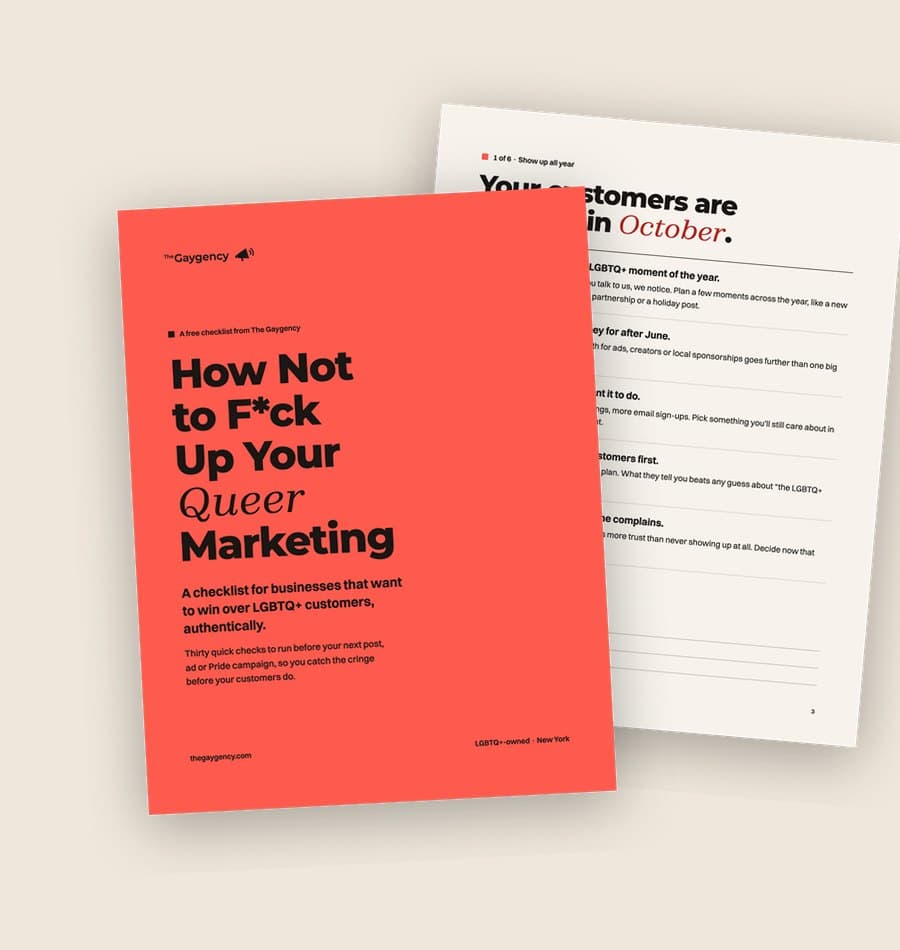
Free checklist
How not to f*ck up your queer marketing
A checklist for businesses that want to win over LGBTQ+ customers, authentically.
Thirty quick checks to run before your next post, ad or Pride campaign, so you catch the cringe before your customers do.
Delivered by email. No spam, ever.
Written by
The marketing and advertising agency for LGBTQ+ businesses and the brands that back them. Strategy, media buying, and brand systems with published results.
See the workKeep reading