Startup Marketing
8 LGBTQ+ marketing wins on a small budget
By The Gaygency · 10-08-26 · 7 min read

The U.S. Small Business Administration recommends that businesses under $5 million in revenue with healthy margins plan to spend 7 to 8% of gross revenue on marketing. For a business doing $300,000 a year, that's $21,000 to $24,000, which sounds reasonable until it has to cover a website, paid ads, email, content, and everything else at once. Most small LGBTQ+-owned and aligned businesses aren't underspending because they don't understand marketing. They're underspending because the standard advice assumes a budget big enough to do all of it, and most small businesses don't have that.
The fix isn't spending more. It's picking a small number of moves that work at small-business scale and doing those well, instead of spreading a thin budget across everything a bigger competitor does. This is the same constraint we build around for every business in our startup stage: a plan sized to where you are now, built from scratch rather than scaled down from an enterprise playbook. Here are eight moves, in the order most small businesses should tackle them.
1. Claim the free listing that already exists for you
Google added an LGBTQ+-owned attribute to Business Profile listings in June 2022, sitting alongside Black-owned, women-led, and veteran-led attributes. If you haven't claimed and verified your Google Business Profile, or added this attribute along with accurate categories, hours, and photos, this is the single highest-value free action available before spending a dollar on ads. It shows up directly in Google Maps and local search results, which is exactly where a customer with buying intent is looking.
2. Get certified if you qualify
If your business is majority owned, operated, and controlled by LGBTQ+ people, certification through the National LGBT Chamber of Commerce is worth the paperwork. NGLCC represents 1.4 million LGBTQ+ business owners contributing $1.7 trillion to the U.S. economy annually, and certification is recognized across more than a third of Fortune 500 and government supplier-diversity programs. That's not a consumer-facing marketing tactic, it's a door into corporate and government procurement budgets that most small businesses never think to knock on, and the certification itself costs far less than a single month of paid media.
3. Fund one paid channel properly instead of two badly
A common small-budget mistake is splitting a modest ad budget across Google, Meta, and TikTok simultaneously, which starves every platform's algorithm of the signal it needs to optimize. Pick the one channel that matches how your buyers behave. If people search for what you sell, that's paid search: the average cost per click across all industries reached $5.42 in 2026, according to WordStream's LocaliQ benchmark report, though it varies widely by category. If you're creating demand for something people don't yet know to search for, paid social usually performs better. Either way, one channel funded well enough to learn beats two channels too thin to learn anything.
At the 2026 average of $5.42 per click, a $500 monthly budget buys about 92 clicks, which is only enough data for one platform to learn from.
4. Build the list you own
Email remains the highest-return channel available to a small business, delivering an average of $36 for every dollar spent according to Litmus's State of Email research. Unlike a social following, a list of email addresses doesn't disappear when a platform changes its algorithm or a payment dispute freezes an account. A single, well-built welcome series tied to one real offer, built once, keeps paying back with no ongoing ad spend.
5. Work with creators while the market is favorable
Pride-season brand deal budgets for LGBTQ+ creators have fallen sharply. Campaign US reported creators seeing roughly a 50% drop in Pride-related brand work in 2024 compared to prior years, as larger advertisers pulled back, and corporate Pride engagement has kept shrinking since. That's a difficult market for the creators involved, and it's also a genuine opening for small businesses that couldn't previously compete for a creator's attention against a national ad budget. Micro and nano creators with small, engaged, relevant audiences are more available and more affordable right now than they have been in years. Creator partnerships built around a real product exchange or a modest flat fee can outperform a much larger paid media spend at this scale.
6. Send every paid click to a page built for that click
A homepage tries to serve every visitor at once, which means it serves none of them especially well. If you're spending anything on paid traffic, a simple landing page matched to that specific offer, with one clear next step, converts meaningfully better than sending the same traffic to a general homepage. This doesn't require a large production budget: a single-purpose page can be built and live in days.
Local LGBTQ+ chambers and community outlets sell placements to an audience that already sought them out, which is the kind of targeting mass platforms charge a premium to approximate.
7. Advertise where your actual audience already is, not where everyone else is
Mass-reach platforms sell scale, not relevance. Community-specific and LGBTQ+ endemic media outlets, along with local LGBTQ+ chambers of commerce and community organizations, typically offer lower costs per impression than a general platform, along with an audience that already trusts the placement. A local chamber newsletter or a community outlet's event listing often costs a fraction of a comparable ad buy on a national platform, and the audience reading it has already opted into caring about businesses like yours. For a small budget, relevance usually beats reach.
8. Systemize reviews and referrals
Word of mouth costs nothing except the systemized effort to ask for it. A simple, repeatable process, texting a review link after every purchase or appointment, or offering a modest referral incentive, turns your existing customers into your lowest-cost acquisition channel. Most small businesses already have satisfied customers who would happily leave a review or make a referral; the gap is almost always that nobody asked.
None of these eight moves require a bigger budget than most small businesses already have. They require picking a short list and finishing it, instead of a long list that never gets past the planning stage.
The first 90 days on a small budget, in order
- Claim and complete your Google Business Profile, including the LGBTQ+-owned attribute if it applies.
- Build one landing page for your single best offer.
- Fund one paid channel, search or social, at a level that lets it learn.
- Set up one welcome email flow tied to that same offer.
- Ask every satisfied customer for a review before moving to anything else.
A small budget forces a decision a bigger one lets you avoid: which channel matters most right now. That constraint is not a disadvantage. It's the reason focused small businesses often outperform larger competitors running five mediocre channels instead of one strong one.
Why this order matters
These eight moves are sequenced deliberately. The first two cost nothing beyond time and, for certification, a modest fee, and they compound before any ad spend begins. The middle moves (one funded paid channel, a matched landing page, and an owned email list) form a complete small loop: traffic in, a page built to convert it, and a list that keeps paying after the ad spend stops. The last two, creators and referrals, extend reach without requiring platform ad budgets at all. A business that works through this list in order, rather than trying all eight moves lightly at once, builds a foundation that a bigger budget later makes stronger instead of one it has to rebuild from scratch.
Frequently asked questions
What if I can only afford one of these eight right now?
Start with the Google Business Profile claim and the LGBTQ+-owned attribute. It costs nothing and it's the one action most likely to be found by someone already looking to buy.
Is NGLCC certification worth it for a very small business?
If you qualify (majority LGBTQ+ ownership, operation, and control) and you have any interest in corporate or government contracts down the line, yes. It's a longer-term door-opener rather than an immediate marketing tactic, so weigh it against your growth plans, not your next quarter.
Should I run Google Ads or Meta ads first with a small budget?
It depends on whether people already search for what you sell. If the demand already exists and people type it into Google, search captures it directly. If you're introducing something new that nobody is searching for yet, social usually does more of the initial work.
How small is too small for paid advertising to make sense?
If your budget can't sustain enough spend for the platform's algorithm to gather meaningful data, usually a few weeks at a level that generates real clicks and conversions, it's often better to hold that budget for organic and referral work until you can fund a channel properly.
Does working with a small or micro creator move the needle?
Often more than a single large creator would, because a small, trusted audience converts at a higher rate than a large, passive one. Fit and trust matter more than follower count at this budget level.
A small budget is a real constraint, not an excuse to skip marketing altogether. Book a call if you want help figuring out which of these eight moves fits your business first.
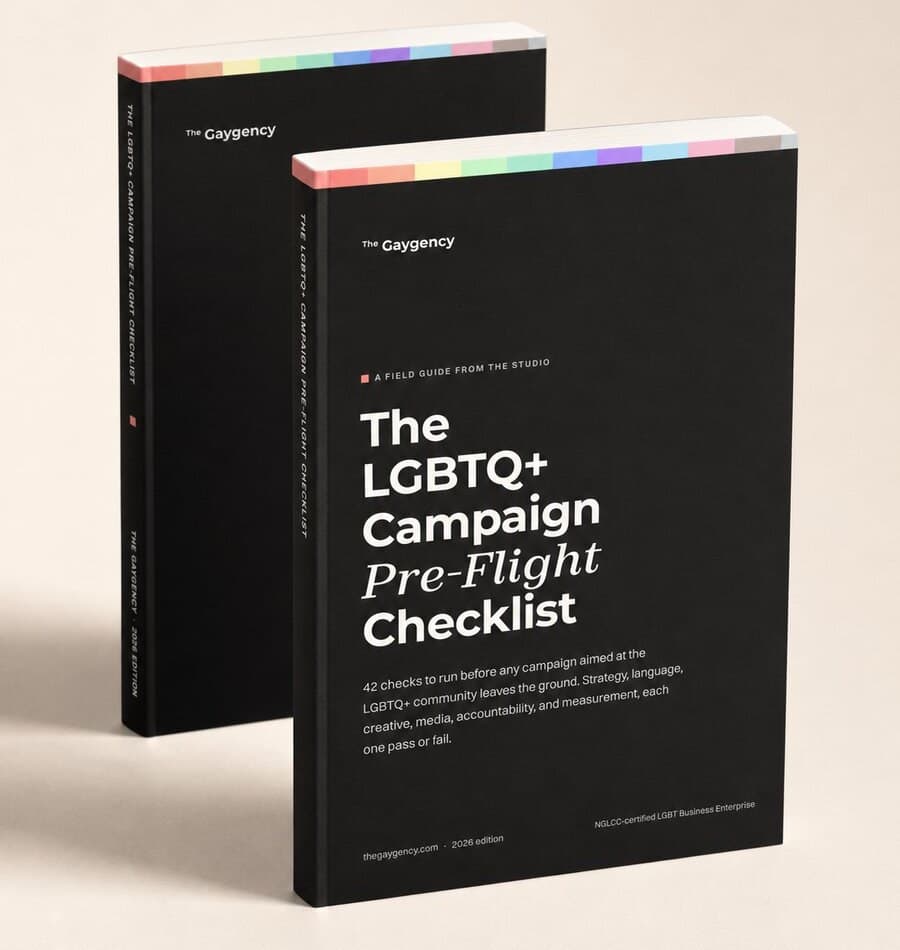
Free campaign guide
Would your campaign pass pre-flight?
The same 42 checks we run inside the studio before any campaign aimed at the LGBTQ+ community goes live.
Delivered by email. No spam, ever.
Written by
The marketing and advertising agency for LGBTQ+ businesses and the brands that back them. Strategy, media buying, and brand systems with published results.
See the workKeep reading