Founder column
What $15M in client revenue taught me about 'niche' markets
By Daniel Montelongo, Founder · 09-25-26 · 4 min read
I hear the word niche applied to LGBTQ+ consumers in almost every new-client conversation I have, usually from someone who means it kindly, as a way of explaining why the budget for this audience sits smaller than the budget for everyone else. I understand where the word comes from. What I do not understand, after four years of running client work against this exact audience, is why anyone still uses it as an excuse.
Since founding The Gaygency in 2022, the studio's work has driven more than fifteen million dollars in revenue across the businesses on our roster: jewelry makers, travel companies, pro sports partnerships, films, clinics, solo founders building their first real brand. Every one of those results came from campaigns built specifically for LGBTQ+ audiences, not from generic reach that happened to include them. If this were a niche in the way the word gets used, that specificity would not have outperformed the alternative as consistently as it has.
The number the word 'niche' is hiding
LGBTQ+ consumers hold an estimated $1.4 trillion in annual purchasing power in the United States, according to LGBT Capital's most recent widely cited market research (LGBT Capital, 2023). That same research put global LGBTQ+ purchasing power at $4.7 trillion. Those are not rounding errors sitting at the edge of the economy. They describe demand that already exists, distributed across every category a person spends money in: groceries, travel, financial services, healthcare, retail, entertainment.
Call a $1.4 trillion market niche often enough, and you start believing your own excuse for underinvesting in it.
I think that is the actual function the word niche serves in most marketing conversations. It is not a description of size. It is a permission slip for treating a market as optional, something a brand can address with a single seasonal campaign instead of a real strategy, because a niche is by definition small enough to skip without consequence. A market this size is not that. It behaves like any large market with distinct behavior patterns, which means it responds to the same discipline any large market requires: real research, real creative built for it, and a media plan that treats it as central rather than supplemental.
Where I first saw the gap
I saw this same pattern from the other side, years before I started The Gaygency, sitting inside agencies running programs for Macy's, Nordstrom, and Virgin America. Those brands never treated their core audiences as niche, no matter how specific the campaign got. A loyalty program aimed at frequent business travelers was not called niche. A jewelry line built for a particular life stage was not called niche. The word only ever got attached to a market when the client asking about it was themselves LGBTQ+, or when the campaign was meant to reach LGBTQ+ consumers specifically. Nothing about the actual market size changed between those conversations. What changed was who was asking and who the money was for.
The market size never changed between meetings. The word did.
That distinction followed me directly into building this studio. I did not want to run an agency where the same market gets called a real opportunity in one meeting and a niche afterthought in the next, depending on which client is in the room. If the number is $1.4 trillion, it is $1.4 trillion regardless of whether the brand asking about it happens to be queer-owned.
Specificity is why the number moves
Here is the part our own results make hardest to argue with. Every client on our roster that leaned into specific, culturally accurate creative and targeting outperformed the version of themselves that had previously run generic campaigns and hoped LGBTQ+ customers would self-select in. That is the opposite of what you would expect if this were a small, hard-to-reach niche. It is exactly what you would expect if the market were large and simply underserved by advertising built for someone else.
I do not think this is complicated as an idea. A campaign that speaks with precision to a specific audience will always outperform a campaign that speaks broadly to everyone and specifically to no one, in any category, for any audience. The reason it shows up so sharply in our numbers is that so few brands have bothered to build the specific version for this particular audience, which means the ones who do are competing against almost nobody for attention that a $1.4 trillion market is already prepared to give.
The businesses that treat this as a real market, not a seasonal add-on, are the ones showing up in our revenue numbers year after year. The ones still calling it niche are the ones asking us, every June, why their one campaign did not move anything. Those are not separate questions. They are the same question, answered by whether a brand believed the number or believed the word.
I do not say any of this to make a case for spending more money. I say it to make a case for spending the money that is already allocated more accurately. A brand does not need a bigger LGBTQ+ marketing line item to see better results. It needs to stop treating the existing line item as an experiment on a small population and start treating it as an investment in a market the size of a mid-sized country's entire economy. The math changes the moment the word does.
If you want to see how this plays out for a specific business, our campaign strategy work is where that specificity gets built, and if you want to talk about your own numbers, book a call.
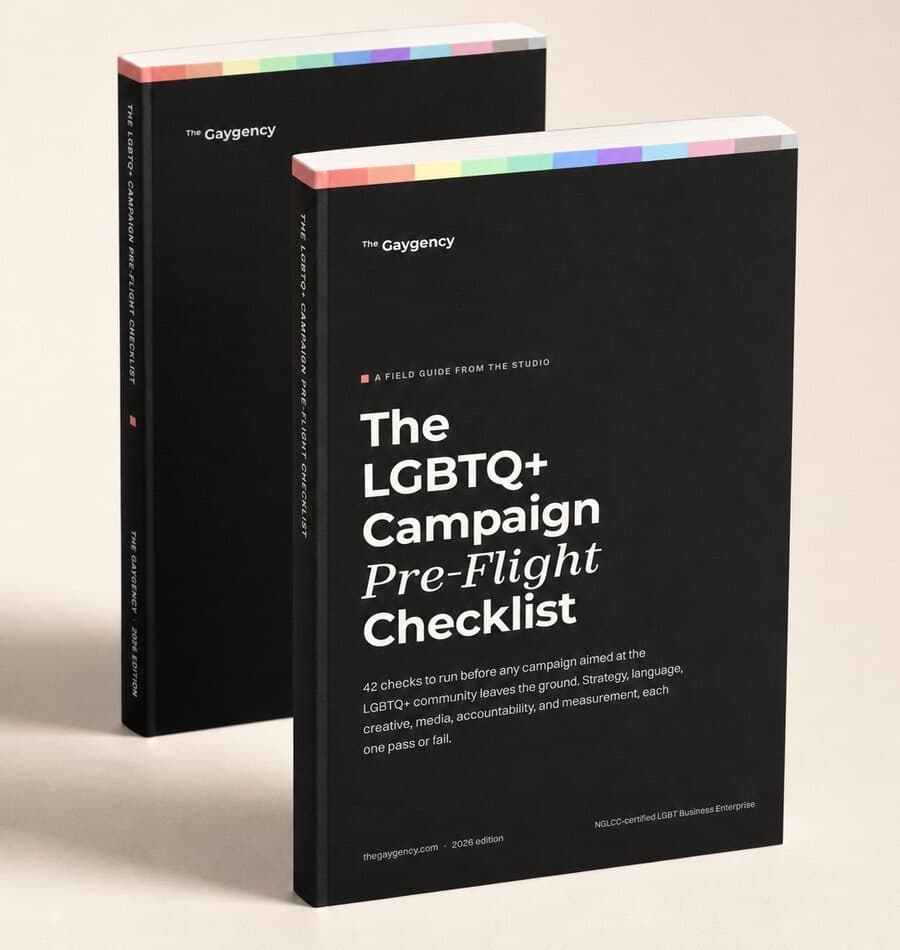
Free campaign guide
Would your campaign pass pre-flight?
The same 42 checks we run inside the studio before any campaign aimed at the LGBTQ+ community goes live.
Delivered by email. No spam, ever.
Written by
Daniel Montelongo
Founder of The Gaygency and Gaydar. Ten years leading campaigns at Apple, Dentsu, and Ann Inc. before building the studio, where he leads every engagement.
About Daniel