Founder column
Before Pride 2026
By Daniel Montelongo, Founder · 04-16-26 · 5 min read
Pride is two months out, and every client conversation I am having right now has the same shape. Someone on the marketing or comms side asks some version of "given everything that happened last year and this winter, what should we be doing this June." I want to write down the answer I keep giving, because I think it holds regardless of which client is asking it.
Here is what we already know, on the record, heading into this season. Gravity Research's 2025 poll found 39 percent of the 49 communications executives in Gravity's Corporate Insiders Group said their company planned to scale back Pride engagement, compared with 9 percent who said in 2024, on a similar question, that they were changing their engagement. NYC Pride lost several Platinum-level sponsors last year and absorbed a reported $750,000 shortfall. WorldPride in Washington, D.C. saw sponsors go quiet without explanation. And this February, CNBC reported that the Human Rights Campaign Foundation's Corporate Equality Index recorded a drop from 377 Fortune 500 participants to 131: companies that chose not to be measured at all, which goes further than choosing a smaller campaign. Two years of data now point the same direction. I do not think anyone walking into this Pride season gets to plead surprise about the environment they are operating in.
Stop asking whether to be loud
The question I am done answering is how loud to be in June. The only question worth a client's time is what still holds up in July.
Most of the strategy conversations I sit in still start from a volume question: bigger campaign or smaller one, more visible or less. I think that framing was always a trap, and this year it is an especially obvious one. Volume was never the variable that mattered. What mattered was whether a brand had anything underneath the campaign that survives past the month, and that variable does not move based on how loud this year's version is. A brand asking "should we be louder or quieter than last year" is still asking last year's question.
What I tell clients instead is to audit what is genuinely load-bearing in their plan before a single asset gets made. Name the LGBTQ+-owned vendors and creators on the roster. Name the policy or benefit commitments that exist independent of the marketing calendar. Name the relationships that were built before this became a harder year to be visible in. If that list is short, the honest move is not a bigger June campaign to compensate. It is spending the two months before Pride building the list, even quietly, rather than spending it on creative that has nothing real behind it.
In practice, that audit takes less time than most teams expect, and it usually surfaces the same three gaps. The first is a vendor list that has never been checked for real LGBTQ+ ownership, just assumed. The second is a policy commitment, health coverage that includes gender affirming care, for instance, that exists on paper but was never mentioned to the community it is supposed to reassure. The third is a creator or community partnership that ran once, three years ago, and has been quietly treated as evidence of an ongoing relationship ever since. None of these gaps are hard to close. They are just easy to avoid noticing until a season like this one makes avoiding them expensive.
The planning conversation worth having in April is not about the campaign. It is about what the campaign is supposed to be resting on.
What I am not telling clients
I am not telling anyone to go quiet because visibility got riskier. Going quiet without ever explaining why reads exactly like the sponsors who disappeared from NYC Pride last year with no statement attached, and that pattern did not land well with the people watching it happen. I am also not telling clients to overcorrect into the loudest possible version of Pride marketing to prove a point, because a louder campaign sitting on the same thin foundation is still a thin foundation, just a more expensive one to build.
There is a narrower version of this same mistake, which is treating a single well-produced piece of creative as if it were the audit itself. A beautiful campaign is still just a campaign. It answers the question of whether a brand can make something that looks considered. It does not answer the question of whether the commitment underneath it would survive being asked about directly, on the record, by a journalist or a customer who read this exact kind of coverage last month.
What I am telling every client, plainly, is this: decide now, before the pressure of the calendar forces a rushed answer, what you are willing to have written down about your commitment to this community. Not a feeling. A specific practice, partnership, or policy that someone could check. If that list is real, build the Pride campaign around naming it clearly. If that list is thin, spend the next two months making it less thin before you spend a dollar on the campaign that is supposed to represent it.
The only forecast I am willing to make
I do not know whether this Pride season brings more retreats or the start of a correction back the other direction, and I am not going to pretend otherwise for the sake of a clean prediction. What I do know is that the brands walking into June with something real to point to are going to have an easier season than the brands hoping volume covers for an empty list, regardless of which direction the broader market moves. That is the only forecast I am willing to make, and it is the one I am building every client's plan around right now.
If you want help building the list before you build the campaign, our brand strategy work is designed to start there, and if Pride season is close enough that you need help fast, book a call.
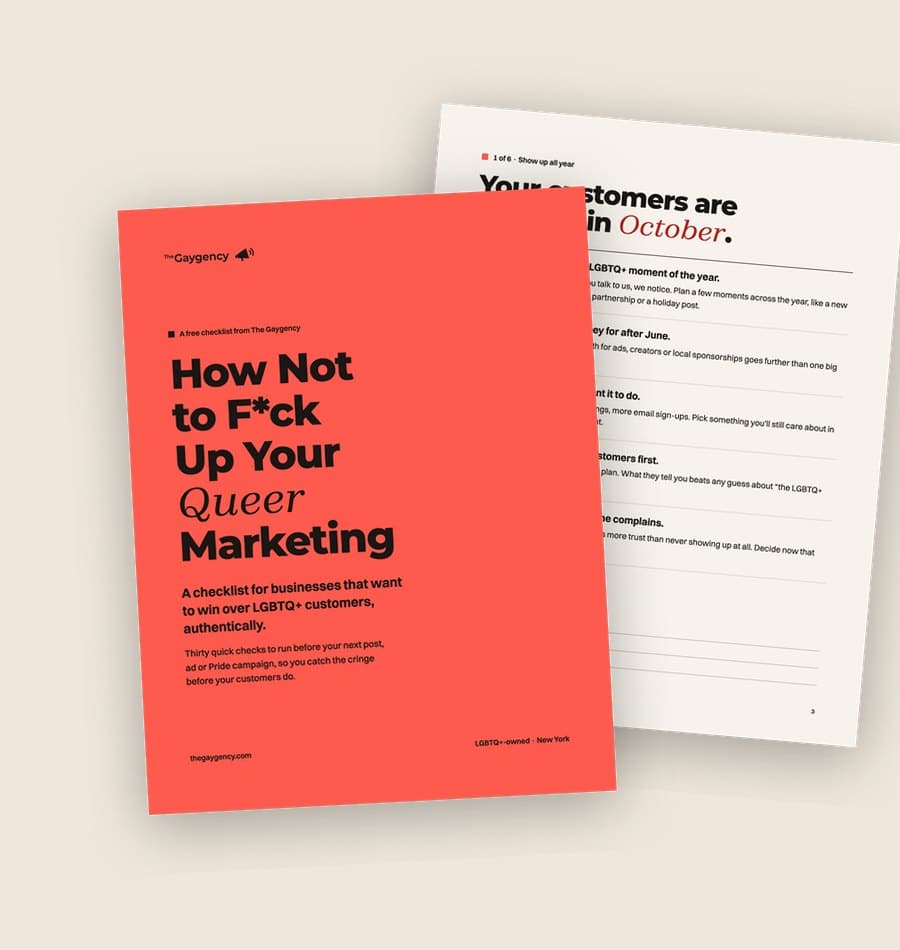
Free checklist
How not to f*ck up your queer marketing
A checklist for businesses that want to win over LGBTQ+ customers, authentically.
Thirty quick checks to run before your next post, ad or Pride campaign, so you catch the cringe before your customers do.
Delivered by email. No spam, ever.
Written by
Daniel Montelongo
Founder of The Gaygency and Gaydar. Ten years leading campaigns at Apple, Dentsu, and Ann Inc. before building the studio, where he leads every engagement.
About Daniel