Founder column
What building Gaydar taught me about our own audience
By Daniel Montelongo, Founder · 08-28-26 · 4 min read

I have spent years telling brands how to reach the LGBTQ+ community. Building Gaydar taught me something different, because a dating app does not let you hide behind a strategy deck. People trust it with their location, their photo, their name, sometimes in places where being visibly queer still carries real risk. Get that wrong and there is no campaign optimization that fixes it. You just lose the person, permanently, and they tell everyone they know why.
The Gaygency designed, built, and shipped Gaydar to the Apple App Store and Google Play, and we grew it with our own paid acquisition system. I run it the same way I run every other part of this studio, which means I am the one who has to sit with what the data tells us about how this community behaves once trust is on the line, which runs deeper than how they respond to an ad.
Trust and safety as the actual product
Every dating app claims to care about user safety. Almost none of them build as if a single bad experience is the whole relationship. With Gaydar, verification is the actual product. Before a profile goes live, we require a real, live moment on camera, a selfie taken in real time, so the person on the other end of a match is who they say they are. That single requirement generates more support tickets and more friction at signup than a lighter version would. We keep it anyway, because the alternative is an app that looks safe in the marketing and is not safe in the use.
I bring that standard back into every brand and product engagement we run now. A campaign that promises safety or inclusion and then routes a user into a form, a checkout, or a support flow that treats them like anyone else is making the same mistake at a smaller scale. The audience notices the gap between the promise and the mechanism every time, and this community in particular has had a lot of practice noticing it.
The community can smell rented interest. They are not cynical; they have been sold to before by people who left the moment the numbers stopped moving, and they remember exactly what that felt like.
That is the plainest thing Gaydar taught me. A user does not evaluate whether an app or a brand supports the LGBTQ+ community by reading its stated values. They evaluate it by what happens when something goes wrong, who answers, how fast, and whether the product was built with their specific risks in mind or retrofitted after a complaint. Renting interest for a quarter shows up immediately in behavior, long before it shows up in a review.
What rented interest looks like from the inside
I can see the pattern clearly now because I watch it happen on the acquisition side of our own app. A user who arrives through a paid campaign built around genuine understanding of this audience, the right imagery, the right language, the right promise, behaves differently from day one than one who arrived through a campaign that treated the community as a targetable segment with a rainbow overlay. The first group sticks around, verifies, engages with support when something is confusing instead of just leaving. The second group churns fast and rarely comes back, because the app they landed on did not match the pitch that got them there.
A live product forces the lesson a strategy deck lets you skip.
That gap shows up in a spreadsheet as a retention number, but the cause of it is not a product bug. It is that people can tell within the first few minutes of using something whether it was built by people who understand their actual risks or by people who read a brief about their risks. Running Gaydar means I see that distinction play out in real usage data every week, not in a focus group or a survey. It is the clearest version of a pattern I now watch for across every client account we manage, because a brand's landing page, checkout flow, or support experience can show the same gap between the pitch and the mechanism.
How we handle consent
The other lesson is about data, and it runs against the instinct most growth teams have. The easy path in a dating product is to collect everything you can justify collecting, because more data theoretically means better matching and better targeting. We do not run it that way. What we ask for, we ask for plainly, and we tell people why we need it, rather than burying it in an agreement nobody reads. For a community that has watched its data get sold, leaked, or subpoenaed by people who meant it harm, that is not a compliance detail. It is the entire basis of whether someone trusts you with their location at two in the morning.
I do not think that lesson is unique to dating apps. Every brand collecting information from LGBTQ+ consumers, whether it is an email address for a loyalty program or a location for a store finder, is asking for a version of the same trust. Most brands never think about it that specifically, because most brands have never had to earn it back after losing it. We had to design for that possibility from day one, and it changed how carefully we think about consent everywhere else we work.
Building your own product instead of only advising on other people's is what forced these lessons on me in the first place. I do not think I would have understood any of this as sharply from the outside. If you want the fuller story of how the studio operates, read more about us, or if you want to talk about how these same principles apply to your own audience, book a call.
Free checklist
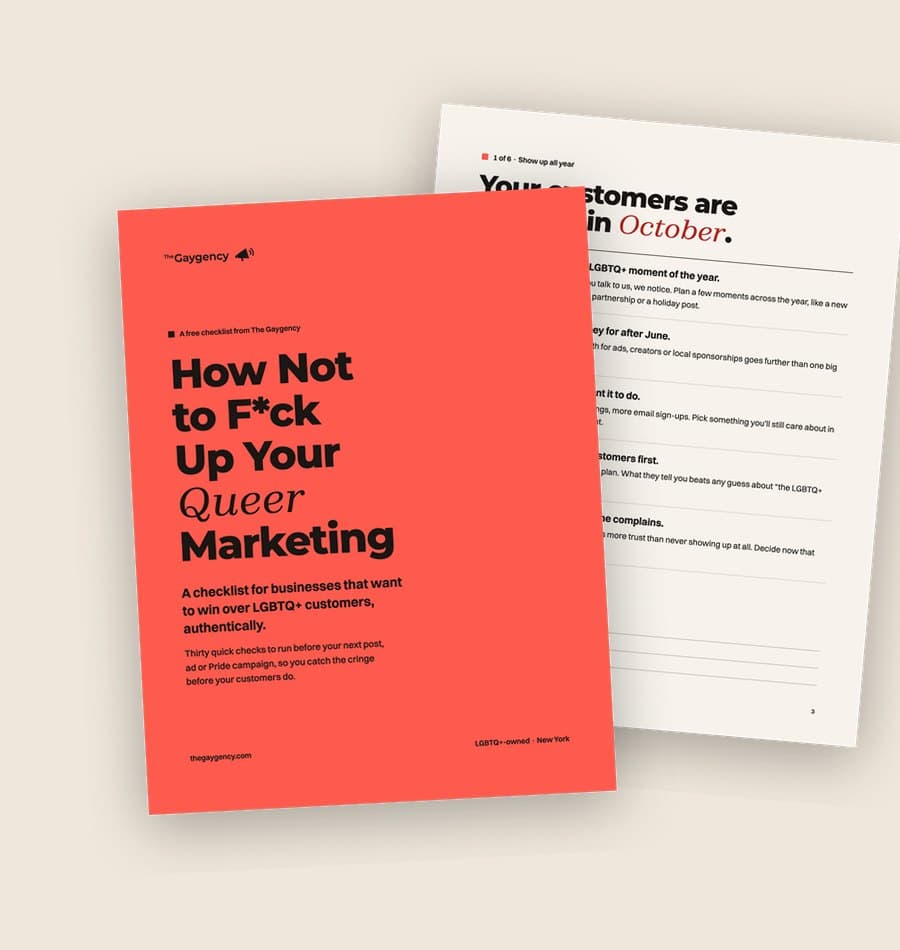
How not to f*ck up your queer marketing
A checklist for businesses that want to win over LGBTQ+ customers, authentically.
Thirty quick checks to run before your next post, ad or Pride campaign, so you catch the cringe before your customers do.
Delivered by email. No spam, ever.
Written by
Daniel Montelongo
Founder of The Gaygency and Gaydar. Ten years leading campaigns at Apple, Dentsu, and Ann Inc. before building the studio, where he leads every engagement.
About Daniel