Founder column
Why I started The Gaygency
By Daniel Montelongo, Founder · 07-06-26 · 5 min read

I spent fifteen years inside other people's agencies before I built my own. Apple, Dentsu, Ann Inc. Multimillion dollar programs for Macy's, Nordstrom, Virgin America. I learned how a real agency runs at a scale most founders never get to see up close: the media systems, the production discipline, the way a good creative team briefs a problem before it briefs a solution. I am grateful for every year of it. It is also where I learned exactly what was missing for people like me.
Queer-owned businesses were overlooked, underserved, or priced out of that caliber of work, not because the work was hard to do, but because the agencies capable of doing it well had no real relationship with this community and no real interest in building one. The ones that did show up mostly arrived in June and left in July. A rainbow logo, a sponsored post, an email blast timed to Pride, and then thirty-one days of silence. I watched that pattern repeat every year I worked in this industry, and I watched queer founders and small business owners pay full agency rates for a fraction of the attention a straight-owned client in the same category would get without asking for it.
I do not think most of the people running those agencies were being cynical on purpose. I think they had never had to build anything for this community themselves, so they did not know what it required, and nobody made them find out.
We started The Gaygency because we were tired of watching our community get treated like a marketing segment.
That is the line I keep coming back to, because it is the plainest way to say what happened. I was not diagramming a market gap. I was tired of watching people I knew, people I am, get treated as a line item that agencies checked once a year. Queer-owned jewelry makers, travel companies, clinics, solo founders building their first real brand: I knew what these businesses were worth, because I had spent years building revenue systems for businesses many times their size, and I could see the same fundamentals sitting there unserved.
So in 2022 I started The Gaygency with no outside capital, which meant every dollar the studio spent came out of what the work itself earned. That was not a strategic choice about ownership structure. It was the only way to build something that answered to clients and to this community first, instead of to investors who would eventually ask why an agency this specific was leaving money on the table by staying specific.
We are the community we market to
That phrase gets repeated a lot in how we describe the studio, and I want to be direct about why it is not a slogan. It is a staffing decision. The Gaygency is 100 percent LGBTQIA+ owned. Our team is a mix of gay, queer, and trans people and straight allies. We are certified as an LGBT Business Enterprise by the National LGBTQ+ & Allied Chamber of Commerce (NGLCC, formerly the National LGBT Chamber of Commerce) and as a Minority Business Enterprise with New York City Small Business Services. None of that is decoration. It is how you build an agency where nobody has to explain the community to the room, because the room already lives in it.
Since 2022 the studio's work has driven more than fifteen million dollars in revenue across the businesses on our roster. I care about that number more than I care about awards or press, because it is the actual proof that specificity works better than the generic reach the industry told these founders they had to settle for. Every client on that list got an agency built for exactly what they are, not an agency that tolerated them as an exception to its usual account.
I also built Gaydar, our own dating app for this community, designed and shipped to the Apple App Store and Google Play, because I did not want The Gaygency to be a studio that only advises. I wanted proof, under our own name, that we build and launch real products instead of decks about them.
None of this means I think every agency owes queer-owned businesses free work or a permanent discount. What I think is that this community deserved a studio that stayed in the room past June, staffed by people who did not need a briefing document to understand the stakes, and honest enough to publish its numbers instead of hiding behind a portfolio of logos. That is the agency I could never find when I needed one. So I built it.
What changed when it became mine
The work itself did not change much in the first year. I was still building brand systems, media plans, and websites, the same disciplines I had run at scale before. What changed was who I was accountable to. At a big agency, a queer-owned client was one account among hundreds, and if the relationship went quiet in July, the agency's quarter was fine either way. Here, if a client's business does not grow, I do not get to point to a portfolio of unrelated wins and call it a good year. Every business on our roster is the studio's actual scorecard, not a case study we can afford to lose.
That accountability is also why I never took outside capital to get this started. An investor asks an agency to grow the account list as fast as possible, and the fastest way to do that in this category would have been to loosen how specific we stayed. I was not interested in that trade. I would rather run a smaller studio that only takes on work we can do at the level this community deserves than a bigger one that starts treating its own founding purpose as a growth constraint to be managed around.
I still run every engagement myself, alongside the team we built to do the work at the standard I learned at Apple and Dentsu, without the overhead those names charge for it. If you want to know more about how we work, read the rest of our story, or if you are ready to talk about your business specifically, book a call.
Free checklist
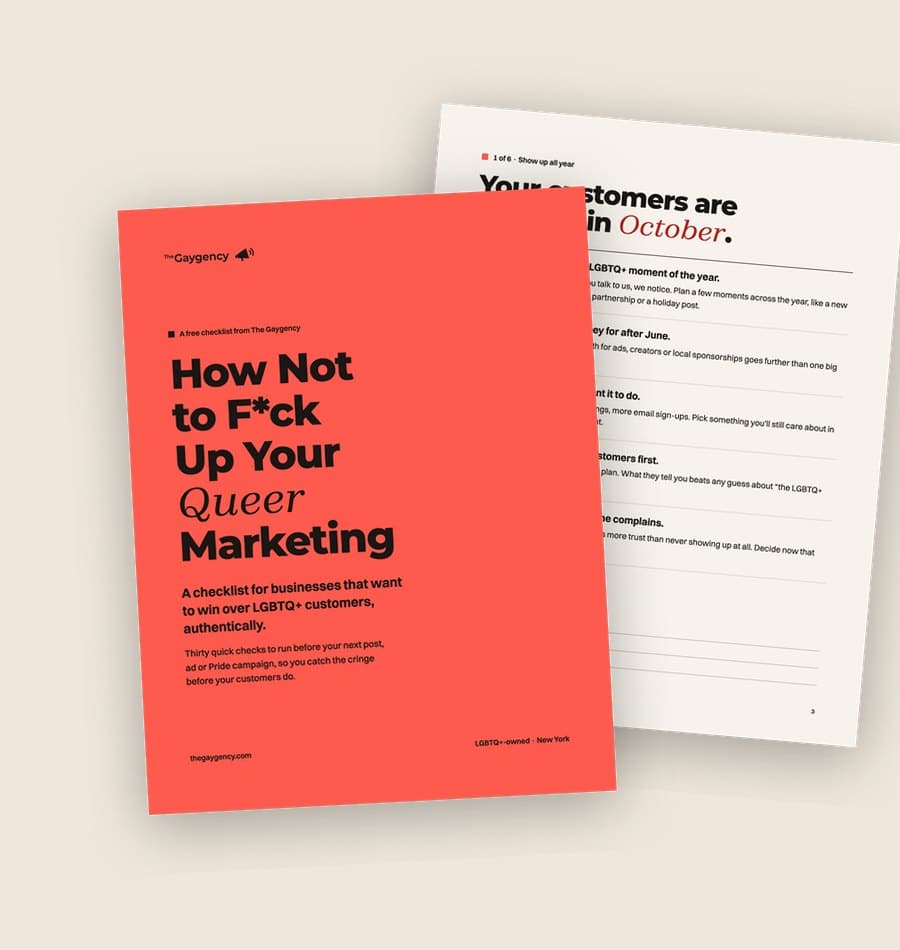
How not to f*ck up your queer marketing
A checklist for businesses that want to win over LGBTQ+ customers, authentically.
Thirty quick checks to run before your next post, ad or Pride campaign, so you catch the cringe before your customers do.
Delivered by email. No spam, ever.
Written by
Daniel Montelongo
Founder of The Gaygency and Gaydar. Ten years leading campaigns at Apple, Dentsu, and Ann Inc. before building the studio, where he leads every engagement.
About Daniel