Founder column
What the CEI exodus means
By Daniel Montelongo, Founder · 02-26-26 · 5 min read

I wrote in December about the pullback we watched happen across last year: a Gravity Research poll that found 39 percent of the 49 communications executives in Gravity's Corporate Insiders Group said their company planned to scale back Pride engagement, compared with 9 percent who said in 2024, on a similar question, that they were changing their engagement, and a wave of sponsors who went quiet at NYC Pride and WorldPride without much explanation. I said then that the honest story was not brands abandoned the community. It was brands that were never truly committed stopped pretending to be. This month gave us a second data point, and I think it confirms the read.
CNBC reported this month that the Human Rights Campaign Foundation's Corporate Equality Index recorded a drop from 377 Fortune 500 companies participating last year to 131 this year, a 65 percent decline in a single cycle. I want to be precise about what that number measures, because the precision matters more than the headline. The Corporate Equality Index is not a survey of public opinion or a poll of intentions. It is a benchmarking tool companies opt into by submitting their own policies, benefits, and practices to be scored and published. A company does not fail the index by accident. It chooses not to submit.
Opting out is its own answer
A poll measures what a company says it might do. An index measures what a company was willing to have written down. Losing 246 companies from the second one tells you more than losing them from the first ever could.
That distinction is why I take this number more seriously than the Pride Pulse Poll data from last year, even though the poll got more coverage at the time. A company can scale back a June campaign quietly and still claim, if asked, that its underlying commitments are unchanged. Declining to submit to the Corporate Equality Index removes that option. It is a public choice not to have specific, checkable practices measured and put on the record. Some of the 246 companies that dropped out may still run genuinely strong internal policies. I have no way to know that, and neither does anyone reading the index, which is the point: withdrawing from measurement is different from failing a measurement, and it is not a more comfortable position to be in. It just moves the discomfort out of public view.
I have spent enough years around large companies to know roughly how a decision like this gets made internally. Nobody sends a memo that says we are pulling back from being measured on this. What happens instead is quieter: legal flags the submission as a new source of risk, communications asks whether the benefit still outweighs the exposure, and somewhere in that conversation the form simply does not get filled out this cycle. That is not a company reversing a commitment in one meeting. It is a company deciding, cycle after cycle, that defending the commitment costs more than letting it lapse quietly, which is its own kind of erosion, even if nobody ever announces it.
An index is only as strong as the number of companies willing to be measured against it.
What this changes for the 131 that stayed
The companies that did submit this year did so knowing the list would be a fraction of its usual size, which makes their participation a more specific signal than it would have been in a year when everyone showed up. There is a version of corporate Pride commitment that only ever made sense as camouflage: safety in a large crowd of similar-looking gestures, where no single brand stood out enough to be a target. That version of the strategy is no longer available. A brand submitting to the Corporate Equality Index this year is choosing visibility in a much smaller group, and a small group draws a different kind of attention than a large one does.
I do not think that changes what I would tell those 131 companies to do. It changes how much credit I think they deserve for doing it. Submitting to a shrinking index is a harder decision this year than it was two years ago, and the community watching this space has more reason than ever to notice which brands made that call and which ones quietly stopped answering the question.
The test I am watching for
None of this tells me whether the pullback deepens further this year or whether some of it reverses before Pride season starts. I am not going to guess at that here, because guessing is not useful. What I am watching for is simpler: whether the brands still willing to be measured keep building the kind of specific, checkable commitments the index rewards, or whether staying on the list becomes its own performance, separate from the practices underneath it. The index is a floor, not a finish line, and a brand that treats submission itself as the achievement has learned the wrong lesson from a year when submission alone became rare.
Small and mid-sized businesses do not have a Corporate Equality Index to quietly skip. Every LGBTQ+-owned business on our roster is measured by this community every day, in every transaction, whether or not anyone publishes a scorecard about it. That is worth remembering when a story like this one makes it sound like corporate commitment is mostly a Fortune 500 problem. The businesses built by and for this community were never optional participants in an index. They are the baseline the index is trying, imperfectly, to measure everyone else against.
If your brand is one of the ones asking what a year-round, checkable commitment to this community requires, our brand strategy work is built around exactly that question, and if you want to talk through where your own practices would land on a public scorecard, book a call.
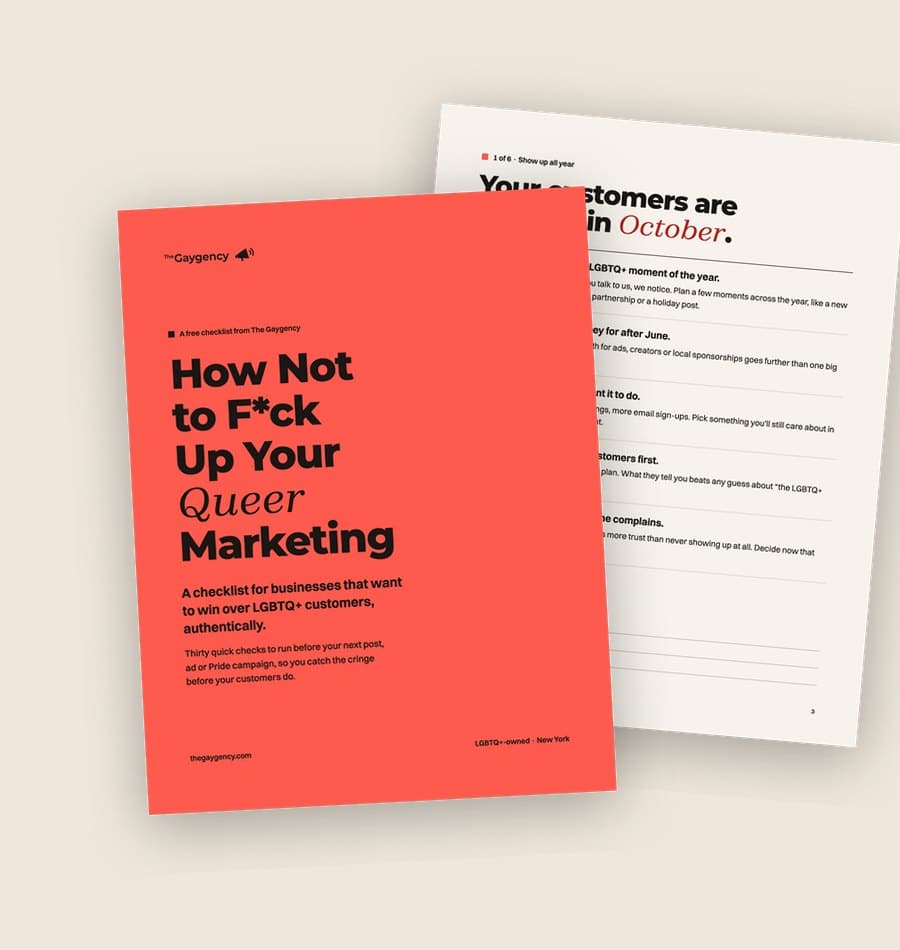
Free checklist
How not to f*ck up your queer marketing
A checklist for businesses that want to win over LGBTQ+ customers, authentically.
Thirty quick checks to run before your next post, ad or Pride campaign, so you catch the cringe before your customers do.
Delivered by email. No spam, ever.
Written by
Daniel Montelongo
Founder of The Gaygency and Gaydar. Ten years leading campaigns at Apple, Dentsu, and Ann Inc. before building the studio, where he leads every engagement.
About Daniel