LGBTQ+ Marketing
Holiday marketing to LGBTQ+ families
By The Gaygency · 10-19-26 · 7 min read

Holiday advertising is built almost entirely around family, more than any other marketing season. That makes it the single biggest representation test a brand runs all year, and most holiday casting still defaults to one family shape by habit rather than by any data that says it should.
What the data says about LGBTQ+ families
The data does not support treating LGBTQ+ parents as a footnote. Family Equality Council's 2019 LGBTQ Family Building Survey found that 77% of LGBTQ+ Millennials, ages 18 to 35, are already parents or are considering having children, a 44% increase over older LGBTQ+ generations, and that 63% of LGBTQ+ people planning families expect to use adoption, foster care, or assisted reproductive technology to get there (Family Equality Council, 2019). Family Equality's ongoing "Facts about LGBTQ+ Families" resource page puts the current estimate at 29% of LGBTQ+ adults raising a child under 18 (Family Equality Council, accessed 2026, citing demographic research from Gary Gates).
A 2017 fact sheet from the Census Bureau's National Advisory Committee, drawing on Williams Institute research, put the range at 2 million to 3.7 million children under 18 with an LGBTQ+ parent, with roughly 200,000 of them being raised by a same-sex couple specifically, and noted that most children currently raised by a same-sex couple were conceived in an earlier different-sex relationship, a pattern that is shifting as more LGBTQ+ people build families intentionally (US Census Bureau National Advisory Committee, 2017). Every one of these numbers has been trending in the same direction for over a decade: more LGBTQ+ people building families, earlier, and more often by intention than by circumstance.
LGBTQ+ Millennials are building families at a rate 44% higher than older generations, so the family audience holiday ads are aimed at already includes them.
A decade of holiday ads, in order
Real casting history shows the same slow, then accelerating, arc as the data.
2015. Kohl's ran a holiday commercial called "Celebrate Togetherness" as part of its "All Together Now" campaign, showing a family preparing a holiday meal together, including a same-sex couple sharing a toast. It was one of the first mainstream department-store holiday ads to include a gay couple, and it drew both praise and organized criticism (Forbes, 2015; USA Today, 2015).
2020. Hallmark Channel's The Christmas House featured the network's first same-sex couple in a holiday movie, five years after Kohl's ad and well over a decade after the network's holiday programming began.
2022. Hallmark's The Holiday Sitter, starring Jonathan Bennett and George Krissa, became the network's first holiday movie built around a gay couple as the leads rather than a supporting storyline.
2025. Hallmark's The Christmas Baby, premiering December 21, 2025, centers a lesbian couple, played by Ali Liebert and Katherine Barrell, navigating a foster-to-adopt process during the holidays while running their own business (GO Magazine, 2025).
Ten years separate Kohl's first same-sex couple in a holiday ad and Hallmark's first same-sex leads. The pace picked up. It did not start there.
Why this is a business question as much as a representation one
Holiday quarter is the highest-revenue period of the year for most consumer brands, which makes invisibility during it a real cost, not a neutral choice. HRC Foundation's Pride in the Marketplace 2026 report found that 71.5% of LGBTQ+ consumers say they buy less from companies they see as retreating from inclusion, and that 69.5% say they are increasing spend with brands they see as staying present (HRC Foundation, 2026). GLAAD and Kantar's 2023 Advertising Visibility Index found that only 3% of national TV ads from the ten biggest US advertisers were LGBTQ-inclusive at all, and that 80% of US consumers said they wanted to see more multidimensional LGBTQ+ representation in advertising (GLAAD and Kantar, 2023). The field is still open. A brand does not need to out-produce anyone to stand out here; it needs to show up at all, with a real family instead of a stand-in for one.
With only 3% of ads from the ten largest US advertisers including any LGBTQ+ representation, showing up at all is still a differentiator in the highest-revenue quarter of the year.
The playbook
Cast a real family, not a diversity checkbox. The Kohl's ad that held up over time was praised specifically for being matter-of-fact: a couple at a dinner table, not a plotline about coming out. The families that read as authentic are the ones where the relationship is simply present, not explained.
Skip the "very special episode" framing. A holiday ad does not need to make a statement about acceptance. It needs to show a family doing what every other family in the campaign is doing: cooking, unwrapping gifts, arguing about the thermostat.
Build it across the season, not into one hero spot. A single inclusive ad that runs once reads as a stunt. The same family, or family type, showing up across email, social, and on-site creative through November and December reads as how the brand sees its customers, not how it staged them for one shoot.
Make room for chosen family. A meaningful share of LGBTQ+ people are estranged from family of origin, and holiday marketing that only ever shows blood relatives around a table quietly excludes them twice: once as LGBTQ+ people, and once as people who spend the holidays with friends instead. A Friendsgiving or chosen-family narrative is a distinct, honest creative angle, not a workaround for representation done properly elsewhere.
Start production timelines now. A November or December campaign needs casting, scripting, and shoot days locked well before Thanksgiving. If the creative isn't in motion by mid-October, the holiday window closes on a brand before the campaign does.
Brief the creative team on language as well as casting. A holiday script that defaults to "husband and wife" in every line of dialogue or voiceover writes LGBTQ+ families out even when the visuals are inclusive. Neutral language, "your partner," "your family," "the person you're shopping for," costs nothing and keeps a single script usable across every family type a brand casts.
A holiday ad does not need to make a statement about acceptance. It needs to show a family doing what every other family in the campaign is doing.
Before you lock the holiday casting
- Does the ad need this family's identity explained, or does it just show them living their life?
- Is this the only inclusive placement in the whole season, or one of several across the calendar?
- Have we considered a chosen-family or Friendsgiving narrative alongside the traditional-family ones?
- Would this family read as real to someone who is part of one like it?
- Is production already moving, or are we planning to cast in November for a November launch?
What this looks like at different budgets
A national retailer running a full holiday campaign has the budget to build multiple family narratives across formats, the way Hallmark now runs several holiday storylines a season instead of one. A smaller brand does not need that scale to do this honestly. One well-cast family in a single email or social series, sustained across the season instead of run once, does more for a local business than a bigger, blander campaign that shows no family in particular. This is the same logic behind the content engine work we build for brands: a repeatable production system beats a one-off hero shoot, especially in a season with this much creative volume to fill. A visual identity that already reflects the range of families a brand serves makes every piece of holiday creative easier to cast, because the decision was made once, upstream, instead of re-litigated on every shoot.
For retailers and local businesses running a holiday push specifically, representation and revenue are not separate goals this quarter. They are the same goal, argued twice.
Frequently asked questions
Do LGBTQ+ families show up in holiday ads?
Rarely, and inconsistently. GLAAD and Kantar's 2023 Advertising Visibility Index found only 3% of national TV ads from the ten largest US advertisers included any LGBTQ+ representation, which means most holiday seasons still run without it.
What does the data say about LGBTQ+ parents in the US?
Family Equality Council's 2019 survey found 77% of LGBTQ+ Millennials are already parents or considering it, a 44% increase over older generations, and a 2017 Census Bureau fact sheet estimated 2 million to 3.7 million children in the US have an LGBTQ+ parent.
How do we avoid tokenism when casting an inclusive holiday ad?
Cast the family to be present, not explained. The ads that hold up, like Kohl's 2015 spot, treat the couple as a normal part of the scene rather than the point of the scene. If the ad needs a line of dialogue to justify the casting, the casting is doing the wrong job.
Is featuring an LGBTQ+ family in a holiday ad risky?
Less risky than it was a decade ago, and the consumer data leans the other direction: HRC Foundation's 2026 research found a majority of LGBTQ+ consumers are actively shifting spend toward brands they see as staying present. The bigger risk at this point is running a season of holiday creative that shows no family like this at all.
What if we cannot afford a full holiday campaign this season?
Scale the ambition, not the honesty. One well-cast family across a smaller run of email and social content, sustained through the season, does more than a single expensive spot that shows nobody in particular.
If your team is planning this season's holiday creative and wants a second set of eyes on the casting, the calendar, or the production plan, book a call and we will help you build a season that looks like your actual customers.
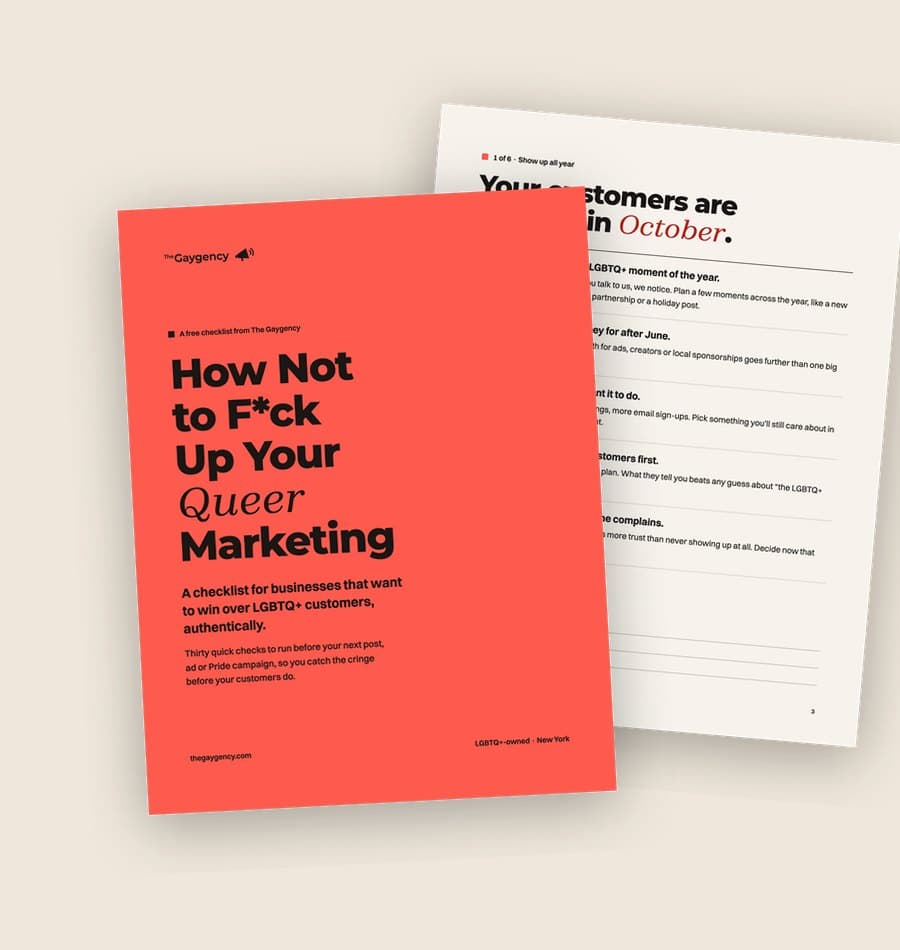
Free checklist
How not to f*ck up your queer marketing
A checklist for businesses that want to win over LGBTQ+ customers, authentically.
Thirty quick checks to run before your next post, ad or Pride campaign, so you catch the cringe before your customers do.
Delivered by email. No spam, ever.
Written by
The marketing and advertising agency for LGBTQ+ businesses and the brands that back them. Strategy, media buying, and brand systems with published results.
See the workKeep reading