LGBTQ+ Marketing
LGBTQ+ travel marketing: the winter booking window
By The Gaygency · 10-26-26 · 7 min read

Winter reads as the off-season for most travel marketing built around LGBTQ+ audiences, timed instead around Pride season and summer festival circuits. That reading does not match the calendar. Aspen Gay Ski Week runs its fiftieth anniversary, a "Golden Jubilee," from January 17 to 24, 2027 (Aspen Gay Ski Week, 2026), and travel brands marketing to that audience in October are not marketing early. They are marketing on time.
The market is bigger than the season it gets credit for
The World Travel & Tourism Council and the International LGBTQ+ Travel Association estimate the global LGBTQ+ travel market at more than $200 billion annually (WTTC, citing IGLTA research, 2026). That figure has no season attached to it. MMGY Global's January 2023 Portrait of LGBTQ+ Travelers in America study, which surveyed thousands of American LGBTQ+ travelers, found that representation in a destination's marketing materials is "very or extremely important" to 43% of respondents, and that personal safety and state politics significantly influence where LGBTQ+ travelers choose to go (MMGY Global, 2023). None of that is Pride-specific. It describes how LGBTQ+ travelers evaluate any trip, in any month.
The same study found LGBTQ+ travelers are considerably more likely to travel solo than the broader population: 50% of respondents said they travel solo, compared with 33% who travel in pairs (MMGY Global, 2023). A winter ski week or group trip built around solo travelers finding community is a better match for that behavior than a couples-focused summer beach campaign is.
Half of the LGBTQ+ travelers in MMGY Global's study travel solo, and event trips like ski weeks are built to turn those solo bookings into a group.
Winter is two different trips, not one
"Winter LGBTQ+ travel" covers two distinct patterns that book differently and need different creative. One is the cold-weather, event-anchored trip: ski weeks like Aspen's, New Year's group travel, holiday gatherings in a specific destination. The other is the warm-weather escape: snowbird travel to places like Palm Springs, Puerto Vallarta, or Fort Lauderdale, where the appeal is leaving winter behind rather than embracing it. Both are real winter travel segments, and treating them as one undifferentiated "off-season LGBTQ+ push" wastes the specificity that makes travel marketing work. A campaign built for a ski week audience (cold-weather gear, event logistics, group dynamics) reads as generic and slightly wrong to someone planning a January week in the desert sun, and the reverse is just as true.
Why winter has a long booking window
Nobody books a ski week the week before it starts.
Winter LGBTQ+ travel, ski weeks, holiday trips, New Year's travel, tends to require lead time that summer beach trips do not: flights into smaller mountain airports, hotel blocks at events like Aspen's, and gear or lesson logistics that get harder to arrange the closer the date gets. That combination pushes the real decision window for a January trip back into October and November, which means a marketing push that starts in the week before Christmas is arriving after most of the audience has already decided.
Booking.com's 2026 Travel Proud report, marking five years of the program, found that LGBTQ+ travelers continue to modify behavior and, in some cases, conceal their identity depending on the destination (Booking.com, 2026). That matters more for winter travel than it might seem: a destination that reads as safe and welcoming during a well-known Pride weekend in June is not automatically read the same way for a ski trip to a town nobody associates with LGBTQ+ travel. Winter marketing has to do the safety-signaling work that a summer Pride-adjacent destination gets for free.
A ski town nobody associates with LGBTQ+ travel has to earn the welcoming read in its marketing that a Pride destination gets by default.
What a long booking window means for the marketing plan
A single push in December is the wrong shape for a decision that gets made in October. Out Adventures, an LGBTQ+ tour operator, generated 6,618 leads at $3.64 per lead, down from $7.47, once its lead generation moved from occasional bursts to an always-on system paired with a landing page that matched the offer (Gaygency client results, verified). That is the pattern a long booking window rewards: sustained, always-on lead capture through the months when the decision is being made, not a spike in the final weeks before departure.
Start the nurture sequence now, not at launch. A prospect who shows interest in a January ski trip in October needs three months of trust-building content before they book, not a single retargeting ad in December.
Retarget across the full consideration window. Winter trips get researched, shelved, and reconsidered more than once before booking. A campaign that only retargets for two weeks misses most of that cycle.
Build destination-specific trust content, not generic travel copy. Past-traveler stories, real safety information for the specific destination, and photography of the actual place in winter, not a generic ski stock image, do the work that a summer Pride-adjacent destination does not need to do as hard.
Weight the calendar toward the decision window, not the trip date. If Aspen Gay Ski Week runs in January, the media spend that drives bookings needs to be heaviest in October and November, not January.
Segment the creative by trip type. A cold-weather event trip and a warm-weather escape are different offers to different mindsets, even when the traveler profile overlaps. Running one generic "book your winter getaway" campaign across both audiences dilutes the specificity that made the destination worth choosing in the first place.
The economics of experience-based travel back this up outside the LGBTQ+ market too. Arival's 2025 research on US experience travelers found average trip spend rose to $3,950 in 2024, up from $3,777 in 2023, even as travelers took fewer, shorter trips overall (Arival, 2025). Spend per trip is climbing while trip frequency falls, which raises the cost of losing a booking to a competitor and raises the value of nurturing a prospect all the way through a long decision instead of hoping a single ad catches them at the right moment.
Questions winter LGBTQ+ travel creative should answer before it runs
- Does this destination read as openly welcoming, or merely tolerant, and does our copy reflect which one it is?
- Have we shown real winter imagery of this specific place, not a generic ski or holiday stock scene?
- Does the campaign account for solo travelers, who make up half of LGBTQ+ travelers surveyed by MMGY Global in 2023, or only couples?
- Is our media spend weighted to the booking window, months before the trip, rather than the week the trip happens?
Representation is the deciding creative variable, not a nice-to-have
MMGY Global's finding that 43% of LGBTQ+ travelers say destination representation affects how confident they feel about a place being inclusive is a creative brief, not a footnote (MMGY Global, 2023). For winter travel specifically, that means real photography of LGBTQ+ travelers in the actual winter setting: on a chairlift, at a lodge, at a fire pit, not a summer beach shot re-used with a snowflake graphic added. Combined with the safety and state-politics factors the same study identified as significant to destination choice, the creative brief for a winter LGBTQ+ campaign has to be accurate about the destination before it gets to be aspirational about it.
Cost of travel is the single biggest factor in where LGBTQ+ travelers go, ahead of destination type. Winter travel that competes on value as well as inclusion is the campaign more people book.
This is where content and email and SMS work do the heaviest lifting for a long booking window: a content system that keeps producing destination-specific trust material through the fall, paired with a nurture sequence that follows a prospect from first interest in October through a January departure, rather than a single ad that has to do all the persuading in one impression. For travel and hospitality brands specifically, the booking-window problem is the whole business model, and winter is the clearest example of why the marketing calendar has to start months before the trip does.
Frequently asked questions
Is LGBTQ+ travel demand year-round, or mostly Pride season?
Year-round. The World Travel & Tourism Council and IGLTA put the global LGBTQ+ travel market at more than $200 billion annually, with no single season attached, and events like Aspen Gay Ski Week, running its fiftieth year in January 2027, show sustained winter demand going back five decades.
How far ahead do LGBTQ+ travelers book winter trips?
The logistics of winter travel, flights to smaller airports, event hotel blocks, and gear or lesson planning, push most decisions back to two to three months before departure, meaning a January trip is typically decided in October or November.
What data exists on LGBTQ+ travel spending and behavior?
MMGY Global's January 2023 Portrait of LGBTQ+ Travelers in America study, surveying thousands of American LGBTQ+ travelers, is the most detailed recent source, covering representation, safety, solo travel rates, and what drives destination choice.
Do LGBTQ+ travelers care about destination safety when booking?
Yes. MMGY Global's 2023 research found personal safety and state politics significantly influence destination choice, and Booking.com's 2026 Travel Proud report found many LGBTQ+ travelers still modify behavior or conceal their identity depending on where they are.
What is the biggest mistake brands make marketing LGBTQ+ winter travel?
Treating it like a smaller version of summer Pride travel marketing. Winter trips need destination-specific safety signaling that a well-known Pride-season destination gets for free, and they need a media calendar weighted to the booking window, months before the trip, not the week it happens.
If your team markets travel or hospitality to LGBTQ+ audiences and wants a lead generation system built for a real booking window instead of a seasonal spike, book a call and we will show you what that looks like.
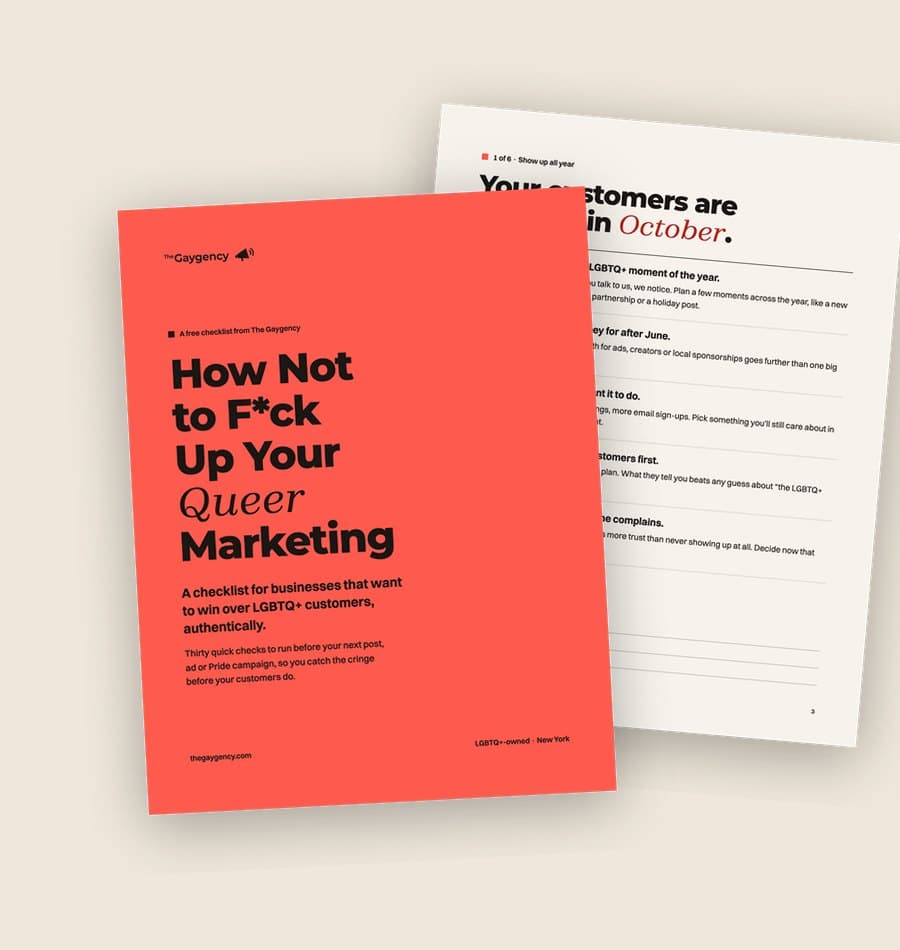
Free checklist
How not to f*ck up your queer marketing
A checklist for businesses that want to win over LGBTQ+ customers, authentically.
Thirty quick checks to run before your next post, ad or Pride campaign, so you catch the cringe before your customers do.
Delivered by email. No spam, ever.
Written by
The marketing and advertising agency for LGBTQ+ businesses and the brands that back them. Strategy, media buying, and brand systems with published results.
See the work