Data brief
Transgender Representation in Advertising: The Numbers
By The Gaygency · 11-16-26 · 7 min read

Transgender representation in advertising: the numbers
Transgender Awareness Week runs November 13 through 19, the week leading into Transgender Day of Remembrance on November 20. It is also, every year, when marketing teams ask the same question: are we seeing more transgender people in advertising, or does it just feel that way because the conversation got louder. The research answers that question with more precision than most people expect, and the answer is not simple. Industry sentiment, consumer perception, and what ends up airing are three different data sets, and right now they do not agree with each other.
How large is the population in question
Gallup's most recent tracking puts LGBTQ+ identification among U.S. adults at 9%, more than double the 3.5% Gallup first measured in 2012 (Gallup, 2025 data). Within that population, the same tracking finds 12% of LGBTQ+ adults identify as transgender, which works out to roughly 1.1% of all U.S. adults. That is not a rounding error or a niche subgroup. It is a population larger than several U.S. states combined, and it has been measured consistently enough, over more than a decade of the same tracking poll, that the growth trend itself is not in dispute.
Gallup's 1.1% figure works out to about one in every ninety American adults, a share no media plan would ignore for any other audience.
What the advertising industry says about itself
GLAAD's 2024 Visibility Perceptions in Advertising study surveyed 200 decision-makers and marketing executives at advertisers and agencies, comparing their answers to a 2021 baseline. The findings describe an industry that believes it has moved, and moved fast, on this specific question:
- 90% of respondents said it is very important to feature LGBTQ+ people in advertising.
- The industry reported an 80% increase in saying the LGBTQ+ community is very important to their business, compared to 2021.
- The importance placed specifically on featuring transgender people in advertising rose 71% compared to 2021, the largest single-group increase in the study.
- 69% of advertisers and agencies said they now have funds specifically allocated to reaching the LGBTQ+ community, up 17% from the prior 2021 survey.
That last set of numbers reads like unambiguous progress. The same report also contains the number that complicates it.
The industry is 55% more likely than in 2021 to say it does not have the expertise or knowledge to get LGBTQ+ representation right.
GLAAD, 2024 Visibility Perceptions in Advertising
Read together, the study describes an industry that wants to include transgender people in its advertising more than it did three years ago, has started budgeting for it, and is simultaneously less confident than before that it knows how to do it without causing harm. GLAAD's own data also found that companies who had already faced public backlash over LGBTQ+ inclusion were up to 1.6 times more likely to increase their commitment afterward rather than retreat, which cuts against the assumption that backlash always produces a pullback.
What audiences say back
Consumer-side research tells a less optimistic story than the industry's self-assessment. Nielsen's research on LGBTQ+ representation in media and advertising found that 63% of LGBTQ+ audiences feel their identity group is misrepresented in media, a figure that climbs to roughly seven in ten among the Black queer community specifically (Nielsen, 2024; Nielsen's 2025 article repeats the 63% and sources it to its 2025 Attitudes on Representation Study). Half of LGBTQ+ audiences, 50.5%, said avoiding stereotypes in advertising and programming would meaningfully improve how included they feel.
63% of LGBTQ+ audiences feel their identity group is misrepresented in media.
Nielsen, 2024 and 2025
Representation is not an abstract preference for this audience. Nielsen's research also found that 42% of U.S. adults overall say seeing themselves represented in a campaign makes them more likely to buy from that brand, and Nielsen Scarborough research specifically found that LGBTQ+ consumers are 62% more likely than the general population to ask a doctor for a specific drug they saw advertised, with Black LGBTQ+ consumers 59% more likely to book an appointment after seeing a healthcare ad. Representation shows up as behavior, which is exactly why the gap between industry confidence and audience perception is a commercial problem as well as an ethical one.
GLAAD's Advertising Visibility Index, first launched with research partner Kantar in 2023, found in its original wave that 66% of Americans believe advertisers have a responsibility to provide visibility for LGBTQ+ individuals, couples, and families, and that more than 70% of the ads GLAAD classified as inclusive relied primarily on celebrity casting, which GLAAD and Kantar's research found to be the least effective way to tell an authentic LGBTQ+ story. GLAAD's 2024 report previewed an updated wave of the same index showing consumers, particularly younger consumers, are 51% more likely than the prior measurement to say the industry still is not doing enough.
The studies cited here all count who is on screen, and none measure who is behind the camera, which is often where authenticity gets decided.
What ends up airing, and how thin transgender representation still is
Advertising does not exist in isolation from the media environment a brand buys into, and that environment shows how far screen representation still has to go. GLAAD's Studio Responsibility Index, now in its 13th annual edition and covering 250 films released theatrically and via streaming in 2024 by the ten largest distributors, found that transgender characters appeared in fewer than 1% of the films tracked that year (GLAAD, released June 2025). Of the 181 total LGBTQ+ characters counted across those films, only three were transgender, about 2% of LGBTQ+ characters and a fraction of a percent of the total cast list across the full study.
The same study found LGBTQ+ representation generally getting shallower rather than deeper: only 27% of LGBTQ+ characters received more than ten minutes of screen time, down from 38% in the prior year's study, while characters appearing on screen for under one minute jumped from 28% to 37% of all LGBTQ+ characters counted, the largest single group tracked. Nielsen's research cites a parallel finding from GLAAD's separate Where We Are on TV research: 36% of LGBTQ+ scripted characters across broadcast, cable, and streaming were not renewed for another season.
The gap, in one place
- 90% of industry executives say featuring LGBTQ+ people in advertising is very important (GLAAD, 2024)
- 55% more of the industry, compared to 2021, admits it lacks the expertise to do it well (GLAAD, 2024)
- 63% of LGBTQ+ audiences say their identity group is misrepresented in media (Nielsen, 2024 and 2025)
- Transgender characters appear in fewer than 1% of major-distributor films (GLAAD Studio Responsibility Index, 2025)
What the data means for a campaign brief
None of this data argues against including transgender people in advertising. Read in full, it argues against doing it without a plan. The industry's own admission that it lacks expertise is the most useful data point in the entire set, because it names the actual failure mode: brands that want credit for inclusion without doing the work of getting the details right, the casting right, and the follow-through right.
A few things the research points to directly. Casting a transgender person in one spot is not the same as building a campaign informed by transgender creators and consultants from the brief stage forward, and audiences report noticing the difference. The backlash data suggests that holding a position after facing criticism builds more credibility than either avoiding the topic entirely or reversing course under pressure. And the widening gap between stated industry values and admitted expertise is itself the case for bringing in a specialist, rather than treating this as a general-market creative exercise with one different casting note.
Frequently asked questions
Is transgender representation in advertising increasing?
Industry self-reporting says yes: GLAAD's 2024 study found a 71% increase in the importance placed on featuring transgender people compared to 2021. Screen representation in film tells a different story, with transgender characters appearing in fewer than 1% of major-distributor films in 2024, per GLAAD's Studio Responsibility Index. Both figures are accurate; they measure different things.
What is GLAAD's Visibility Perceptions in Advertising report?
It is a survey of 200 decision-makers and marketing executives at advertisers and agencies, run by GLAAD and compared against a 2021 baseline, measuring how the industry itself perceives its progress and gaps on LGBTQ+ inclusion in advertising.
Does the Studio Responsibility Index measure advertising?
No. It measures LGBTQ+ and transgender character representation in films released theatrically and via streaming by the ten largest distributors. It is included here because it describes the media environment a brand's advertising runs alongside, not the ads themselves.
Why do advertising executives say they lack expertise on this topic, even as budgets increase?
GLAAD's research does not break down the reasons in detail, but the pattern is consistent with what shows up across LGBTQ+ marketing broadly: budget and intent have moved faster than in-house knowledge of specific language, casting, and creative practices, which is a documented gap rather than a guess.
Where should a brand start if it wants to close that gap?
Start with the same brief-level questions that any specialist creative process starts with: who is telling this story, who reviewed it before it shipped, and what happens if the campaign draws criticism. Those questions matter more than any single casting decision.
Closing this gap is brief-level work before it is casting-level work, which is what our brand strategy and messaging framework engagements are built to catch early. Corporate teams weighing exactly this kind of representation decision under real scrutiny are who our enterprise partnership exists for.
If your team wants a second set of eyes on a campaign before it airs, book a call.
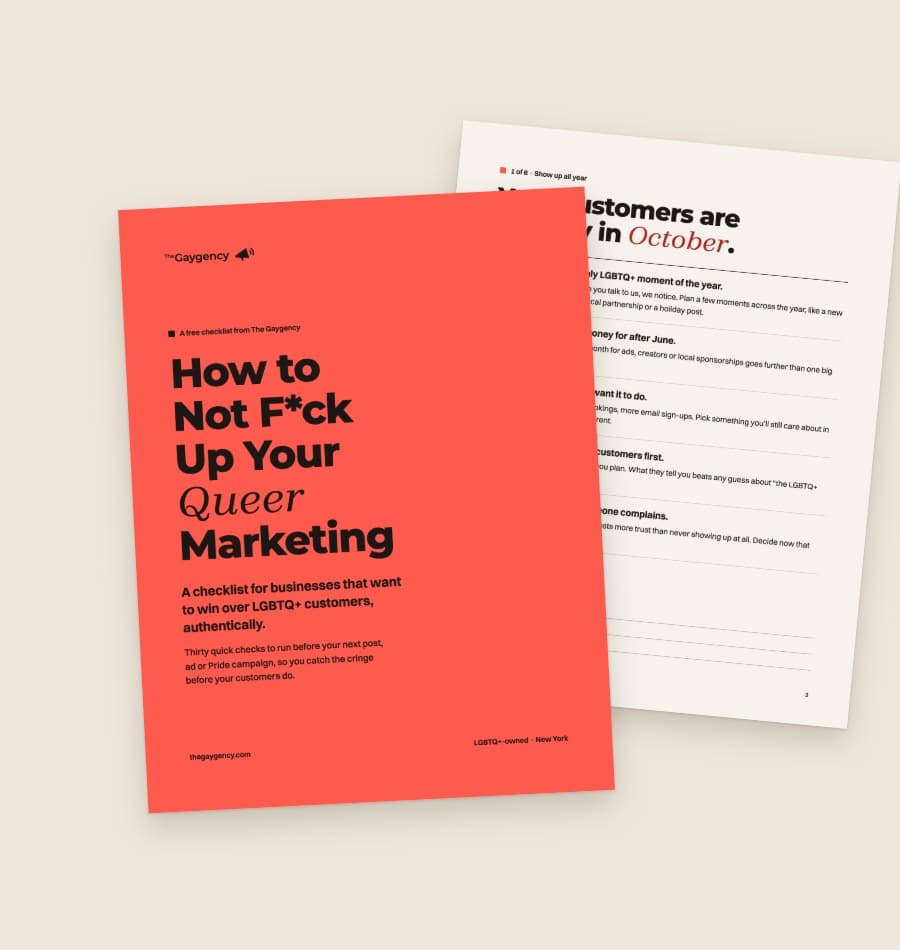
Free checklist
How to not f*ck up your queer marketing
A checklist for businesses that want to win over LGBTQ+ customers, authentically.
Thirty quick checks to run before your next post, ad or Pride campaign, so you catch the cringe before your customers do.
Delivered by email. No spam, ever.
Written by
The marketing and advertising agency for LGBTQ+ businesses and the brands that back them. Strategy, media buying, and brand systems with published results.
See the work