SEO
SEO for LGBTQ+ Businesses: Rank Without a Big Budget
By The Gaygency · 09-07-26 · 7 min read

Most LGBTQ+-owned businesses hear "SEO" and assume it means a monthly retainer they cannot afford yet. That assumption costs them rankings they could have for free. Search does not reward ad spend. It rewards a page that answers the question better than whatever currently sits in position one, served from a site Google can read and trust without friction. A lot of that work is unpaid. It just has to happen in the right order.
This is that order: the technical basics, the free listings, the keyword research that costs nothing but attention, and the content that earns a ranking without a content team. It ends with what to leave alone until there is a real budget for it.
The technical foundation costs nothing but time
Before a single blog post gets written, confirm Google can find and load the site correctly. Three checks, all free:
Speed. A slow page loses visitors before it loses rankings, but it eventually loses both. When Sugar Wood rebuilt its site with a technical-first approach, load speed improved by 30% and bounce rate dropped 15% in the same pass, no new content required. Google's own PageSpeed Insights tool flags the fix list for free.
Indexing. Set up Google Search Console, submit an XML sitemap, and check the Coverage report weekly for pages Google cannot crawl or has excluded. A business that skips this step can publish excellent content that never shows up in results because Google never fully indexed the section it lives in.
Mobile rendering. Most search traffic now arrives on a phone. If the mobile version of a page hides content, breaks navigation, or loads slower than the desktop version, that is the version Google evaluates first under mobile-first indexing.
None of this requires a developer retainer. It requires an afternoon and a free Search Console account.
Search does not care how big the marketing budget is. It cares whether the page answers the question better than the page currently ranking.
Claim the free real estate before paying for anything
A Google Business Profile is free and, for any business with a physical location or a defined service area, it is usually the single most valuable listing available. Fill in every field: category, hours, service area, photos, and a business description that states plainly what the business does and who it serves. Then ask recent customers for reviews. Reviews are a ranking factor for local results and a trust signal for the person reading them.
Beyond Google, get listed anywhere a credible, free citation already exists. NGLCC, the National LGBT Chamber of Commerce, represents an estimated 1.4 million LGBTQ+-owned businesses that together contribute roughly $1.7 trillion to the US economy each year (NGLCC data, reported by Forbes, June 2024). A Certified LGBT Business Enterprise listing, a local LGBT chamber of commerce directory entry, and any relevant industry association directory are backlinks and citations that cost nothing but the application.
The zero-budget SEO checklist for this quarter
- Run the site through Google PageSpeed Insights and fix the top three flagged issues
- Set up Google Search Console and submit the sitemap
- Claim and fully complete the Google Business Profile
- Get listed in the NGLCC directory and any relevant local chamber
- Pull the site's current keyword rankings from Search Console's Performance report
- Rewrite the three page titles that do not currently include what a buyer would type
- Add one FAQ section to the page that gets the most traffic today
Every item on this checklist runs on free Google tools, and Search Console is the one worth checking weekly.
Keyword research that costs nothing but attention
Skip the expensive keyword tools until there is a reason to pay for one. Google itself hands over most of what a small business needs for free:
Autocomplete and People Also Ask. Type the core service into Google and read what autocompletes. Open three results and read the "People also ask" box. Those are real, current questions from real searchers, sorted by Google's own relevance model.
Search Console's Performance report. Once a site has any traffic, this report shows the exact phrases people already used to find it, including ones the site was never intentionally targeting. That list is often the best keyword research a business will ever get, because it reflects real behavior instead of a guess.
Google Keyword Planner. Free with a Google Ads account, even one that has never run a paid campaign. It will not give exact search volume without ad spend, but the relative volume ranges are enough to prioritize.
The pattern worth internalizing: buyers rarely type "inclusive" or "LGBTQ-friendly." They type what they need, plus a location, a feature, or a price qualifier. A business's SEO content should be built around that language, not around how the business wants to describe itself.
Content that earns a ranking without a content team
One well-built page beats ten thin ones. A single page that fully answers a real question, with clear headers, a direct opening paragraph, and specific details a competitor's generic page skipped, will outrank five shallow posts published on a rushed schedule.
Structure matters as much as word count. Use one H1, logical H2s that match the subtopics a reader wants answered, and short paragraphs. Readability is one reason. The other is how AI search tools read a page when deciding what to cite in an answer, which matters more every quarter as a growing share of research never reaches a traditional results page.
Adam's Nest grew its e-commerce revenue 60% in the first year of a content and technical SEO engagement built on exactly this pattern: fix the foundation, then publish pages built around real buyer questions instead of generic category copy.
A single page that fully answers a real question outperforms five shallow posts published on a rushed schedule.
For a business with a storefront, the local results panel often delivers the first ranking wins weeks before the content does.
What AI search changes for a small business
The rise of AI answer engines is not bad news for a business without a big content budget. Large, established competitors have spent years building domain authority for traditional rankings, and that advantage still matters in classic search results. AI answer engines weigh clear, specific, well-structured text more heavily than raw domain size, which narrows the gap for a smaller business willing to write the clearest page on a specific question. Structured data, a plainly worded first paragraph that answers the query directly, and a dedicated FAQ section all improve the odds of being the source an AI tool cites by name.
What to delay until there is a real budget
Not every SEO expense is worth making early. Hold off on:
Paid link-building services. Most charge for links that provide little real value and, in the worst cases, risk a Google penalty. Earned links from real directories, press coverage, and partnerships cost time, not a monthly retainer.
Enterprise SEO software. Tools built for agencies managing dozens of accounts solve problems a single small business does not have yet. Google Search Console and Bing Webmaster Tools cover the fundamentals at no cost.
A full site rebuild, unless the current site is the actual bottleneck. If the technical basics above reveal a site that cannot be fixed without a rebuild, that is when a website build becomes the right next investment, not before.
For a founder running the business and the marketing at the same time, the sequencing matters more than the budget size. Fix what Google can already see for free, claim the listings that cost nothing, and write for the real questions people are typing before spending a dollar on anything else.
Frequently asked questions
How long until an LGBTQ+-owned small business sees SEO results?
Technical fixes and Google Business Profile improvements can show movement within weeks, especially for local searches. Content built around real buyer questions typically takes a few months to rank, and the gains compound from there rather than fading.
Do I need a blog to rank?
Not necessarily. A service page, a location page, or an FAQ page that fully answers a real question can rank without ever being labeled a blog post. The format matters less than whether the page answers the question completely.
Should "LGBTQ-owned" appear on every page?
Only where it is genuinely relevant to the buyer's decision, such as an About page or a dedicated section. Repeating it on every page dilutes the keyword focus each page needs for the service or product it sells.
Does it matter that my business is LGBTQ+ owned but not LGBTQ+ specific?
For most searches, no. A plumber, a bakery, or a law firm should rank primarily for what it does and where it operates. Ownership can be a trust signal in the About page and directory listings without needing to anchor every title tag.
What is the first paid SEO tool worth buying once there is a budget?
A rank tracker that shows position changes over time, paired with a backlink checker. Both save hours of manual checking that the free Google tools cannot replace once a site has more than a handful of target keywords.
Ranking without a big budget is not a workaround. It is the correct order of operations for any business, and it is where the real return sits before a single dollar goes to media spend. Book a call and we will map the highest-value fixes for your specific site first.
Free checklist
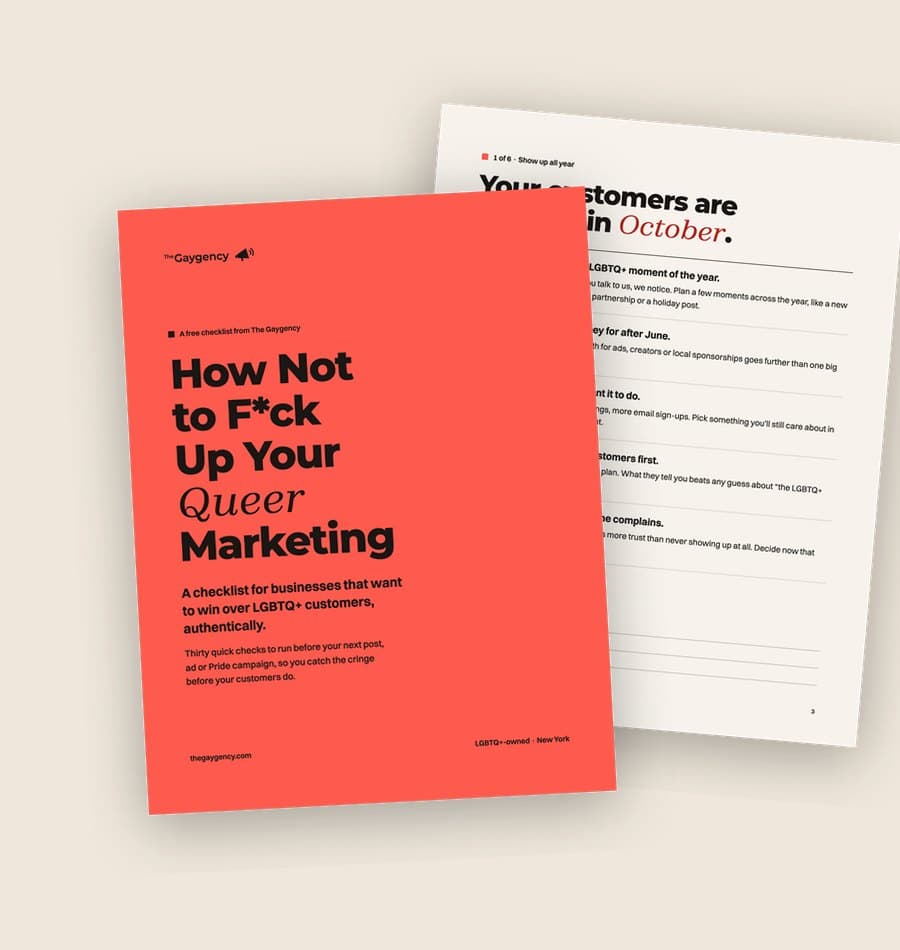
How not to f*ck up your queer marketing
A checklist for businesses that want to win over LGBTQ+ customers, authentically.
Thirty quick checks to run before your next post, ad or Pride campaign, so you catch the cringe before your customers do.
Delivered by email. No spam, ever.
Written by
The marketing and advertising agency for LGBTQ+ businesses and the brands that back them. Strategy, media buying, and brand systems with published results.
See the work