Founder column
What the 2025 pullback told us
By Daniel Montelongo, Founder · 12-04-25 · 5 min read
I have spent this year watching brands go quiet, and I want to write down what I think before the year closes, because I do not think most of the commentary I have read has named the real thing that happened.
Gravity Research's 2025 Pride Pulse Poll found that 39 percent of the 49 communications executives in Gravity's Corporate Insiders Group said their company planned to scale back its public Pride engagement this year, compared with 9 percent who said in 2024, on a similar question, that they were changing their engagement. That is no modest adjustment: a thirty point jump in twelve months, inside companies large enough to have real legal and communications teams weighing the decision, not a handful of brands improvising under pressure. Something changed in how the math got done, and I do not think the honest answer is that thirty percent of corporate America stopped believing in something it believed in last year.
The belief was never the load-bearing part
The pullback did not expose a change of heart. It exposed which brands never had a year-round relationship holding the June campaign up in the first place.
I built this studio on a specific bet: that a brand's Pride marketing is only as real as what it does in the other eleven months. This year tested that bet in public, at scale, and I think it held up. The brands scaling back this year were, almost without exception, the ones whose Pride presence was a June line item and nothing else: no LGBTQ+-owned vendor relationships, no policy commitments a pulled ad budget does not touch, no creative partnerships that outlast a news cycle. When the political weather got less certain, those brands had nothing underneath the campaign to justify keeping it running, because the campaign was the whole relationship.
I watched this show up concretely at NYC Pride, where Garnier, Mastercard, Skyy Vodka, and Target were named among the Platinum-level sponsors that withdrew or scaled back their support this year, part of a pullback that left the event with a reported $750,000 shortfall. Some of those exits came with an explanation. Most did not. WorldPride in Washington, D.C. saw the same pattern this year: a sponsor list that included brands with nothing public to say about their own participation, which is its own kind of message. Silence from a sponsor a community expected to hear from reads as a decision, whether or not the brand intended it as one.
I do not think every brand that pulled back this year deserves the same read. A few put out a plain statement: budgets got harder to defend internally this year, and they said so instead of vanishing without comment. I respect that more than I respect silence, even though the outcome for this year's sponsorship total looks the same either way. A brand willing to name the reason it is stepping back is at least treating the relationship as one worth explaining itself to. A brand that just stops showing up is treating the community as an audience it never owed an explanation to in the first place, and I think that distinction will matter more in a year or two than the raw sponsorship numbers do right now.
Why I did not treat this as bad news for the industry
None of this discouraged me, and I want to be specific about why. A market correcting toward honesty is not a market collapsing. For years, a brand could buy a rainbow logo's worth of goodwill in June at a steep discount to what real, sustained community investment would have cost. That price was always going to move once the political cost of visibility went up. What this year did was make the discount disappear for brands that were only ever paying the June price. It did not touch the brands that were already paying the real price, because their commitment was never priced at whatever gets us through Pride month without incident.
A binder full of one-year sponsorships is not the same asset as a relationship.
I think that is the part getting missed in a lot of the coverage I have read this year. The story is not brands abandoned the LGBTQ+ community. The story is brands that were never truly committed stopped pretending to be, at the exact moment pretending got expensive. That is information, not a tragedy. It tells this community, and it tells us as an agency, exactly which brands were building something real and which ones were renting a season.
What I am telling clients right now
Every client on our roster asked some version of the same question this year: should we be doing less, given what everyone else is doing? My answer has stayed the same all year. The brands pulling back are not competition for this community's attention. They were never real competition, because they were never in the relationship to begin with. A brand that keeps showing up now, honestly and specifically, is not swimming against a tide. It is standing in a room that just got a lot less crowded, in front of an audience that is going to remember exactly who was still there.
I do not know yet how much of this pullback reverses next year, and I am not going to guess at it here. What I do know is that the test was never how loud a brand was this month. It is whether what it built holds up in the months nobody is measuring it. That is the only version of this work I have ever been interested in building for clients, and it is the version I intend to keep building regardless of what the rest of the year looks like for anyone else.
If you want to build something that does not depend on the political weather holding steady, our brand strategy work starts with exactly that question, and if you want to talk through where your own commitment stands, book a call.
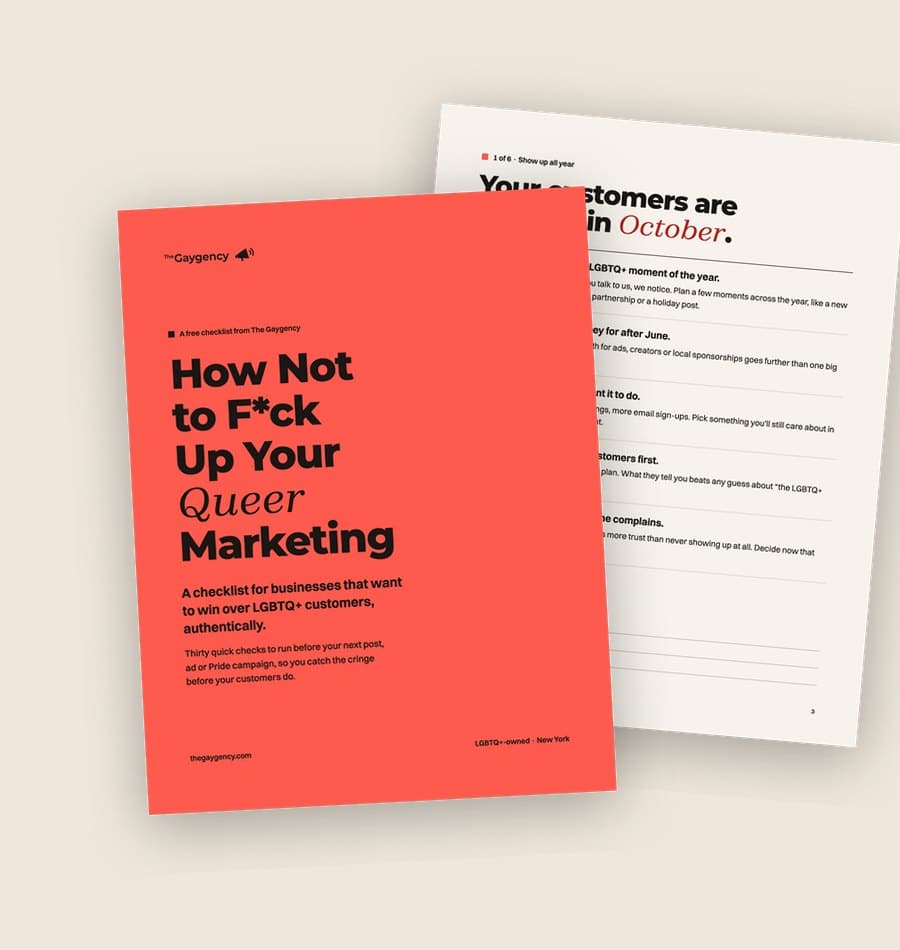
Free checklist
How not to f*ck up your queer marketing
A checklist for businesses that want to win over LGBTQ+ customers, authentically.
Thirty quick checks to run before your next post, ad or Pride campaign, so you catch the cringe before your customers do.
Delivered by email. No spam, ever.
Written by
Daniel Montelongo
Founder of The Gaygency and Gaydar. Ten years leading campaigns at Apple, Dentsu, and Ann Inc. before building the studio, where he leads every engagement.
About Daniel