Email & SMS
Email Marketing That Converts Without Spamming Your List
By The Gaygency · 06-25-26 · 9 min read

Email produces a higher return than any other digital channel, and it is not close. Litmus's State of Email research puts the average return at $36 for every dollar spent, with retail and e-commerce brands seeing returns as high as $45 (Litmus, State of Email research). Paid social returns $2 to $5 on the same dollar by comparison. That gap has held for years because email is where purchase decisions get finished, in the one inbox the algorithm does not own.
Most businesses squander the channel the same way: treat the list like a megaphone, send the same message to everyone as often as possible, and watch unsubscribes climb until the list is dead weight. This guide is the alternative: how to build a list worth owning, the welcome flow that does the selling, the three segments that hold most of the value, and the technical setup Google and Yahoo now require before your mail even reaches the inbox.
Why email beats paid, structurally
Three reasons the economics tilt this hard:
You own the relationship. When Meta raises CPMs or Apple rewrites privacy rules, your list does not care. Every paid channel is rented land with a landlord who changes the terms annually. The list is the one asset that survives every platform shift, which is why we build email and SMS programs as owned infrastructure, not campaigns.
The audience raised its hand. Everyone on the list chose to be there. That intent signal outperforms any behavioral targeting a platform can model, because it is a request, not a prediction.
The economics compound. A subscriber acquired two years ago costs nothing to reach today. Email is one of the only channels where acquisition cost falls over time, and it is what turns a paid budget into a permanent asset: our Nasty Pig program banked 20,000 subscribers in its first year, an owned channel that shrinks the paid bill every month it exists. Adam's Nest added 5,000 email and SMS subscribers as part of a program that grew year-over-year revenue 60%, and that list sells for a Provincetown shop in February, when the sidewalk does not.
Paid media rents the audience. The list is the one you get to keep.
Building a list worth having
The goal is not a big list. It is a relevant one. Five thousand people who want what you sell outperform fifty thousand who vaguely remember a popup.
Make the capture offer specific. "Get our newsletter" converts poorly on cold traffic because it asks for something and offers nothing in return. A specific offer, a checklist, a calculator, a template, a sizing guide, converts several times higher on the same traffic. The offer needs a before and after. Specificity is the entire difference, on email captures and on the landing pages that host them.
Put capture where intent already is. Homepage, top posts, and product pages, matched to context. A denim sizing guide on a denim page will outperform a generic popup everywhere, and it is the same principle we apply for local and boutique retailers under retail and local businesses.
Use the checkout. For e-commerce, the opt-in checkbox at checkout is routinely the highest-quality capture on the site. These are buyers, not browsers, and the flows built for them return the most per send.
Never buy a list. Purchased lists wreck sender reputation, violate CAN-SPAM and GDPR, and convert near zero. Inbox providers score your domain on how recipients treat your mail, and strangers treat it like what it is.
A welcome flow is five decisions in a row. Map it on paper before building it in software.
Three segments handle most of the value
Segmentation sounds like enterprise software and is mostly three buckets:
New subscribers. Joined in the last 30 days, have not bought. They get the welcome flow below, and nothing else interrupts it.
Customers. They get product value, cross-sell, and loyalty content. Sending "why you should buy" pitches to people who already bought is how brands train buyers to ignore them.
Lapsed. No opens in 90 to 180 days. They get one re-engagement sequence, then removal. Mailing the unresponsive is not persistence, it is deliverability damage: inbox providers read engagement rates, and dead weight drags every future send toward spam.
The welcome flow that does the selling
The welcome flow is the highest-revenue automation you will ever build, because it fires when attention peaks. GetResponse's benchmark data puts the average welcome email open rate at 83.6%, the highest of any email type, and automated emails as a category generate a disproportionate share of revenue: about 41% of total email revenue from roughly 5% of total sends, according to Klaviyo's 2026 benchmark analysis of more than 183,000 brands (GetResponse email marketing benchmarks; Klaviyo email benchmark report, 2026). Five emails do most of that work:
Day 0: deliver the promise. Whatever they signed up for, send it immediately, in a short email. Deliver, thank, and say what is coming next. This email gets your highest open rate ever recorded. Do not waste it on throat-clearing.
Day 2: the problem, in their words. Describe the problem you solve and why the usual fixes disappoint. No pitch. You are proving you understand their situation better than the competitors do.
Day 3 or 4: proof with numbers. One or two customer stories with specifics. "Sarah cut invoicing from 8 hours a week to 45 minutes" outsells any adjective. Soft call to action.
Day 7: the offer. A direct, specific invitation: buy, book, start. A time-limited incentive if your margins allow it. Make the ask plainly. Subtlety at this stage is just noise.
Day 9 or 10: the objection. Whatever stops people at the line for your product: price, complexity, timing, trust. Name it, answer it honestly, ask again.
Welcome flow benchmarks worth holding
- Email 1 open rate: above 60%, and closer to GetResponse's 83.6% welcome email benchmark if the capture promise and the email match exactly (GetResponse email marketing benchmarks).
- Flow revenue: automated flows generate close to 41% of total email revenue from about 5% of sends, so an underbuilt welcome flow is leaving the most valuable part of the channel unused (Klaviyo email benchmark report, 2026).
- Timing: the flow finishes inside 10 days. Attention decays faster than most send calendars admit.
Staying out of spam
Excellent copy still lands in spam when the technical floor is missing, and the floor moved in 2024. Starting in February of that year, Google and Yahoo began requiring any sender pushing more than 5,000 emails a day to authenticate every message with both SPF and DKIM, publish a DMARC record, keep spam complaint rates under 0.3%, and support one-click unsubscribe (Google and Yahoo bulk sender requirements, effective February 2024). That is not a best practice anymore. It is the price of admission to two of the largest inboxes in the world.
Authenticate: SPF, DKIM, and DMARC. All three DNS records, configured once, in about 30 minutes with your email platform's instructions. Without them you are not being filtered, you are being refused.
Keep the list clean. Honor unsubscribes instantly, drop hard bounces after one failure, and run the lapsed segment process above on schedule. List hygiene is not administration. It is the sender reputation you send with, and it is what keeps your spam complaint rate under the 0.3% ceiling Google and Yahoo now enforce.
Hold a human frequency. One to two sends a week is the ceiling for most general lists. Daily works only for content people invited daily. When in doubt, start weekly and earn upward.
Write subject lines like a person. No all-caps, no exclamation stacking, no "FREE GUARANTEED LIMITED TIME." Accurate and interesting beats clever and flagged, every send.
Deliverability is not a technical detail. It is whether the channel exists.
The numbers that tell you the truth
| Metric | Strong | Average | Needs attention |
|---|---|---|---|
| Campaign open rate | Above 45% | 25% to 35% | Below 20% |
| Campaign click rate | Above 3.4% | 1.7% to 3% | Below 1% |
| Automated flow open rate | Above 60% | 40% to 60% | Below 30% |
| Unsubscribe rate | Below 0.1% | 0.1% to 0.3% | Above 0.3% |
Email program health benchmarks, based on Klaviyo's 2026 analysis of more than 183,000 brands
High unsubscribes mean too much frequency, wrong content, or a signup promise the sends do not keep. Low opens mean deliverability trouble, weak subject lines, or a list gone cold. Fix the sick metric before scaling volume; more email to an unhealthy list compounds the illness, not the revenue.
For a seasonal retailer, the list is the location that never closes.
Email rewards the boring virtues: a specific offer, a clean list, a welcome flow that respects attention, and DNS records nobody will ever see. Do those four things and the channel pays out for years.
Frequently asked questions
What is a good email open rate in 2026?
Campaign open rates in the 25% to 35% range are typical, with strong programs clearing 45%. Automated flows run much higher, averaging above 40% and often above 60% for a well-built welcome sequence, based on Klaviyo's 2026 analysis of more than 183,000 brands (Klaviyo email benchmark report, 2026).
How many emails should a welcome flow have?
Five works for most businesses: deliver the promise on day 0, name the problem on day 2, show proof around day 3 or 4, make the offer on day 7, and answer the main objection around day 9 or 10. The flow should finish inside 10 days, before the attention that triggered the signup decays.
Why is my email going to spam?
Usually a missing or misconfigured SPF, DKIM, or DMARC record, a spam complaint rate above 0.3%, or a list full of unengaged addresses dragging down your sender reputation. Since February 2024, Google and Yahoo enforce all of this directly for any sender pushing more than 5,000 emails a day (Google and Yahoo bulk sender requirements, 2024).
Do I need SPF, DKIM, and DMARC for a small list?
Every sender benefits from all three, and Google and Yahoo require basic authentication from every sender regardless of volume. The stricter requirements, including a published DMARC policy, apply once you cross roughly 5,000 emails a day, but setting it up early costs about 30 minutes and prevents a painful deliverability fix later.
What is a good click-through rate for email?
A campaign click rate above 3% is strong, 1.7% to 3% is average, and under 1% signals a problem with either the offer or the audience. Automated flows should click meaningfully higher than campaigns, since they reach people at the exact moment they took an action that made the message relevant.
If you would rather hand it to a team that builds these programs for a living, that is work we do for e-commerce brands and founders at every stage. Book a call and bring your current open and click rates. We will tell you which of the four boring virtues above is missing.
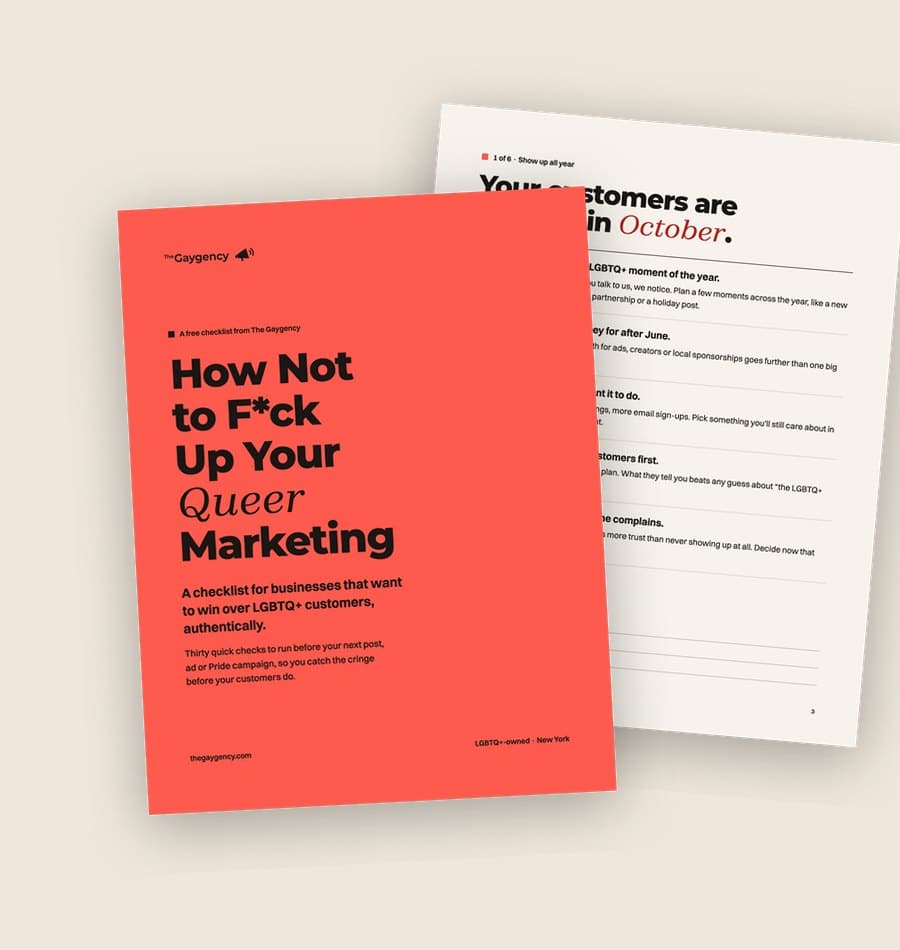
Free checklist
How not to f*ck up your queer marketing
A checklist for businesses that want to win over LGBTQ+ customers, authentically.
Thirty quick checks to run before your next post, ad or Pride campaign, so you catch the cringe before your customers do.
Delivered by email. No spam, ever.
Written by
The marketing and advertising agency for LGBTQ+ businesses and the brands that back them. Strategy, media buying, and brand systems with published results.
See the work