Definitions
Pink Money Explained: The $1.4 Trillion LGBTQ+ Market
By The Gaygency · 09-10-26 · 7 min read

Pink money, also called the pink dollar, is the collective spending power of LGBTQ+ consumers: an estimated $1.4 trillion a year in the United States. Brands gain or lose their share of it based on how consistently they show up. Our glossary tracks this term alongside more than a thousand others in LGBTQ+ culture and marketing.
A $1.4 trillion figure for the United States appears in LGBT Capital's market research, which put US LGBTQ+ purchasing power at $1.4 trillion and global purchasing power at $4.7 trillion in its 2023 estimate, a modeled figure built from data at the end of 2022 (LGBT Capital, 2023). The HRC Foundation's 2026 Pride in the Marketplace report, a different study, gives more than $1.4 trillion in the United States and more than $3.9 trillion worldwide (HRC Foundation, 2026). The number gets repeated often enough that it can start to sound abstract, a talking point instead of a real market. It is not abstract. The demand it describes already exists, distributed across every category a person spends money in: groceries, travel, financial services, healthcare, retail, entertainment. The people generating it are not a niche audience waiting to be discovered. They are already customers of every brand reading this, whether or not those brands have done anything to earn the loyalty that comes with being seen.
Where the term comes from
"Pink dollar" predates "pink money" by decades, coined originally to describe the disposable income of gay consumers, mostly gay men, in the 1980s and 1990s, back when marketers assumed the LGBTQ+ market meant urban, affluent, childless gay men with above-average discretionary spending. That assumption was always incomplete. It excluded lesbian, bisexual, and transgender consumers, ignored income disparities within the community, and mistook a visible early-adopter segment for the whole market.
The term persisted because the underlying idea, that a historically overlooked consumer group represents real and measurable purchasing power, was directionally correct even when the early data behind it was thin. Modern usage of pink money describes the full LGBTQ+ consumer market, not a narrow slice of it, and modern research on it is considerably more rigorous than the estimates that first popularized the term.
Pink money was never a niche budget line. It was demand that already existed before anyone measured it honestly.
Modern estimates count every category a person spends in, groceries and healthcare included, not the narrow slice the 1980s term implied.
Why the number keeps moving
The $1.4 trillion figure is not fixed, and it will not stay at $1.4 trillion. Two forces move it in the same direction. First, the population identifying as LGBTQ+ keeps growing across generations: Gallup's 2024 data, released in 2025, puts overall US adult identification at 9.3%, rising to 23.1% among Gen Z specifically, compared with 1.8% of adults born before 1946 (Gallup, 2024 data). Each birth cohort identifies at a higher rate than the one before it, which means the buying population's share of the total economy grows through generational replacement alone, independent of any cultural shift. Second, LGBTQ+-owned businesses, a related but distinct economic figure, are compounding on their own: NGLCC says about 1.4 million LGBT-owned businesses generate over $1.7 trillion in economic impact, with close to 450 corporate partners now recognizing NGLCC's Certified LGBTBE program (NGLCC website, accessed 2026).
None of this means every brand automatically captures a proportional share as the number rises. It means the cost of getting this market wrong keeps rising too.
Pink money in one paragraph Pink money is the estimated $1.4 trillion in annual U.S. spending power LGBTQ+ consumers hold (LGBT Capital, 2023; HRC Foundation, 2026). It is active, mobile spending rather than a fixed niche budget: it shifts toward brands seen as consistently supportive and away from brands seen as retreating, which is why the term now describes a loyalty dynamic as much as a market size.
The affluence myth the term can obscure
The original pink dollar concept carried an assumption that has aged badly: that LGBTQ+ consumers, as a group, are more affluent than the general population, with more disposable income to chase. Some parts of the community do show above-average discretionary spending in specific categories, and marketers correctly noticed that decades ago. But treating "the LGBTQ+ market" as uniformly affluent misreads most of the actual market, and the gap matters for anyone building a strategy around this number.
The Williams Institute at UCLA School of Law found that only 25% of lesbian, bisexual, and queer women have household incomes above $75,000, compared with 33% of heterosexual women and 40% of heterosexual men, and that 48% of LBQ women live in households below 200% of the federal poverty line (Williams Institute, March 2021). Separately, an HRC Foundation analysis of the 2021 LGBTQ+ Community Survey found that women in the LGBTQ+ community earned about 87 cents for every dollar the typical full-time US worker earned, with sharper gaps for Black and Latine LGBTQ+ women specifically (HRC Foundation, 2021 LGBTQ+ Community Survey).
None of this shrinks the $1.4 trillion figure. It explains why the figure is not evenly distributed, and why a strategy built entirely around an affluent, childless, high-disposable-income archetype leaves most of this market's actual spending untouched. A campaign or an offer built for one narrow slice of the community, priced and pitched as though it applies to all of it, will underperform against a market this large and this internally varied.
Only a quarter of lesbian, bisexual, and queer women report household incomes above $75,000, a gap the affluent-archetype strategy never accounts for.
The part most explanations leave out: loyalty, not size
The size of the number gets repeated constantly. What gets left out more often is that this spending is not loyal by default, and it is actively moving right now. Research from the HRC Foundation found that 71.5% of LGBTQ+ consumers report buying less from brands they perceive as retreating from previous support, while 69.5% report increasing spending with brands they see as genuinely supportive (HRC Foundation, Pride in the Marketplace 2026). That is not two abstract percentages. It is millions of individual purchase decisions happening in real time, in response to what a brand does or does not do, and it is large enough to show up in the quarterly results of national retailers.
This is the piece that separates a brand chasing pink money correctly from one treating it as a seasonal talking point. No brand claims the $1.4 trillion once a year in June. It is reallocated continuously, and the brands earning a growing share of it are the ones showing up with the same posture in November as they did in Pride month.
The $1.4 trillion is not a static prize. It is a moving balance, and the brands winning share of it right now are the ones that stayed consistent while others went quiet.
What this means for how a brand should approach it
Chasing pink money as a slogan produces the kind of surface-level campaign that gets called out for it. Treating it as what it is, an existing, growing, mobile consumer market, changes the questions a brand should be asking. Does the brand strategy genuinely account for this audience, or does it bolt a Pride campaign onto a positioning built for someone else? Does the paid media plan reach this audience with any precision, given that the platforms themselves removed most of the interest-based targeting that used to make this easy? Is the spend consistent across the calendar, or does it spike every June and vanish every July?
Enterprise brand teams sitting on established consumer bases, and businesses at any stage trying to reach this market for the first time, both run into the same mistake: treating the $1.4 trillion as a number to reference in a deck rather than a market to build a real strategy around. The number is real. The market behind it responds to specifics, not to being told it is valuable.
Frequently asked questions
Is pink money the same thing as pinkwashing?
No. Pink money describes the market and its spending power. Pinkwashing describes a specific corporate behavior: using LGBTQ+ imagery or support to improve a public image without real commitment behind it. A brand can pursue pink money honestly or exploit it through pinkwashing. The term itself is neutral.
Where does the $1.4 trillion figure come from?
It traces to LGBT Capital's market research on LGBTQ+ purchasing power, which estimates $1.4 trillion in annual US spending power and $4.7 trillion globally (LGBT Capital, 2023). HRC Foundation's 2026 report is a separate study that gives the same $1.4 trillion for the United States and more than $3.9 trillion worldwide (HRC Foundation, 2026), so name the source with each figure and do not pair one study's U.S. number with the other's global number.
Is pink money only about gay men?
No, and that is one of the most common misreadings of the term. The modern figure represents the full LGBTQ+ consumer market: lesbian, gay, bisexual, transgender, and queer consumers across every income level and life stage, not the narrow, affluent gay-male segment the term originally implied.
Does the $1.4 trillion figure account for LGBTQ+-owned business revenue too?
No, those are separate figures. The $1.4 trillion describes LGBTQ+ consumer spending. NGLCC separately says LGBT business owners generate over $1.7 trillion in economic impact (NGLCC website, accessed 2026), which is a related but distinct number describing business output rather than consumer spend.
How should a brand measure whether it is earning a real share of pink money?
Through the same measurement discipline applied to any other market: tracked revenue, retention, and attribution specific to this audience rather than assuming goodwill from a single seasonal campaign. Closing that gap is what our measurement and analytics work does.
Pink money is not a metaphor and it is not seasonal. It is $1.4 trillion in spending that already exists, already has opinions about which brands earned it, and is already deciding where to go next. Book a call and we will map what earning a real share of it looks like for your category.
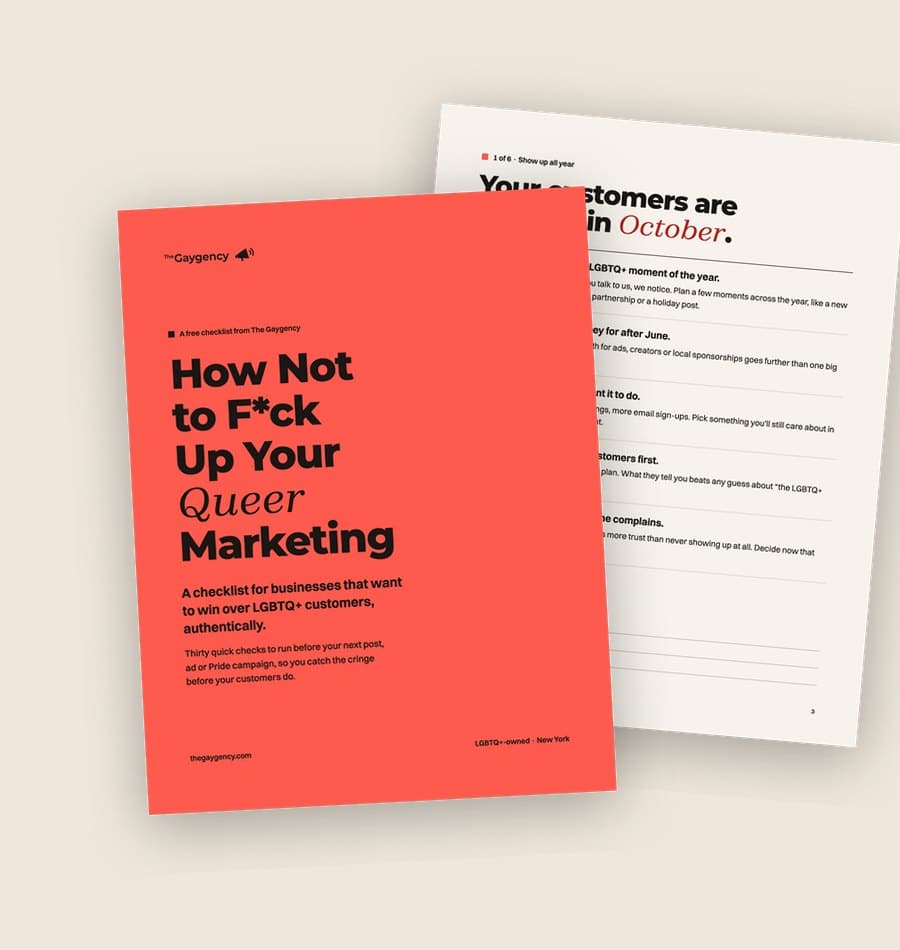
Free checklist
How not to f*ck up your queer marketing
A checklist for businesses that want to win over LGBTQ+ customers, authentically.
Thirty quick checks to run before your next post, ad or Pride campaign, so you catch the cringe before your customers do.
Delivered by email. No spam, ever.
Written by
The marketing and advertising agency for LGBTQ+ businesses and the brands that back them. Strategy, media buying, and brand systems with published results.
See the work