Agency selection
How to choose an LGBTQ+ marketing agency: 15 questions
By The Gaygency · 07-30-26 · 7 min read
The LGBTQ+ marketing agency category has gotten crowded, and a lot of what filled it is shallow. Most brands doing this work do not use a specialist at all. The Association of National Advertisers found that 64% of brands doing LGBTQ+ marketing do not use a specialized agency, and among the brands that do use one, 75% choose an agency that is certified LGBT-owned (Association of National Advertisers, LGBTQ+ Marketing Inclusion Report, 2021). That gap is the whole story. The demand for specialist support exists. Most agencies claiming to fill it have not done the work to prove they can.
This is the list we would want if we were the one hiring. Fifteen questions, in plain language, with what a real answer sounds like. Ask all fifteen before you sign anything.
"LGBTQ+-owned" is a claim. A certification is a claim somebody else checked.
Certification and ownership
1. Is the agency certified, and by whom?
A certification means a third party checked the ownership claim against a documented standard, instead of taking a website footer's word for it. The National LGBT Chamber of Commerce (NGLCC) certifies LGBT Business Enterprises against ownership, control, and operation criteria, the same category most Fortune 500 supplier-diversity programs recognize. Ask for the certificate number and the certifying body's name. (For reference, The Gaygency has held NGLCC LGBTBE certification since it was founded in 2022.)
2. Who is on the team, specifically?
An agency selling LGBTQ+ marketing expertise should be able to describe who does the daily work, not only who owns the company. Ask how the account team is staffed and whether the people writing your copy and running your media have lived experience with the community you are trying to reach. One founder photo on an About page is not a team.
3. What happens to your accounts if the relationship ends?
Ask this before you sign, not after a bad quarter. Confirm in writing whether you will own the ad accounts, the analytics properties, the pixel data, and the creative files from day one, or whether any of it stays inside the agency's own accounts. An agency that hesitates on this question is answering it.
Team, data, and reach
4. What is their reach into LGBTQ+ audiences right now?
Platform targeting for this audience is not what it used to be. Meta removed the ability to target ads by LGBTQ+ interest categories in 2022, and eliminated detailed-targeting exclusions altogether in March 2025. An agency still pitching precision targeting the way platforms offered it five years ago either has not kept up or is hoping you have not. Ask what they use instead: first-party data, contextual placement, creator partnerships, or endemic media.
5. Do they have first-party data, and how was it sourced?
If an agency claims a proprietary audience dataset, ask three things: how large it is, how it was collected, and how it is secured. A dataset assembled from scraped public profiles is a liability. A dataset built from verified, consented, hashed records is an asset. The Gaygency's own dataset covers more than 1 million verified LGBTQ+ consumers, held in a secured hash and offered as an optional add-on to paid media, not a mandatory upsell.
A dataset built from consented, hashed records is an asset, and one assembled from scraped profiles is a liability the client inherits.
6. Do they have real relationships with LGBTQ+ press and creators?
There is a difference between an agency with a media list and an agency with relationships. Ask for two or three journalists or creators they have placed earned coverage with in the last year, by name. A vague answer usually means the relationships are vague too.
Proof it works
7. Can they show real client numbers?
Case studies with adjectives are marketing language. Case studies with numbers are proof. Ask for return on ad spend, cost per lead, revenue tracked, or conversion lift, tied to a named client whenever the client allows it. An agency with real results publishes them. An agency without them talks about brand awareness instead.
Case studies with adjectives are marketing language. Case studies with numbers are proof.
8. What did they consider a win, and who decided that?
Before you look at a single number, find out what the campaign was trying to move. A launch that hit its impression goal and missed its revenue goal gets written up as a success anyway more often than it should.
9. How do they measure success, and can you see it yourself?
Ask whether reporting is a monthly document the agency assembles, or a live dashboard tied to your own revenue and lead data that you can open on your own schedule. The difference tells you whether the agency wants to be checked or wants to be trusted on faith.
How they handle pressure
10. How have they advised a client through a backlash moment?
This is no longer hypothetical. Gravity Research's 2025 Pride Pulse Poll found that 39% of large companies planned to reduce their public Pride engagement (Gravity Research, 2025), and the HRC Foundation's Pride in the Marketplace 2026 report found that 71.5% of LGBTQ+ consumers buy less from brands they see as retreating, while 69.5% increase spending with brands that stay visibly supportive (HRC Foundation, 2026). An agency worth hiring has a point of view on staying present without inviting risk you are not prepared for, and can describe a real client decision where that judgment mattered. See how that calibration works for CMOs and brand teams.
Consumers now punish retreat more than presence, which makes an agency's backlash judgment a revenue question rather than a communications one.
11. Will they push you to be louder than you want to be?
Advocacy and strategy are different services. Ask directly whether the agency's default posture is maximum visibility regardless of your risk tolerance, or a plan calibrated to where you are. Either can be right for the right client. The wrong sign is an agency that has never considered the difference.
Contracts, ownership, and reporting
12. What is the actual contract structure?
Project fee, monthly retainer, or a hybrid of both. Find out the minimum commitment, the notice period to pause or cancel, and whether pricing changes automatically or only by agreement. Vague answers here usually predict vague invoices later.
13. Do they understand your industry, or only the LGBTQ+ angle?
LGBTQ+ marketing expertise without industry context is half a specialist. A healthcare brand needs an agency that respects clinical claims and patient privacy. A hospitality brand needs one that understands booking windows. Ask for examples in your category specifically, not examples that merely happen to be LGBTQ+-facing.
14. What happens when the engagement ends?
Ask about the offboarding process before you need one. A professional agency has a documented handoff: credentials transferred, files delivered, a closing report, a clean exit. If nobody can describe that process, assume it does not exist yet.
15. What do their references say when you are not in the room?
Ask for two or three former or current clients you can call directly, and ask the plainest question there is: would you hire them again. A messaging framework can make any agency sound credible in a pitch deck. A reference call is where you find out whether the work behind it was real.
The pattern underneath all fifteen
Every one of these questions is asking the same thing from a different angle: is this a specialist practice, or a generalist agency with one LGBTQ+ campaign in the portfolio. Most agencies will tell you the truth if you ask plainly enough. The ones that dodge are answering too.
If it helps to check this against a specific agency instead of an abstract standard, The Gaygency was founded in 2022 in New York, is NGLCC-certified, and has tracked more than $15 million in client revenue since opening. None of that replaces asking the fifteen questions yourself. It means we expect to be asked them.
Print this list before your first agency call. Fifteen questions take about twenty minutes to ask, and the answers will tell you more than any pitch deck.
Frequently asked questions
Is a certified LGBT-owned agency always the right choice?
Certification confirms the agency meets a documented ownership and control standard. It does not by itself confirm the team, the data, or the case studies fit your business. Treat certification as one of the fifteen questions, not a substitute for the other fourteen.
How much should an LGBTQ+ marketing agency cost?
Pricing varies too much by scope, market, and engagement type for a single figure to be useful. What matters more at the diligence stage is contract structure: project versus retainer, minimum commitment, and what triggers a price change.
Can a generalist agency do LGBTQ+ marketing well with the right briefing?
Sometimes, especially for a single campaign with clear guardrails. What a generalist agency typically cannot supply is standing data, media relationships, and pattern recognition built from other engagements in the space, the parts of a specialist's advantage that only show up over time.
What is the biggest mistake brands make when hiring in this category?
Treating the search like hiring for a logo instead of hiring a strategic partner. The fifteen questions above are weighted toward data, proof, and structure because those are the parts that determine whether year two looks better than year one.
Should we run a formal RFP, or just talk to a few agencies directly?
Either can work. What matters is asking the same fifteen questions of every agency in the process, in the same order, so the answers can be compared. An RFP that lets each agency define its own terms produces answers that cannot be lined up against each other.
Want to hear how the answers sound in person? Book a call and ask us the fifteen questions directly.
Agency, company, firm, or studio: does the label matter?
Not really, and it is worth saying plainly because the words get used interchangeably. People search for an LGBTQ+ marketing company, an LGBTQ+ marketing agency, a queer advertising firm, and a gay marketing studio, and they usually mean the same thing: a team that plans and runs marketing aimed at this community.
What separates them is the list of questions above, not the noun on the homepage. A one-person consultancy calling itself an agency and a forty-person company calling itself a studio will still differ on the things that matter: whether LGBTQ+ people are on the team doing the work, whether the media plan survives the loss of interest-based targeting, and whether anyone will show you what happened after a campaign ran.
The Gaygency is an LGBTQ+ marketing company and advertising agency based in New York, NGLCC-certified as an LGBT Business Enterprise. If you are comparing us against others on this list of questions, that is exactly the right way to do it.
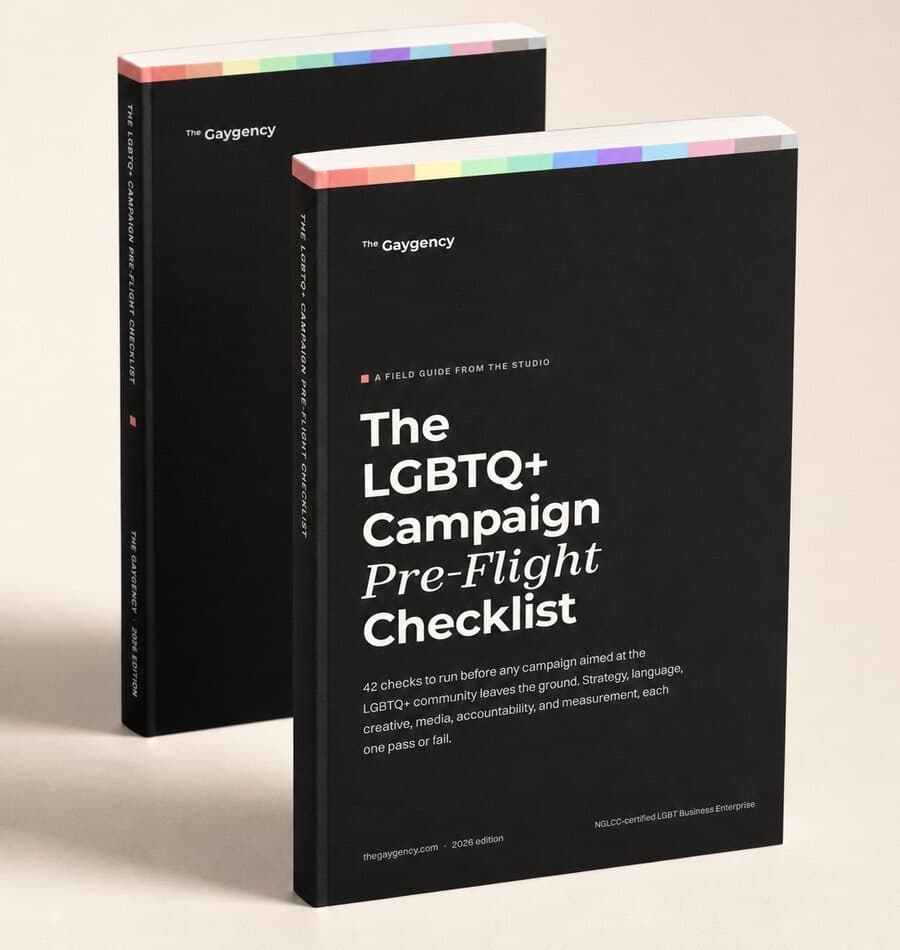
Free campaign guide
Would your campaign pass pre-flight?
The same 42 checks we run inside the studio before any campaign aimed at the LGBTQ+ community goes live.
Delivered by email. No spam, ever.
Written by
The marketing and advertising agency for LGBTQ+ businesses and the brands that back them. Strategy, media buying, and brand systems with published results.
See the work