Agency vs. In-House
LGBTQ+ Marketing Agency vs. In-House: Which Do You Need?
By The Gaygency · 08-13-26 · 7 min read

The question is usually framed as a single choice: hire in-house, or hire an agency. In practice, almost no business makes that choice once and keeps it forever. A five-person startup, a fifty-person company with a marketing coordinator already on staff, and a public company with a full internal team are answering three different questions, and the right answer changes as the business grows. Here is the actual math behind each option, and a framework for knowing which one fits where you are now.
What an in-house hire costs
A single marketing manager has a median salary of $161,030 a year, according to the U.S. Bureau of Labor Statistics' Occupational Outlook Handbook, using May 2024 wage data. A marketing specialist or coordinator role, the BLS category covering market research analysts and marketing specialists, has a median of $76,950. A graphic designer adds a median of $61,300. None of those figures include payroll tax, benefits, software licenses, or the media budget itself, which typically add another 25 to 40 percent on top of salary. A single senior in-house hire, before spending a dollar on ads, usually costs more than the annual retainer for a specialist agency team covering strategy, creative, and media together.
What a specialist agency brings that a generalist does not
The ANA's LGBTQ+ Marketing Inclusion Report found that 64 percent of brands doing LGBTQ+ marketing do not use a specialized agency at all (ANA, 2021). Of the 36 percent that do, 75 percent choose a certified LGBT-owned shop over a generalist one. That gap is the opportunity most companies are leaving on the table: a specialist agency arrives already fluent in the audience, the media, the cultural calendar, and the specific ways generic campaigns misfire with this market, instead of learning it on your budget over the first two quarters.
The question nobody asks early enough
Most companies compare in-house and agency costs on a monthly basis and stop there. The more useful comparison is opportunity cost over a full year: what is a plateaued account worth if it stays flat for four more quarters versus what a specialist retainer costs to potentially fix it. A business generating meaningful revenue that has been flat for two years is not choosing between a $76,950 coordinator and an agency retainer in the abstract. It is choosing between another flat year and whatever growth a properly staffed effort, in either model, could produce. Frame the decision around the cost of inaction rather than the invoice alone, and the math usually looks different than it does on a first pass.
What in-house wins at
None of this means in-house is the wrong answer. An internal hire lives inside the product, sits in on customer calls, and can turn around a same-day response that an outside partner working across several accounts cannot always match. If your business needs someone answering support tickets, managing the same three social channels daily, and attending every internal meeting, that is a role, not a project, and an agency retainer is the wrong shape for it. The honest comparison is not "which is better." It is "which job is this, and who is built to do it."
The ramp-up gap most comparisons skip
A new in-house hire, however strong, spends the first stretch of the job learning your product, your customers, and, if LGBTQ+ marketing is new territory for the company, the audience itself: the platforms this audience uses safely, the creative patterns that read as authentic instead of performative, and the cultural calendar beyond Pride month. A specialist agency skips that ramp-up entirely, because the audience fluency already exists before the first meeting. That gap is invisible on an org chart and a spreadsheet, and it is exactly where most of the "the agency was faster than we expected" feedback we hear from new clients comes from: the team does not work longer hours; there is just no first quarter spent learning the basics on your budget.
Ownership and contract terms
Whichever model you choose, the accounts, the audience data, and the creative files should belong to the business, not to whoever built them. This matters more with agencies than with employees, since an employee's work product is already yours by default. Before signing with any agency, confirm in writing that you retain the ad accounts, the pixel and conversion data, and every creative asset if the relationship ends. An agency that resists putting that in writing is telling you something about how it plans to keep you as a client.
If leaving an agency requires losing your own ad accounts and audience data, that was never a partnership. It was a lease.
A framework by stage
If you are a solo founder or early-stage business, the math rarely supports a full-time senior hire yet. A brand strategy foundation built once, paired with a lean specialist partnership for the one or two channels that matter most, gets more done per dollar than a junior in-house hire figuring it out alone. Our startup work is built around exactly this stage.
If you have real revenue and a plateau, you likely already have someone in-house managing the day-to-day, and the gap is usually strategy: nobody re-planning the account past the first quarter, and nobody accountable for a number instead of a task list. A campaign strategy partnership layered on top of your existing team, rather than replacing it, is what our established-business work is built to solve.
If you are an enterprise brand team, the calculation shifts again. You likely have both budget and headcount, and the gap is specialist depth: LGBTQ+ audience data, risk calibration, and a partner who can sit alongside your agency of record instead of replacing it. Our enterprise work exists for this exact structure.
The hybrid model most companies land on
Companies rarely stay purely in-house or purely agency-run once they pass a certain size. The pattern that shows up most often, across our own client base and the wider market, is an in-house lead who owns the relationship, the brand voice, and the daily channels, paired with a specialist agency running the audience strategy, the media buying, and the measurement infrastructure that would otherwise take a full internal team to build and maintain. That combination gets the institutional memory of in-house and the audience depth of a specialist, without asking one hire to be both.
Certification is one filter worth applying if you go the specialist route. Of the roughly 34 to 36 percent of brands in the ANA's own recent survey years that do use a specialized agency, three in four chose one certified as LGBT-owned rather than a generalist agency claiming the expertise. The National LGBT Chamber of Commerce has certified more than 2,000 LGBT Business Enterprises to date, so the option to hire a certified specialist exists at meaningfully more scale today than it did even five years ago. Certification is not a guarantee of quality on its own, but it is a verifiable credential you can check before you sign, in the same way you would check any vendor's references.
Before you decide, ask three questions: Is the work a daily job or a quarterly project? Does anyone on staff already understand this specific audience, or would a new hire spend their first two quarters learning it? And if you hired in-house today, what would you stop doing to make room for the salary, benefits, and tools that hire requires?
Frequently asked questions
Is it cheaper to hire in-house or an agency?
It depends on the job. A single in-house marketing manager has a median salary of $161,030 before benefits, per BLS data, which by itself often exceeds a specialist agency's annual retainer. A full in-house team covering strategy, creative, media, and analytics costs meaningfully more than either option alone.
When should a business hire an LGBTQ+ marketing agency?
When the work requires audience fluency your team does not already have, when you need a campaign or system built rather than daily maintenance, or when your current results have plateaued and nobody internally is accountable for re-planning the strategy past the first quarter.
Can an in-house marketer do LGBTQ+ marketing well?
Yes, if they have the training, the data, and the time to build that expertise. The ANA's 2021 research found most brands doing LGBTQ+ marketing still do not use a specialist, which means most in-house teams are learning this audience without a dedicated partner, a gap a specialist retainer closes quickly.
What does a specialist LGBTQ+ marketing agency do differently?
A specialist agency starts with cultural and audience fluency a generalist has to build from zero: the calendar, the platforms where this audience is safest to reach, the creative patterns that read as authentic versus performative, and, where available, first-party data built specifically for this market.
What should you ask an LGBTQ+ marketing agency before hiring one?
Ask whether the agency is certified LGBT-owned, ask for specific client results with numbers attached rather than vague case studies, ask who owns your ad accounts and data if the relationship ends, and ask how they measure a campaign's success six months later, not only at launch.
Ready to figure out which model fits your business today. Book a call and we will map it against your stage, not a template.
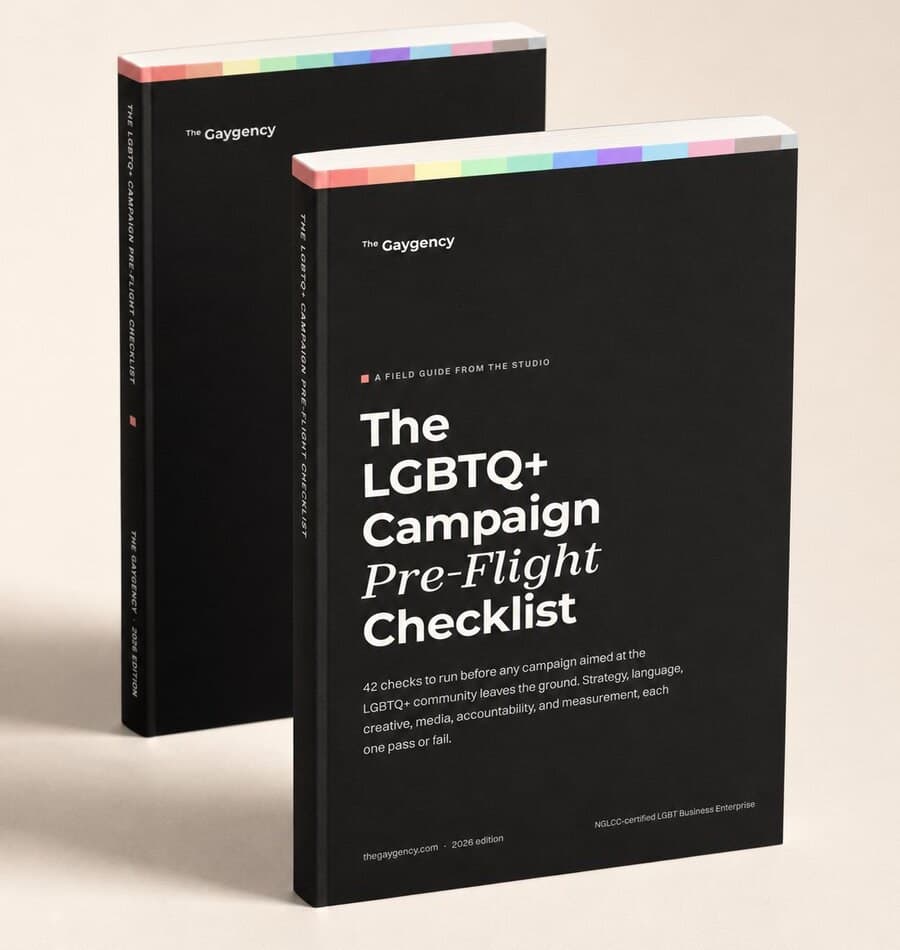
Free campaign guide
Would your campaign pass pre-flight?
The same 42 checks we run inside the studio before any campaign aimed at the LGBTQ+ community goes live.
Delivered by email. No spam, ever.
Written by
The marketing and advertising agency for LGBTQ+ businesses and the brands that back them. Strategy, media buying, and brand systems with published results.
See the work