Trend report
Who Is Winning the LGBTQ+ Wallet in 2026
By The Gaygency · 07-16-26 · 7 min read
LGBTQ+ consumers hold more than $1.4 trillion in annual U.S. spending power (HRC Foundation, 2026), and in 2026 a clear majority of that spending is moving based on a single question: did this company stay present, or did it retreat. The HRC Foundation's Pride in the Marketplace 2026 report found that 71.5% of LGBTQ+ consumers report buying less from companies they perceive as reducing inclusion commitments, while roughly 70% report increasing spending with companies they view as genuinely supportive (HRC Foundation, 2026). This is the majority of a trillion-dollar consumer bloc actively reallocating its spending in real time, not a small, symbolic shift, and the data names the specific companies on both sides.
The companies losing ground
CNBC's reporting on the HRC Foundation survey named Target, Walmart, and Amazon as the companies most frequently cited by LGBTQ+ consumers who said they reduced their spending (CNBC, June 2026). All three share a pattern worth naming plainly: each built a visible, years-long public association with LGBTQ+ and broader DEI commitments, then scaled some portion of that commitment back publicly enough that customers noticed and named the company specifically in a national survey.
That is the mechanism to understand here. The consumers penalizing these companies are not people who never supported them. Many are former customers who built a specific expectation based on years of visible commitment, and who experienced the pullback as a broken promise rather than a neutral business decision. A company that never made the promise in the first place is in a different, less exposed position than one that made it loudly and then walked it back.
LGBTQ+ consumers are not punishing companies for staying quiet from the start. They are punishing companies for changing their mind in public.
The companies gaining ground
The same CNBC report named Costco, Apple, and Kroger as the companies most frequently cited by consumers who said they increased their spending (CNBC, June 2026). None of these three ran the loudest LGBTQ+ marketing campaigns of the last decade. What they share instead is consistency: no highly publicized reversal, no visible retreat under pressure, and in Costco's specific case, public statements defending its diversity commitments when shareholder pressure to abandon them became a news story.
That distinction matters for any brand trying to plan its own posture. Winning this shift in loyalty does not appear to require the loudest campaign. It appears to require the absence of a visible, public U-turn. A steady, unremarkable consistency is outperforming both aggressive visibility and quiet retreat.
The data rewards the most consistent supporter, not the loudest. A modest commitment maintained without interruption is currently outperforming a large commitment that gets walked back under pressure.
Why this is happening now
Three things are compounding at once. First, the audience itself keeps growing: 9.3% of U.S. adults identify as LGBTQ+ in Gallup's 2024 data, and that figure rises to 23.1% among Gen Z specifically (Gallup, 2024 data), which means the buying power behind this behavior is younger and growing every year, not shrinking. Second, corporate visibility on LGBTQ+ issues has become genuinely harder to sustain, with Fortune 500 participation in HRC's Corporate Equality Index falling 65% in a single year, from 377 companies in 2025 to 131 in 2026 (HRC Foundation, 2026; CNBC, February 2026), which means more companies are making a visible retreat decision at the same time, giving consumers more contrast to react to. Third, information about which companies did what travels faster and further than it used to, largely through the same queer and mainstream press covering this beat closely through 2026.
Put together, this is a market response to a genuinely new level of transparency about corporate behavior, not a temporary news cycle, and it is running into an audience with enough scale and enough growth to make that response financially material.
What this means if you are deciding your posture right now
If you have never made a loud public commitment, you are not automatically penalized for staying quiet. The data shows consumers punishing visible retreat specifically, not the absence of a campaign. A company with no history here can build one carefully, starting small, without inheriting the reputational risk of a company walking back an old promise.
If you have made public commitments in the past, consistency now matters more than scale. A modest, sustained level of support is safer and more rewarded than a large commitment you cannot guarantee you will maintain through the next round of political or shareholder pressure. Decide what you can commit to for years, not one quarter, before you commit to anything publicly.
Measure this like the business decision it is, not like a communications question. If your company is losing or gaining share based on perceived DEI posture, that belongs in the same revenue conversation as pricing or product. Our measurement and analytics work is built to connect brand and reputation signals to actual revenue movement, not sentiment alone.
If your growth has stalled and you suspect this dynamic is part of why, treat it as a strategy problem, not a messaging problem. Established businesses facing this exact tension, wanting to keep community trust while reaching a broader market, are exactly who for established brands is built for.
If you are a corporate brand team weighing real political exposure against real spending power, this is not a decision to make in a single meeting. For enterprise walks through the evidence-first, risk-calibrated approach we use with brand teams facing this exact tradeoff.
If your business already serves this audience directly and depends on its loyalty, this data is your retention argument internally. Fashion, retail, and e-commerce brands built around a loyal LGBTQ+ customer base should treat consistency as a growth lever, not only a values statement. See fashion and e-commerce for how we approach that category.
The audience that is reallocating $1.4 trillion in spending power is also the fastest-growing generational cohort in the country. This is not a wallet that shrinks if you wait it out.
The specialist gap behind the shift
Most companies going through this shift are doing it without specialized help. The ANA's LGBTQ+ Marketing Inclusion Survey found that 64% of brands doing LGBTQ+ marketing do not use a specialized agency at all, and among the ones that do, 75% chose a certified LGBT-owned shop (ANA, LGBTQ+ Marketing Inclusion Survey). That gap shows up directly in the buycott data: companies making high-stakes, public decisions about DEI posture without anyone in the room who understands how this specific audience reads those decisions are more likely to end up in the "companies losing ground" column above, not because their instincts were malicious, but because nobody on the team had the specific expertise to see the reversal the way a customer would.
We built The Gaygency in 2022 to close exactly this gap. We are an NGLCC-certified LGBT Business Enterprise based in New York, we have generated more than $15 million in tracked client revenue since founding, and we hold a proprietary, securely hashed dataset of more than one million verified LGBTQ+ consumers that we use to answer questions like this one with actual numbers instead of guesses.
Frequently asked questions
How much LGBTQ+ spending is shifting between brands, in real terms?
The HRC Foundation's 2026 survey found 71.5% of LGBTQ+ consumers reducing spending with companies seen as retreating from inclusion, and about 70% increasing spending with companies seen as supportive, out of a consumer bloc with more than $1.4 trillion in annual spending power (HRC Foundation, 2026).
Which companies are losing LGBTQ+ customers in 2026?
Target, Walmart, and Amazon were the companies most frequently named by consumers who said they reduced spending, according to CNBC's reporting on the HRC Foundation's 2026 survey (CNBC, June 2026).
Which companies are gaining LGBTQ+ customers in 2026?
Costco, Apple, and Kroger were the companies most frequently named by consumers who said they increased spending with the same survey (CNBC, June 2026).
Is this shift permanent, or a short-term reaction?
It is too early to call it permanent, but the underlying driver, a growing LGBTQ+ population with rising spending power and more visibility into corporate behavior, is structural rather than a single news cycle (Gallup, 2025; HRC Foundation, 2026).
Do we need a large, visible campaign to benefit from this shift?
No. The data suggests consistency at a sustainable scale outperforms a large commitment that later gets reversed. A smaller, dependable commitment comes with less risk and appears to earn comparable loyalty.
If you want to know where your specific customer base sits in this shift, book a call and we will walk through what our verified LGBTQ+ consumer dataset shows for your category.
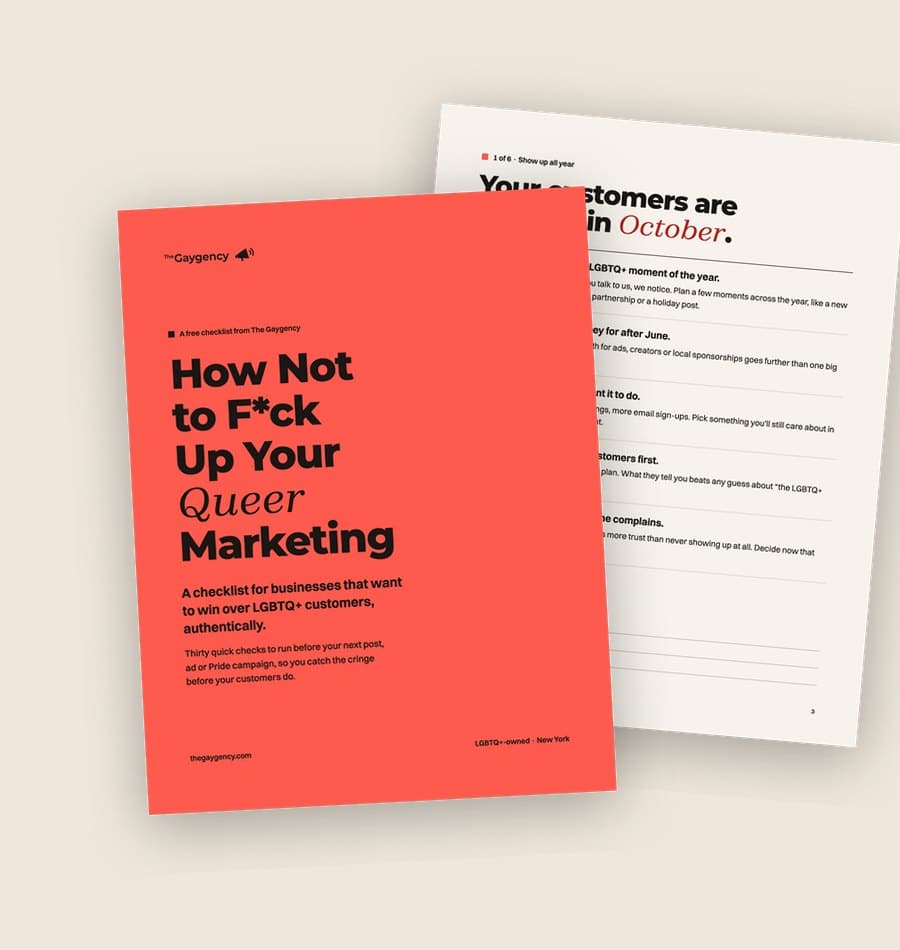
Free checklist
How not to f*ck up your queer marketing
A checklist for businesses that want to win over LGBTQ+ customers, authentically.
Thirty quick checks to run before your next post, ad or Pride campaign, so you catch the cringe before your customers do.
Delivered by email. No spam, ever.
Written by
The marketing and advertising agency for LGBTQ+ businesses and the brands that back them. Strategy, media buying, and brand systems with published results.
See the work