Trend report
The State of Pride Sponsorship 2026
By The Gaygency · 07-14-26 · 7 min read
Pride organizers across the country are entering their second consecutive year of corporate funding shortfalls, and the gaps are large enough to threaten programming itself. Heritage of Pride, the nonprofit behind NYC Pride, entered the 2025 season facing a corporate sponsorship shortfall of roughly $750,000 after several past sponsors withdrew or scaled back (Scripps News, June 2025). San Francisco Pride reported a $200,000 gap after corporate donors dropped out (Scripps News, June 2025). St. Louis Pride said it was more than $150,000 short of a prior-year budget of about $480,000 (NBC News, 2025). Tampa Pride then announced a full one-year hiatus for 2026, citing funding cuts, lost sponsorships, and the end of local DEI programs (Fox 13 News, September 2025).
None of this is new, but it runs deeper than most marketers assume. Here is what the data shows, and what it means for anyone deciding how, or whether, to sponsor Pride this year.
How we got here
The pullback did not start this year. Gravity Research's Pride Pulse Poll, which surveys communications and public affairs executives at Fortune 1000 and equivalent companies, found in early 2025 that 39% of the 49 executives it polled said their company planned to reduce Pride-related engagement that year, citing pressure from the Trump administration's DEI policies and concern about conservative backlash (Gravity Research, 2025). That was the first year the pullback showed up as a broad, measurable trend rather than a handful of headline exits.
The pattern held into 2026 and widened. The Human Rights Campaign Foundation's 2026 Corporate Equality Index, the annual benchmark of corporate LGBTQ+ policy, found Fortune 500 participation fell 65% in a single year: from 377 companies submitting information in 2025 to just 131 in 2026 (HRC Foundation, 2026; CNBC, February 2026). Companies have gone quieter about Pride sponsorship, and many have stopped participating in the index that used to track their commitment at all.
That said, the picture is not simple abandonment. The same reporting period that produced these funding gaps also produced, per NYC Pride's own media director, "a promising rebound in the number of partners returning to Pride parades" even as total sponsorship dollars lagged (Campaign, 2026). Fewer companies are giving at the largest sponsorship tiers, but the number of companies participating at some level is not collapsing uniformly. The money is more concentrated in fewer, smaller gifts.
Who is still funding, and how
The clearest shift of the past two seasons is not who left. It is how the companies that stayed chose to show up. The Capital Pride Alliance, which organized WorldPride D.C. in 2025, reported that a group of former sponsors, including Comcast/Xfinity, Booz Allen Hamilton, Mastercard, Deloitte, Visa, and Amtrak, did not participate publicly that year, while other sponsors continued funding as unrecognized, silent partners: money without a logo, a booth, or a press mention (BizBash, 2025).
That is the pattern our enterprise clients ask us about most: not "should we sponsor," but "how visible should our sponsorship be." A silent sponsorship still funds the organization and still shows up in the budget as support, just without the public exposure of a branded activation. For a brand team weighing genuine political risk against a real commitment to the community, that middle option is often the right call, not a compromise to be embarrassed about.
Fewer companies are funding Pride at the top sponsorship tier. That does not mean fewer companies are funding Pride. Some of them just stopped putting their name on it.
What the funding gap means for organizers and brands
For Pride organizers, the immediate problem is operational: security costs, permits, staging, and artist fees do not shrink because sponsorship dollars did. Organizations like Tampa Pride, faced with an unclosable gap, are choosing hiatus over a diminished event (Fox 13 News, September 2025). Others, like NYC Pride, are scaling their 2026 budgets down in anticipation of continued reduced corporate giving, rather than betting on a rebound (Marketing Brew, 2026).
For brands, the calculus has changed in a way that favors the ones willing to stay. As fewer companies compete for visible sponsorship placement, the marginal value of showing up consistently goes up. A brand that sponsors the same local Pride event every year, at a modest and sustainable level, now stands out more than it did five years ago, when dozens of companies competed for the same float space. Consistency is cheaper to maintain than it is to fake, and it reads as more credible precisely because so many companies have stopped showing up at all.
That credibility question connects directly to consumer behavior. The HRC Foundation's Pride in the Marketplace 2026 report found that 71.5% of LGBTQ+ consumers report buying less from companies they see as retreating from inclusion commitments, while about 70% report increasing spending with companies they view as genuinely supportive (HRC Foundation, 2026). Pride sponsorship is one of the most visible, most legible signals consumers use to sort companies into those two categories. Pulling out is not a neutral, low-risk choice. It is a visible signal too.
A defensible Pride sponsorship in 2026 has three characteristics: it is proportionate to your actual risk tolerance and budget, it is consistent with what you do the rest of the year, and it does not disappear the moment a competitor's sponsorship does. Inconsistency is what reads as opportunism, not the size of the check.
How to decide your posture this year
Start with what you already do, not what looks good this month. If your company has no year-round record on LGBTQ+ inclusion, a large branded Pride sponsorship this year will read as new and possibly opportunistic. A smaller, well-matched sponsorship tied to existing community work reads as credible.
Decide your visibility tier deliberately, in advance. Internal-only support, community-level sponsorship with modest visibility, and mainstream-facing sponsorship each come with a different risk and a different payoff. Choosing one under pressure, after a reporter calls, is how companies end up making decisions they regret. A brand team that wants a structured way to make this call before the pressure arrives should look at for enterprise, where we walk through exactly this kind of calibrated framework.
Measure what the sponsorship is for. A sponsorship aimed at community trust and long-term brand equity should be measured differently than a sponsorship aimed at short-term acquisition. Confusing the two goals is a common reason sponsorship budgets get cut the following year: nobody can show what it did. Our measurement and analytics work exists partly to solve this exact problem before the budget conversation happens again.
If you are a business that serves this community directly, treat local sponsorship as part of your growth plan, not a separate line item. Bars, event venues, and nightlife businesses in particular depend on the same community goodwill that Pride sponsorship builds. See bars, nightlife, and events for how we think about that category specifically.
If you are a founder-led business without the budget for a formal sponsorship, show up in smaller, sustainable ways instead. A modest, repeated presence beats a one-time gesture you cannot afford to repeat. For startups covers how we sequence brand-building work for exactly this budget reality.
Showing up the same way every year costs little, and fewer brands bother to do it, which is exactly why it reads as credible now.
Frequently asked questions
Why did corporate Pride sponsorship drop so much in 2026?
Corporate sponsors cited political pressure and DEI policy rollbacks as the primary drivers, a trend that Gravity Research first measured at 39% of the 49 executives Gravity polled saying their company planned to scale back in 2025 (Gravity Research, 2025) and that widened into 2026, based on funding shortfalls reported by NYC Pride, San Francisco Pride, and St. Louis Pride, and a 65% drop in Fortune 500 participation in HRC's Corporate Equality Index (HRC Foundation, 2026).
Is it still worth sponsoring Pride in 2026 if budgets are being cut everywhere?
For most brands with an existing, credible connection to the LGBTQ+ community, yes. As fewer companies sponsor visibly, consistent sponsors stand out more, and consumer data shows LGBTQ+ shoppers actively reward brands they see as staying present (HRC Foundation, 2026).
What does a "silent sponsor" mean in Pride marketing?
A company that funds a Pride organization or event without public branding, a booth, or press recognition attached to the gift. The Capital Pride Alliance reported this pattern from several sponsors during the 2025 WorldPride D.C. events (BizBash, 2025).
Which Pride organizations were hit hardest by funding cuts in 2026?
NYC Pride's organizer Heritage of Pride, San Francisco Pride, and St. Louis Pride all reported significant shortfalls during the 2025 season, and Tampa Pride announced a full hiatus of its 2026 events (Scripps News, June 2025; NBC News, 2025; Fox 13 News, September 2025).
How should a brand decide how visible its Pride sponsorship should be?
By setting a deliberate visibility tier in advance, based on actual risk tolerance and existing year-round commitment, rather than reacting to pressure in the moment. This is the exact planning process we walk enterprise clients through at for enterprise.
If your team is deciding what Pride sponsorship, or any visible LGBTQ+ commitment, should look like this year, book a call and we will help you build a posture you can defend in January as easily as in June.
Free checklist
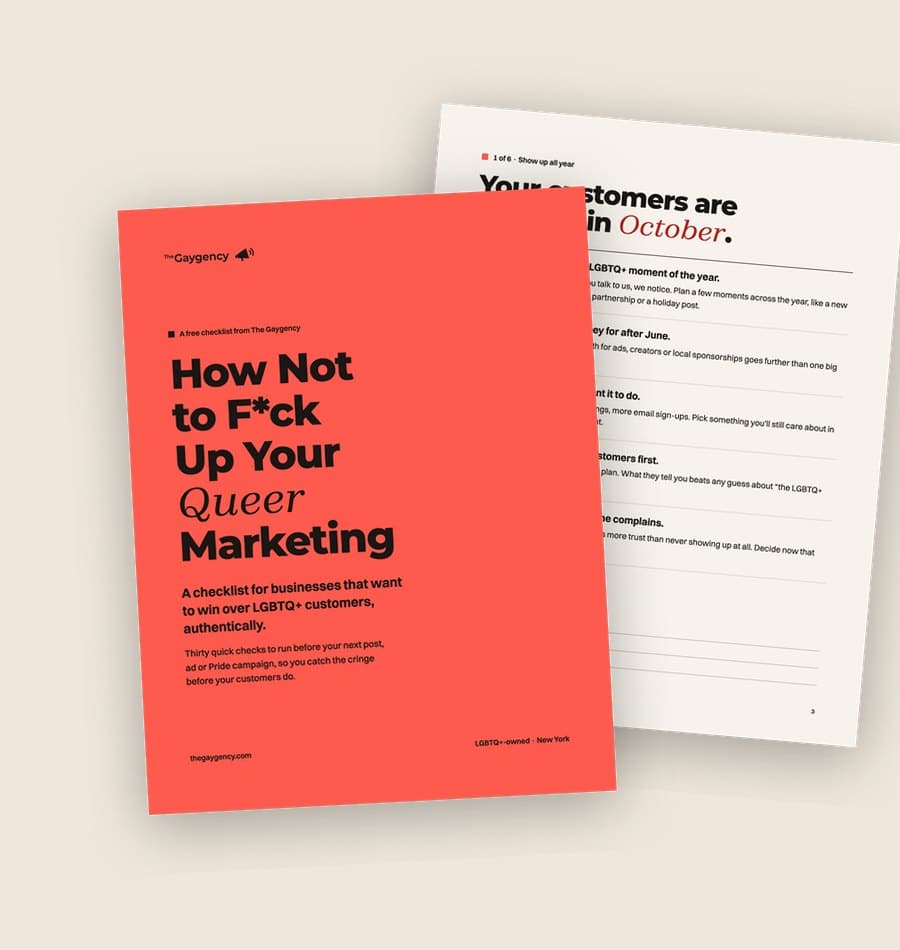
How not to f*ck up your queer marketing
A checklist for businesses that want to win over LGBTQ+ customers, authentically.
Thirty quick checks to run before your next post, ad or Pride campaign, so you catch the cringe before your customers do.
Delivered by email. No spam, ever.
Written by
The marketing and advertising agency for LGBTQ+ businesses and the brands that back them. Strategy, media buying, and brand systems with published results.
See the work