Email Marketing
How to Build an LGBTQ+ Email List That Converts
By The Gaygency · 08-27-26 · 7 min read

Most email list-building advice assumes the same thing about every subscriber: that getting on the list carries no risk beyond an inbox getting a little fuller. For a meaningful share of an LGBTQ+ audience, that assumption is wrong. A subscriber who is not out at work, not out to family, or living somewhere that is not safe to be visibly queer is making a real calculation before they hand over an email address: who else might see this, what will the subject line say, and what happens if the wrong person opens their inbox at the wrong moment.
That is not a reason to avoid email as a channel. It is a reason to build the list differently than a generic playbook would. Nasty Pig added 20,000 email subscribers in a single year working with us, and Ric Sena Presents grew opt-in by 20% once the capture strategy accounted for how this specific audience behaves. The tactics that get there are not exotic. They are the standard list-building fundamentals, built with one additional constraint in mind: does this respect what it might cost someone to be on this list.
A subscriber who is not out yet is not a smaller opportunity. They are a person doing real risk math before they hand over an email address.
Start with the risk generic advice ignores
Before building a single capture form, decide how the brand handles the fact that some subscribers are not fully out. That means: does the sender name and subject line reveal anything about the list's subject matter to someone glancing at a notification on a locked screen or a shared family device? Does the unsubscribe process require a public action, like commenting or replying, that could out someone accidentally? Is there a way for a subscriber to control how visible the brand's identity is in their inbox? None of this requires a complicated system. It requires deciding on these answers before the first campaign sends, not after a subscriber flags a problem.
Build lead magnets around real value, not a discount alone
A 10% off code has some pull, but it's rarely enough reason for someone weighing privacy risk to hand over an email address. The stronger lead magnets in this space trade on things a discount cannot: early access to a community event, a resource that solves a real problem, a first look at a drop or a collection, or access to a private community space. Oasis added more than 300 email subscribers in the first 72 hours of a launch built around exactly this kind of access, not a coupon. The value exchange has to be worth the calculation a subscriber is already running in their head.
The signup only happens when the value on offer outweighs the privacy calculation the subscriber is already running.
Design capture points that do not require outing anyone
A pop-up that asks "are you part of the LGBTQ+ community?" before someone can subscribe forces a public-feeling answer to a private question, often in a browser window someone else could glance at. Capture points work better when they ask about interest or intent rather than identity: what someone wants to hear about, not who someone is. A landing page built around a specific offer or piece of content, rather than a general "join our community" ask, does this naturally, because the signup is about the thing being offered, not a declaration of identity.
Give subscribers a way to control how the email shows up
Where the platform allows it, letting subscribers choose a preferred sender name or opt into a lower-visibility version of the newsletter is a small build with outsized trust value. This matters most for organizations working in health, community support, or anything where a family member or coworker seeing the subject line could create real harm. It is a level of care that a generic email platform default will not offer on its own, and it is worth the extra setup time for any list where discretion is part of the actual product.
Segment by declared behavior, not assumed identity
Once someone is on the list, segment by what they have told the brand, through clicks, purchases, and stated preferences, not by an identity the brand is guessing at from a name or a purchase category. This produces better targeting anyway: a subscriber who clicks on travel content should get more travel content, regardless of any assumption about who they are. It also avoids the specific failure mode of a brand assuming an identity about a subscriber that is wrong, which reads as invasive even when the guess happens to be accurate.
The best segmentation in this space is built on what someone told the brand, never on what the brand assumed about them.
Segmenting on clicks and purchases produces better targeting than guessing at identity, and it never asks a subscriber to out themselves.
The welcome series sets the tone for everything after it
The first email a new subscriber gets sets the expectation for every one that follows. State plainly what they signed up for, how often they will hear from the brand, and how to adjust or leave at any time without friction. For a subscriber weighing privacy concerns, a clear, low-pressure welcome series signals that the brand understands the stakes. A welcome series that immediately floods the inbox with unrelated campaigns signals the opposite, and the unsubscribe rate will show it within the first week.
Growth channels that work for this audience
Beyond the website popup, the channels that grow a list fastest for this audience tend to be relationship-driven rather than purely transactional. Creator partnerships with people the audience already trusts convert better than cold ads, because the endorsement brings context a stranger's ad cannot. Community events, whether in-person or online, are natural list-building moments when the value exchange, event updates, early access to future dates, is obvious and welcome. A referral program that rewards an existing subscriber for bringing in someone they trust also tends to outperform paid acquisition here, since trust is doing work that an algorithm cannot replace, particularly now that Meta has removed the interest-based targeting categories that used to make this audience easier to reach with cold paid traffic.
Measure by revenue, not opens
Open rates have gotten less reliable as a metric across the industry, and they were never the number that paid the bills. Track list growth and campaign performance against revenue per send and lifetime value per subscriber, not vanity engagement numbers. A smaller, well-segmented list that converts consistently is worth more than a large one built on lead magnets nobody wanted in the first place.
Before the next capture form goes live
- Does the sender name or subject line reveal anything a subscriber would not want visible on a locked screen?
- Is the lead magnet worth the privacy calculation a subscriber is making?
- Can someone unsubscribe without taking a public action?
- Is segmentation based on what a subscriber told the brand, or an assumption about who they are?
This discipline matters most for organizations whose whole relationship with their audience depends on trust being handled carefully. Nonprofits and community organizations building supporter lists on small teams and borrowed hours often get this right by necessity, since a donor list is already a trust relationship before it is a marketing channel. The same care scales up to any brand serious about this audience.
Frequently asked questions
Does SMS carry the same privacy considerations as email?
More, in some cases, since a text message notification is often visible on a lock screen without anyone opening the phone. Any SMS program aimed at this audience needs consent, quiet hours, and message content handled with the same discretion as email, if not more.
Is it worth asking subscribers directly how they want to be addressed or referred to?
Yes, where it is relevant to the content, such as a welcome flow for a community-focused brand. Asking once, with an easy way to update the answer later, respects the subscriber more than guessing or defaulting to generic language throughout every send.
How big should a list be before segmentation is worth the effort?
Segmentation pays off earlier than most people expect. Even a list in the low thousands benefits from splitting by declared interest or purchase behavior, since the alternative is sending the same message to people with different reasons for being on the list.
What is a realistic timeline for meaningful list growth?
It depends on the lead magnet and the traffic behind it, but a well-built capture strategy paired with real promotion, rather than a passive popup alone, can show meaningful growth within the first few months. Nasty Pig's 20,000 subscribers came over a full year of sustained work, not a single campaign.
Should the brand ever ask subscribers to confirm their identity for targeting purposes?
No. Asking a subscriber to declare an identity for marketing segmentation purposes creates exactly the risk this guide is built to avoid, and it is unnecessary. Behavior-based segmentation gets to better targeting without ever requiring that disclosure.
A list built with this much care converts because the people on it trust how it was built. Book a call and we will build a capture and segmentation strategy around your audience, not a generic template.
Free checklist
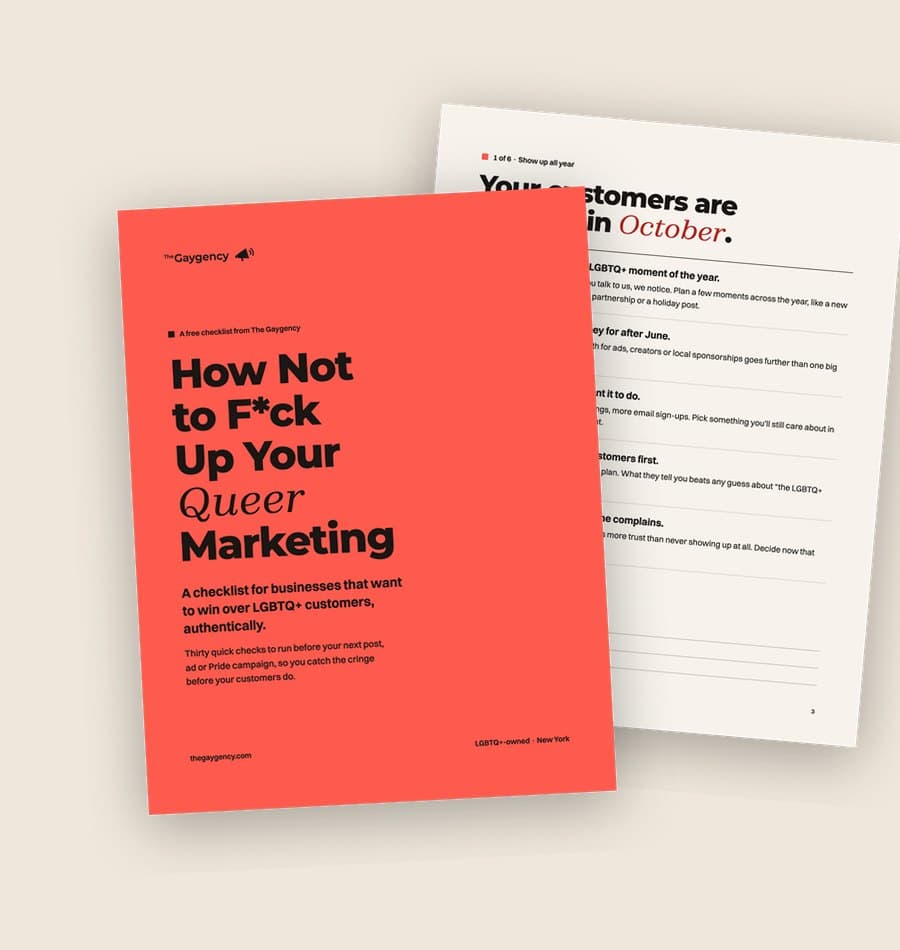
How not to f*ck up your queer marketing
A checklist for businesses that want to win over LGBTQ+ customers, authentically.
Thirty quick checks to run before your next post, ad or Pride campaign, so you catch the cringe before your customers do.
Delivered by email. No spam, ever.
Written by
The marketing and advertising agency for LGBTQ+ businesses and the brands that back them. Strategy, media buying, and brand systems with published results.
See the work