Healthcare Marketing
LGBTQ+ Marketing for Healthcare Brands
By The Gaygency · 08-17-26 · 7 min read

LGBTQ+ patients do not distrust healthcare marketing in the abstract. They distrust it because of documented experience. KFF's Survey on Racism, Discrimination, and Health, fielded June through August 2023, found that LGBT adults are twice as likely as non-LGBT adults to report being treated unfairly or with disrespect by a doctor or other provider. Sixty percent said they prepare for possible insults or feel they need to be careful about their appearance to be treated fairly during a healthcare visit. Among those who had a recent negative experience, 39 percent said it made them less likely to seek care again, 36 percent switched providers, and 24 percent said their health got worse as a result. A generic stock photo of a rainbow flag in a waiting room does not address any of that history. Healthcare marketing to this audience has to answer a different question than most consumer marketing does: "can we prove you will be safe here," not "will you like us."
Why the population is too large to treat as a footnote
Gallup's 2024 measurement put LGBTQ+ identification among U.S. adults at 9.3 percent, and at 23.1 percent among Gen Z specifically, and Gallup's 2025 update holds the overall figure at 9 percent, with 23 percent of adults under 30.
A patient base that is nearly one in four among Gen Z is not a niche group. It is a large share of who is already walking through the door.
Inside any health system, hospital network, clinic, telehealth platform, or insurance product, that share of the patient base is not a niche group requiring a once-a-year campaign. It is a population large enough that a marketing plan built without it in mind is a plan built against the data on your own patient roster.
What the data says patients look for
HRC's Healthcare Equality Index, now in its 17th edition for 2026, evaluated nearly 2,300 healthcare facilities nationwide, with 741 actively participating in the survey. Of those, 323 facilities earned the top "LGBTQ+ Healthcare Equality Leader" designation and another 343 earned "High Performer" status, meaning close to 90 percent of active participants achieved one of the top two designations. A 2025 longitudinal study using HEI and HCAHPS patient satisfaction data found that hospitals consistently participating in the HEI scored higher on patient satisfaction than those that never participated. The takeaway for a marketing team is direct: point to real standards and documented policy, not imagery alone. A credential a patient can verify does more work than a photo ever will.
The mental health entry point
Behavioral health is where a large share of this audience is already engaging with the healthcare system, which makes it a practical starting point for a broader healthcare marketing plan. KFF's 2023 survey found that 46 percent of LGBT adults reported receiving mental health services in the past three years, roughly double the 22 percent of non-LGBT adults who said the same. At the same time, 46 percent of LGBT adults also said there was a period in the past three years when they thought they needed mental health services but did not get them, more than double the 20 percent of non-LGBT adults reporting the same gap. Those two numbers together describe both an existing relationship with care and an unmet need sitting right next to it: this population is already looking for behavioral health support at a higher rate than the general population, and a meaningful share of that demand is going unmet. A marketing plan for a therapy practice, a telehealth behavioral platform, or a hospital system's behavioral health division that accounts for this pattern is targeting a documented gap, not a hypothetical one. Our therapists and coaches practice sits directly at this intersection.
Community-trusted referral channels
Content and provider-directory placement work better in this category than broad-reach advertising, in part because trusted referral networks already exist and patients use them. The Gay and Lesbian Medical Association, known as GLMA, maintains a provider directory built specifically so LGBTQ+ patients can find clinicians with relevant experience, and organizations like it are the kind of channel healthcare marketers should be building relationships with directly rather than treating as competition for attention. A media plan that includes outreach to these existing trusted networks, alongside paid placement, reaches patients through a channel they already believe, which does more for a healthcare brand's credibility than an impression count ever will.
Why targeting has to change, not only the creative
Meta removed detailed interest targeting based on sexual orientation and LGBTQ+ culture years ago, and continued narrowing targeting options since. That removes the easiest lever most consumer marketers reach for first. For healthcare specifically, that constraint is a feature, not a bug: content and community placement, not interest-based ad targeting, were always the more responsible way to reach patients about sensitive care, since a poorly configured retargeting pixel following someone from a specific clinic's page onto a shared household device creates real privacy risk that has nothing to do with LGBTQ+ identity specifically and everything to do with sound paid social and paid search hygiene. Build the media plan around where patients already look for trustworthy information, provider directories, condition-specific content, and referral partnerships, rather than around identity-based ad targeting that is both increasingly unavailable and, for this category, was never the safest lever to begin with.
What this looks like in practice
We have run this playbook at a smaller scale with BodyFactory Skin Care, a med-spa and wellness client, where six years of consistent growth produced 20 percent year-over-year growth every year, a 4.5x return on ad spend, and a single weekend that generated $250,000 in revenue. Med-spas and wellness clinics sit inside the healthcare experience even when the care is elective, which is why our med-spas and wellness work applies directly here. The same principles extend to mental health providers and therapists, covered in our therapists and coaches practice, where privacy and trust matter just as much as they do in a clinical setting.
For larger health systems and HIPAA-governed organizations, the bar is higher, and so is the need for a partner who has already worked inside it. That is the kind of work our enterprise engagements handle, where discretion, compliance review, and a named team are part of the operating model, not an afterthought bolted onto a generic campaign.
The internal review your marketing team should not skip
Before any healthcare campaign touching LGBTQ+ patients ships, route it through the same people who would review a clinical patient-facing document: compliance, privacy, and, where one exists, a patient advisory or community advisory group. Marketing teams accustomed to running consumer campaigns without that layer of review sometimes treat it as friction. In a category where a documented history of discrimination in care settings is the reason the audience is cautious in the first place, that review is what turns a well-intentioned campaign into one a skeptical patient can trust: the difference between a marketing team saying "we are safe" and a compliance-reviewed, policy-backed campaign showing it.
Before you launch a campaign to LGBTQ+ patients, check four things: does your intake form allow a patient to record their name and pronouns without a legal document, does your provider directory flag which providers have documented LGBTQ+ training, does your retargeting setup avoid exposing a visit to sensitive care on a shared device, and can you name a specific policy or credential in the ad copy instead of only an image.
Frequently asked questions
Why do LGBTQ+ patients avoid health care?
KFF's 2023 survey found that 60 percent of LGBT adults prepare for possible insults or feel they need to be careful about their appearance to be treated fairly during a healthcare visit, and a meaningful share who had a negative experience later avoided or delayed care, switched providers, or said their health got worse as a result.
What is the HRC Healthcare Equality Index?
The Healthcare Equality Index is HRC Foundation's biennial benchmarking survey of U.S. healthcare facilities, now in its 17th edition for 2026. It scores participating facilities on non-discrimination policy, staff training, patient services, and community engagement related to LGBTQ+ patients, visitors, and employees.
How should healthcare brands market to LGBTQ+ patients?
Lead with verifiable policy and credentials rather than imagery alone, make intake and records systems reflect a patient's actual name and pronouns, and build media plans around trustworthy placement and content rather than identity-based ad targeting, which is both increasingly unavailable on major platforms and was never the most responsible lever for sensitive care categories.
Is healthcare marketing to LGBTQ+ audiences regulated differently?
Healthcare marketing overall is subject to HIPAA and general advertising compliance requirements that apply regardless of audience. What changes for LGBTQ+ patients is the practical risk profile: sensitive-care retargeting, shared-device exposure, and intake-form design all matter more for a population with documented experience of discrimination in care settings.
What makes LGBTQ+ patients trust a healthcare brand?
Consistency and verifiability. A named policy, a credential like HRC's Healthcare Equality Index designation, and a track record a patient can check do more to build trust than seasonal messaging, because the underlying concern is safety in the room.
Ready to build a healthcare marketing plan that holds up to scrutiny. Book a call and we will start with your intake process, not your ad copy.
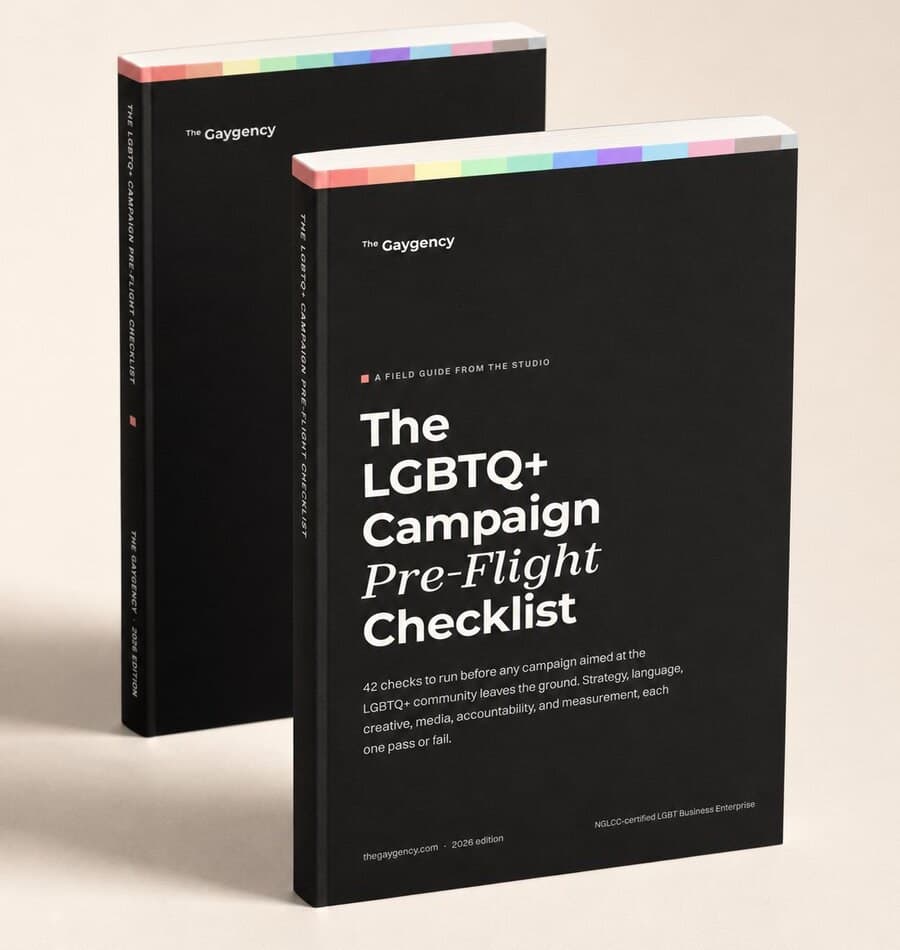
Free campaign guide
Would your campaign pass pre-flight?
The same 42 checks we run inside the studio before any campaign aimed at the LGBTQ+ community goes live.
Delivered by email. No spam, ever.
Written by
The marketing and advertising agency for LGBTQ+ businesses and the brands that back them. Strategy, media buying, and brand systems with published results.
See the work