The stats hub
LGBTQ+ Marketing Statistics 2026
By The Gaygency · 07-12-26 · 8 min read

This page collects the LGBTQ+ marketing and consumer statistics we use when we plan campaigns, organized by theme, with a named source and year on every figure. If a number floating around the industry could not be traced to a primary source, it is not here. We update this page as the underlying research updates, and we keep the URL the same so it stays worth bookmarking.
Population and demographics
9.3% of U.S. adults identify as LGBTQ+. Based on Gallup's 2024 data, released in 2025, up from 7.6% in 2023 (Gallup, 2024 data). Gallup's newer release, using 2025 data, puts the share at 9%.
23.1% of Gen Z adults identify as LGBTQ+. Compared with 14.2% of millennials and 1.8% of adults born before 1946 (Gallup, 2024 data). In Gallup's 2025 data, nearly one in four Gen Z adults identify as something other than heterosexual.
Bisexual identification is the largest single share of the LGBTQ+ population. More than half of LGBTQ+ adults identify as bisexual, representing about 5.3% of all U.S. adults. Of LGBTQ+ adults, 17% are gay, 16% are lesbian and 12% are transgender (Gallup, 2025 data).
The increase is generational, not universal. Each older generation shows a successively lower identification rate, from 23.1% of Gen Z down to under 2% of the oldest Americans surveyed (Gallup, 2024 data). That gradient is the clearest evidence that this population's share of the buying public will keep growing as generational replacement continues.
Gen Z identifies as LGBTQ+ at 23.1%, against 1.8% of adults born before 1946, in Gallup's 2024 data. Each older generation sits lower.
Spending power
LGBTQ+ consumers hold more than $1.4 trillion in annual U.S. spending power. From the HRC Foundation's Pride in the Marketplace 2026 consumer report (HRC Foundation, 2026).
LGBTQ-owned businesses contribute close to $2 trillion to the U.S. economy annually. Figure cited by NGLCC co-founder and CEO Chance Mitchell alongside the organization's 2,000th LGBT Business Enterprise certification, a milestone announced in 2023 (NGLCC, 2023). It is a different, higher figure than the $1.7 trillion below, for the same group of businesses.
LGBTQ-owned businesses generate over $1.7 trillion in economic impact, with the community spending more than $917 billion annually on goods and services. From NGLCC data reported by Forbes (Forbes, 2024). NGLCC's own site still gives $1.7 trillion across about 1.4 million LGBT-owned businesses, and a secondary source dates it to a 2017 NGLCC survey of about 450 businesses, so check the report year before treating it as current.
Buycott and brand loyalty behavior
71.5% of LGBTQ+ consumers say they are buying less from companies perceived as reducing inclusion commitments. From the HRC Foundation's Pride in the Marketplace 2026 report, released June 17, 2026 (HRC Foundation, 2026).
Roughly 70% of LGBTQ+ consumers say they have increased spending with companies they view as genuinely supportive. Same report (HRC Foundation, 2026).
Target, Walmart, and Amazon were the companies most cited by consumers who said they reduced spending. Costco, Apple, and Kroger were the companies most cited by consumers who said they increased spending. Reported by CNBC based on the HRC Foundation survey (CNBC, June 2026).
The buycott is not organized activism. It is millions of individual purchase decisions responding to what companies do, and it is large enough now to move quarterly revenue for national retailers.
Corporate engagement and the Pride pullback
39% of the 49 executives polled said their company planned to reduce Pride-related engagement in 2025. From Gravity Research's 2025 Pride Pulse Poll of communications and public affairs executives at Fortune 1000 and equivalent companies (Gravity Research, 2025).
Fortune 500 participation in HRC's Corporate Equality Index fell 65% in one year. From 377 participating companies in 2025 to 131 in 2026 (HRC Foundation, 2026; CNBC, February 2026).
534 companies earned a perfect score in the 2026 Corporate Equality Index, representing nearly 6 million U.S. employees, out of 1,450 companies that participated in the full index (HRC Foundation, 2026; CNBC, February 2026).
Heritage of Pride, the organizer of NYC Pride, faced a roughly $750,000 corporate sponsorship shortfall for its 2025 season, after several past sponsors withdrew or reduced support (Scripps News, June 2025).
San Francisco Pride faced a $200,000 budget gap in 2025 after corporate donors dropped out (Scripps News, June 2025).
St. Louis Pride reported a 2025 shortfall of more than $150,000 against a prior-year budget of roughly $480,000 (NBC News, 2025).
Tampa Pride announced a one-year hiatus of its 2026 events, citing funding cuts, lost sponsorships, and the end of local DEI programs (Fox 13 News, September 2025).
Several official Pride sponsors chose to fund without public branding rather than withdraw entirely. The Capital Pride Alliance, which organized WorldPride D.C. in 2025, reported that companies including Comcast/Xfinity, Booz Allen Hamilton, Mastercard, Deloitte, Visa, and Amtrak sat out public participation that year, while other sponsors provided funding as unrecognized, silent partners (BizBash, 2025).
Platform and media environment
None of the six major social platforms scored above 56 out of 100 on LGBTQ safety in GLAAD's 2026 index. TikTok led at 56, followed by Instagram (41), Facebook (40), Threads (39), YouTube (30), and X (29) (GLAAD, 2026).
Bluesky grew from 25.9 million to 41.4 million users over 2025, a gain of nearly 60%. From the platform's first full transparency report (Bluesky Transparency Report, 2026).
Meta removed LGBT-interest and sexual-orientation ad targeting categories in 2022, and in March 2025 removed detailed targeting exclusions from ad campaigns entirely, which closed the last precise interest-based path to this audience on the platform (Meta Business Help Center, 2025).
The takeaway for media planners: there is no platform feature left that lets you target this audience by interest with any precision. First-party data, direct community partnerships, and creator relationships now do the job that interest targeting used to do.
Agency and marketing industry behavior
64% of brands doing LGBTQ+ marketing do not use a specialized agency. From the ANA's LGBTQ+ Marketing Inclusion Report (ANA, LGBTQ+ Marketing Inclusion Report, 2021).
Of the brands that do use a specialized agency, 75% chose a certified LGBT-owned shop. Same report (ANA, LGBTQ+ Marketing Inclusion Report, 2021).
Most companies doing this work are not using a specialist. The ones who tried one overwhelmingly stuck with a certified LGBT-owned agency once they did.
Where the research infrastructure stands
Community Marketing & Insights, the 30-year LGBTQ+ consumer research firm, was acquired by the HRC Foundation in late 2025 and rebranded as Community Insights. Its research now appears under the Community Insights name (HRC Foundation / Community Insights, 2025). Check any citation that points to the old communitymarketinginc.com address before relying on it, and look for the same research under the Community Insights name.
How to use this data
For a board deck or investor update: lead with the population trend (9.3% of adults and 23.1% of Gen Z in Gallup's 2024 data; 9% overall in its 2025 data) and the spending figure ($1.4 trillion), then pair it with the buycott data to show the loyalty behind the number can be won or lost.
For a media plan: treat the Meta targeting changes and the platform safety scores as your channel-mix argument. Interest-based targeting is gone and the safety environment is uneven across platforms, which is the case for first-party data and a multi-channel plan rather than a single-platform bet.
For a Pride sponsorship decision: use the corporate pullback figures as a baseline, not a reason to skip the category entirely. A shrinking field of visible sponsors is exactly the condition under which a consistent, present brand stands out.
For an agency selection process: the ANA figures are the plainest argument available. Most brands are not using a specialist, and the ones who tried one mostly stayed with a certified LGBT-owned agency once they compared the results.
Methodology and sourcing
Every figure on this page traces to a named, dated, publicly available source: a research organization's own report or press release, or a news outlet's direct reporting on that report. We do not cite secondhand aggregator posts, and we do not round numbers up. Where two credible sources report slightly different figures for the same underlying claim, such as NGLCC's $1.7 trillion and $2 trillion economic contribution figures cited in different releases, we show both with their separate sourcing rather than picking the more flattering one. This page is reviewed and updated as new research publishes, on the same URL, so it stays citable over time instead of going stale the way most "2025 stats" roundups already have.
Frequently asked questions
What percentage of Americans are LGBTQ+ in 2026?
Gallup's most recent release, using 2025 data, puts the share at 9% of U.S. adults, with nearly one in four Gen Z adults identifying as LGBTQ+. Its 2024 data gave 9.3% overall and 23.1% among Gen Z (Gallup, 2024 data and 2025 data).
How much buying power do LGBTQ+ consumers have?
The HRC Foundation's Pride in the Marketplace 2026 report puts LGBTQ+ consumer spending power in the United States at more than $1.4 trillion annually (HRC Foundation, 2026).
Is the LGBTQ+ buycott a real shift in spending, or is it overstated?
Yes, measurably. 71.5% report buying less from companies seen as retreating from inclusion, and about 70% report increasing spending with companies seen as supportive, with named retailers on both sides of that shift (HRC Foundation, 2026; CNBC, June 2026).
Why did so many companies pull back on Pride sponsorship in 2026?
Corporate sponsors cited political pressure and DEI policy rollbacks as the primary drivers, a trend Gravity Research first measured at 39% of the 49 executives Gravity polled saying their company planned to scale back in 2025, one that produced funding shortfalls at NYC Pride, San Francisco Pride, St. Louis Pride, and others that season and carried into 2026 (Gravity Research, 2025; Scripps News, June 2025; NBC News, 2025).
Can I still target LGBTQ+ audiences precisely on Meta or Instagram?
Not through interest-based targeting. Meta removed LGBT-interest categories in 2022 and eliminated detailed targeting exclusions in March 2025, which means the platform no longer offers a precise, interest-based path to this audience. First-party data is the remaining precise option (Meta Business Help Center, 2025).
Need a data source you can defend in a board meeting instead of a statistic you found on a slide from three years ago? Book a call and we will walk through what our verified consumer dataset can tell you about your specific category, available as an add-on to our paid social and paid search work.
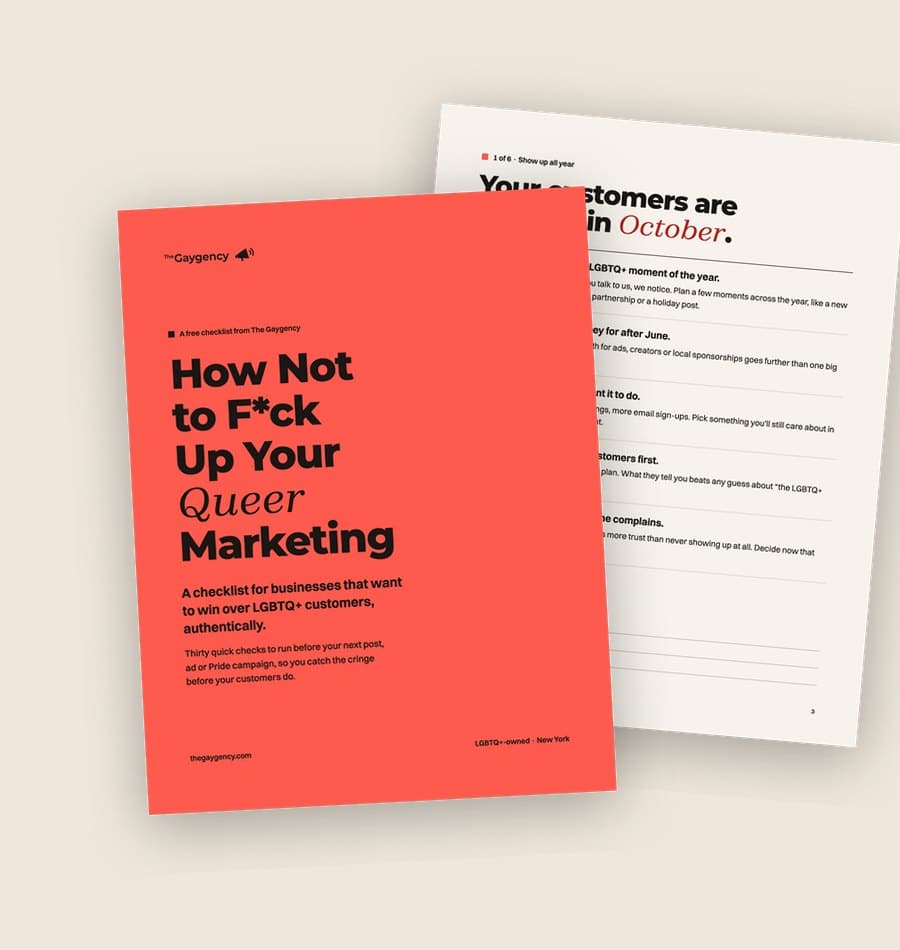
Free checklist
How not to f*ck up your queer marketing
A checklist for businesses that want to win over LGBTQ+ customers, authentically.
Thirty quick checks to run before your next post, ad or Pride campaign, so you catch the cringe before your customers do.
Delivered by email. No spam, ever.
Written by
The marketing and advertising agency for LGBTQ+ businesses and the brands that back them. Strategy, media buying, and brand systems with published results.
See the work