LGBTQ+ Marketing Glossary
What Is Rainbow Washing? Definition, Examples, and How to Avoid It
By The Gaygency · 08-10-26 · 6 min read

Rainbow washing is when a brand displays LGBTQ+ symbols, such as rainbow logos, Pride collections, or a single June social post, to appear supportive without matching that display with real policy, funding, or presence for LGBTQ+ people during the rest of the year.
That is the whole definition. Everything below is what it means in practice, where the term came from, and how to check whether your own plan qualifies before you publish it.
Where the term comes from
Rainbow washing is a direct descendant of pinkwashing, a term coined to describe governments and companies using LGBTQ+ support to distract from unrelated harm, most often documented in a political or geopolitical context. You can read the fuller distinction in our pinkwashing glossary entry. Rainbow washing narrowed that idea to marketing specifically: a seasonal display of support with nothing behind it, rather than deflection from a scandal. Both terms describe the same underlying failure, performance without substance, applied to different targets.
Pinkwashing and rainbow washing describe the same failure: support that performs well in public and does nothing once the cameras move on.
Why the term has teeth right now
The gap between performance and substance is not an abstract complaint anymore. Gravity Research found that 39 percent of large companies reduced their public Pride engagement in 2025. At the same time, the Human Rights Campaign Foundation's "Pride in the Marketplace 2026" research, reported by CNBC on June 17, 2026, found 71.5 percent of LGBTQ+ consumers say they buy less from brands they see as retreating, while 69.5 percent say they increase spending with brands they see as staying present. LGBT Capital estimates LGBTQ+ purchasing power in the United States at $1.4 trillion a year. That is not a niche audience deciding this quietly. It is a market-sized one, watching in public, with the receipts to back up what it says.
A brand's June is judged against its November, and both are public record now. Screenshots do not expire.
The 69.5 percent who reward brands that stay present are describing behavior in October and February, months no Pride campaign covers.
The four-question test
Skip the long checklist. Before a campaign ships, run it against four questions:
Does the commitment survive past June? A Pride collection, a donation, or a partnership that disappears by July 1 is the clearest signal of rainbow washing there is. The genuine version stays on the calendar and the balance sheet year-round.
Can you name the number? "A portion of proceeds benefits LGBTQ+ organizations" without a dollar figure is a statement designed to sound generous without being checkable. Five percent of $20,000 is $1,000. If the brand will not say the number, that is usually the reason.
Did an LGBTQ+ person help make it, or only appear in it? Representation that exists only in front of the camera, with no LGBTQ+ voice in the writers' room, the vendor list, or the leadership making the call, is set dressing rather than authorship.
Does the message change by market? A Pride campaign that runs in markets where it is popular and gets quietly dropped in markets where it might draw political pushback is not support. It is targeting that switches off under pressure.
A campaign that passes all four is not rainbow washing, regardless of budget. A campaign that fails even one is worth rewriting before it ships, not after a screenshot goes viral.
The test is not whether the campaign looks good in June. It is whether the same four answers hold up in November.
A cautionary example
In May 2023, Target removed a portion of its Pride merchandise from stores following threats made against staff, a decision widely reported at the time. Whatever the underlying safety concern, the public read on the decision was capitulation: a brand that had built visible Pride merchandising for years pulled back the moment pressure appeared. That is a fifth failure mode worth adding to the four-question test on its own: the fourth question asks whether the message changes by market; this one asks whether it changes under pressure applied after launch. A commitment that holds in a calm quarter and disappears in a difficult one was never much of a commitment. It was a bet that nobody would push back.
Target's 2023 reversal shows the pressure test arrives after launch, so the decision about what holds under pushback has to be made before the campaign ships.
Rainbow washing versus a genuine misstep
Not every awkward Pride campaign is rainbow washing, and treating every imperfect attempt as bad faith discourages brands from trying at all. The distinction is intent and follow-through, not execution quality. A brand that tries something earnest, gets the tone wrong, and responds by listening and adjusting is having a bad campaign, not committing rainbow washing. A brand that never intended to follow through past the media cycle is the one the term is built to describe. The four-question test is useful precisely because it separates the two: a sincere but clumsy campaign usually still passes questions one and two, the commitment survives and the number is named, even when the creative itself misses.
Quick self-audit before you approve a Pride asset: pull last year's version and check whether the same donation, product, or partner is still active today. If the answer is no and nobody on the team can say why it ended, that is the rainbow washing pattern in one line item.
What it looks like when a brand avoids it
The brands that pass the four-question test share a structure, not a budget. Mastercard's True Name program changed what got printed on a credit card for transgender and non-binary customers, a permanent product change rather than a seasonal ad. Absolut has advertised in LGBTQ+ media since the early 1980s and kept its Rainbow vodka edition on shelves year-round rather than as a June release. Neither required a Fortune 500 marketing budget to execute the underlying idea: pick one real thing, name the number, and keep it running. The scale changes; the structure does not. A brand strategy built around that structure is what makes the difference defensible when someone on your board asks why the company is doing this at all.
The internal test as well as the public one
Rainbow washing is usually diagnosed from outside, by consumers or journalists, but the more useful audit happens before launch. Bring your campaign strategy plan to the four-question test in the room where the budget gets approved, not after the creative is already shot. Enterprise brand and legal teams navigating exactly this calibration, how far to go and what to be able to defend later, are who our enterprise work is built around: the goal is a plan you can stand behind in November as confidently as you did in June.
Frequently asked questions
What is rainbow washing?
Rainbow washing is when a brand displays LGBTQ+ symbols, like rainbow logos or Pride products, to appear supportive without backing that display with real policy, funding, or year-round presence for LGBTQ+ people.
What is the difference between rainbow washing and pinkwashing?
Pinkwashing is the broader term, most often used to describe a government or institution invoking LGBTQ+ rights to distract from unrelated harm. Rainbow washing is the marketing-specific version: a seasonal display of support, usually during Pride, with no substance behind it.
Is rainbow washing illegal?
No. There is no law against a brand running a Pride campaign without follow-through. The consequence is reputational and financial, documented in HRC's 2026 finding that 71.5 percent of LGBTQ+ consumers reduce spending with brands they see as retreating, not legal.
How can a brand avoid rainbow washing?
Run every campaign against four questions before it ships: does the commitment survive past June, can you name the dollar figure, did an LGBTQ+ person help make the decision or only appear in the ad, and does the message stay consistent across every market the brand serves.
What is rainbow capitalism?
Rainbow capitalism describes the broader commercial trend of marketing to LGBTQ+ identity for profit, including but not limited to rainbow washing. Some use it neutrally to describe any LGBTQ+-targeted commerce; others use it critically to describe profit-driven support with no deeper commitment, which is where it overlaps directly with rainbow washing.
Want a second read on a campaign before it ships. Book a call and we will run it against the four-question test together.
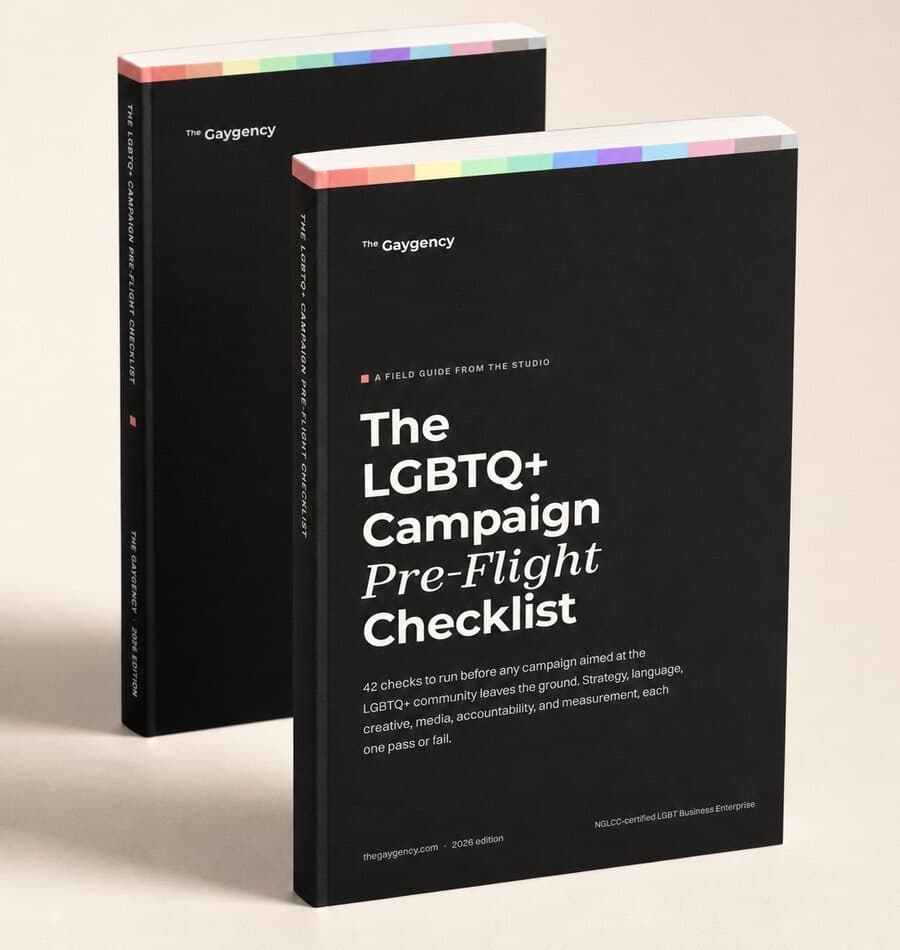
Free campaign guide
Would your campaign pass pre-flight?
The same 42 checks we run inside the studio before any campaign aimed at the LGBTQ+ community goes live.
Delivered by email. No spam, ever.
Written by
The marketing and advertising agency for LGBTQ+ businesses and the brands that back them. Strategy, media buying, and brand systems with published results.
See the work