Brand Strategy
Why Brand Strategy Comes Before the Logo
By The Gaygency · 04-16-26 · 10 min read
Most founders think about brand in terms of design. Logo, colors, fonts. The visual layer you put on top of the business. When someone says "we need to work on our brand," what they usually mean is "we need a new logo" or "our website looks dated."
The instinct is not wrong. Visual identity matters, and buyers judge it in seconds. But identity is the second step, not the first, and doing the steps out of order is the single most common reason rebrands fail. We see it in the intake calls: a founder two rounds deep with a designer, unhappy with every direction, unable to say why. The problem is never the designer. The problem is that nobody wrote down what the design was supposed to communicate.
Brand strategy is that document. The logo is one output of it.
The logo is not the brand. The logo is the compression of the brand. You cannot compress something that has not been written down.
What brand strategy is
Brand strategy is a written document, usually ten to twenty pages, that answers four questions in plain language. Not a mood board. Not a color exploration. A document your whole team can read, argue with, and use.
Who are you? Your positioning: what you do, who you do it for, and what makes you different from the alternatives a buyer would compare you against. A positioning statement is a specific, defensible claim. "We help independent restaurants build customer loyalty programs that work without expensive POS integrations" is positioning. "We help businesses grow" is a shrug.
Who is your customer? Two or three audience profiles built from real customer conversations, not demographics pulled from a template. A useful profile describes what the customer is trying to accomplish, what they are afraid of, what they have already tried, and what would make them trust you. If you cannot fill in those four fields for your best customer, you have research to do before you have strategy to write.
What do you say and how do you say it? Voice and tone: the words you use, the words you refuse, and how the register shifts between a pitch, a social post, and a support email. Brands that sound like three different companies across three channels feel untrustworthy even when the product is excellent. This is the same discipline behind our messaging framework work, and it is the part founders most often skip.
Where do you sit in the market? Competitive context. Who the three or four closest alternatives are, how each positions itself, and where you are genuinely different. Not a SWOT chart. A direct answer to the question a buyer will ask out loud: why you and not them?
Positioning gets decided on the wall, in writing, before anyone opens a design tool.
Why strategy has to precede design
Design is communication. A strong logo communicates something true about the brand: its personality, its position, who it is for. A designer cannot communicate a truth that has not been defined.
Skip the strategy and one of two failure modes takes over.
The designer guesses. They work from a brief that says "modern but approachable" and a mood board of competitors. The output looks fine and says nothing, because there was nothing to say. Six months later the founder cannot explain why the brand feels generic. It feels generic because it was designed from a generic brief.
The client redesigns by revision. Round after round of feedback, because the founder is using the design process to figure out what they want the company to be. The designer becomes a brand strategist by accident, at an hourly rate, without the research. Everyone burns money and goodwill.
Either way you get a logo that works aesthetically and fails strategically. It decorates. It does not position.
When the order is right, the opposite happens. When we rebuilt Sugar Wood, the strategy work came first: positioning, audience, voice. The visual identity and website were built to express decisions that already existed on paper. Sales rose 20% in the first quarter after launch, bounce rate dropped 15%, and the founder walked into investor meetings with a brand document instead of a color palette. The design was good. The design was also the third step, not the first.
Round after round of revisions is not a design problem. It is a founder using the design process to decide what the company is.
What the research says about brand consistency
The founder's instinct that this is worth doing right is backed by data outside our own client roster. Marq's State of Brand Consistency Report, which surveyed more than 400 brand management professionals, found that companies with strong brand consistency across every channel reported an average revenue increase of 10% to 20%, and the top performers reported gains as high as 33% (Marq, State of Brand Consistency Report, 2019). Sixty-eight percent of respondents in the same study said brand consistency contributed at least 10% to their revenue growth. That study is older than the others cited on this page, and it remains the most-cited primary research on the subject because nobody has run a larger one since.
The mechanism is not complicated. A consistent brand needs fewer touchpoints to convert a buyer, because the buyer is not re-learning who you are on every channel. Inconsistent brands pay a tax on every impression: the ad, the website, and the sales deck each have to reintroduce the company from scratch, and every reintroduction is a chance to lose the person you were trying to convert.
That consistency is only possible once the strategy exists. You cannot brief a designer, a copywriter, and a media buyer to sound like the same company if nobody has written down what that company sounds like.
What belongs in the document
A strategy document that gets used, rather than filed, contains six things:
- Mission. One or two sentences on why the organization exists and who it serves. Internal language, not a tagline.
- Positioning statement. The specific claim, in words a customer would recognize.
- Audience profiles. Two or three, each with goals, fears, prior attempts, and decision criteria.
- Voice and tone rules. Words you use, words you ban, and paired examples of on-brand and off-brand copy. Rules a new hire could apply on day one.
- Competitive context. The closest alternatives and one honest sentence on how you differ from each.
- Brand principles. Three to five commitments specific enough to change behavior. "We believe in quality" changes nothing. "No deliverable ships without a second review" changes Tuesdays.
Each section should be short. If a section needs more than two pages, the thinking is not finished. Length is where unfinished decisions go to hide.
The two-page test Every section of a brand strategy document should fit in two pages or fewer. A positioning statement that needs a preamble is not a position. An audience profile that runs five pages is research notes, not a profile. Compression is the proof that a decision was made.
What skipping it costs
Founders who skip strategy find out they needed it in one of three expensive ways.
The do-over rebrand. The company grows, the brand does not fit, and the whole identity gets rebuilt from scratch, this time with the strategy work included. Published agency pricing shows why the timing matters: a full rebrand for a small-to-midsize business commonly runs $50,000 to $150,000, and $150,000 to $500,000 or more for an enterprise, according to project pricing data compiled by branding studio Blankboard (Blankboard Studio, 2025). Doing the strategy work up front, inside the original engagement, costs a fraction of that because it is one project instead of two.
The consistency tax. The website, the sales deck, the email flows, and the social feed each sound like a different company, because different people made decisions with no shared document to check against. Every new hire adds drift. Nobody can point to the sentence that settles an argument, so every argument repeats. This is the 10% to 20% revenue gap the Marq research measured, and it shows up in a hundred small decisions that never quite agree with each other.
The amplified mistake. Paid media multiplies whatever message you give it. If the positioning is muddled, ads make the muddle expensive. We regularly meet brands that spent $5,000 to $20,000 on paid campaigns before anyone questioned whether the underlying message was right. The media buying was fine. The strategy underneath it did not exist. This is why our brand strategy engagements often start with founders who came in asking about ads.
With a strategy document on the desk, logo review becomes a check against criteria instead of a taste debate.
The right order
Strategy first. Identity second: logo, color system, typography, built to express the strategy. Then the website, the materials, and the campaigns, each of which inherits decisions from the layer above through work like visual identity.
This is not a sequence invented to sell more phases. It is the direction the dependencies run. The logo depends on the positioning. The website depends on the audience profiles. The campaign depends on the voice. Reverse the order and every downstream decision gets made twice, once by guess and once by correction.
Build in the right order and you pay for each decision once. Skip a step and you pay for it at every step that follows.
Brand strategy by business stage
The scope of the document changes with the size of the business, but the sequence does not.
Startups and founder-led businesses usually need the shortest version of this document, but they need it before the first dollar goes to a designer or a media buyer. A ten-page strategy that takes two weeks to write is cheaper than a logo you redo twice. See for startups for how we scope this work at an early-stage budget.
Established businesses with real revenue often have a brand that was true five years ago and has not been rewritten since the product, the customer, or the market changed. The symptom is usually a flat quarter that a new campaign does not fix, because the campaign is built on positioning that no longer matches the business. See for established brands.
Enterprise and corporate brand teams carry the highest cost of getting this wrong, because a muddled position gets amplified across more channels, more markets, and more stakeholders before anyone catches it. The strategy document becomes the reference every team, agency, and vendor is briefed from. See for enterprise.
Frequently asked questions
What is brand strategy in simple terms?
Brand strategy is a written document that defines who your company is, who it serves, what it says, and why it wins against the alternatives. It is the thinking a logo, website, and ad campaign are supposed to express. Without it, design has nothing true to communicate.
How much does brand strategy cost?
Pricing varies with scope and business size, from a focused sprint for a solo founder up to a multi-month engagement for an enterprise brand team. The more useful number to plan around is the alternative: skipping strategy and rebuilding later means paying for a second round of design, new collateral, and lost time on top of the original project, at the rebrand price ranges cited above (Blankboard Studio, 2025).
How long does a brand strategy engagement take?
A focused engagement typically runs a few weeks: research and interviews, then a working draft, then a review and install session with the team. Enterprise engagements with more stakeholders and markets to reconcile run longer. Either way, strategy should finish before a designer opens a file.
What is the difference between brand strategy and branding?
Branding usually means the visual system: logo, color, type, templates. Brand strategy is what that system is supposed to communicate. Branding without strategy is decoration. Strategy without branding is a document nobody sees. Both are necessary, and the order matters.
Do I need brand strategy before I build a website?
Yes. A website is one of the most expensive places to discover that nobody agreed on the positioning, because copy, layout, and calls to action all depend on knowing who the site is talking to and why they should trust it. Building a site before the strategy exists is how "modern but approachable" websites happen.
If you are starting a brand or rebuilding one, the strategy document is the first thing we produce. It is the least glamorous deliverable we make and the one every other deliverable depends on. Book a call and we will tell you honestly whether you need a strategy sprint or you already have one buried in your team's heads and just need it written down.
Free checklist
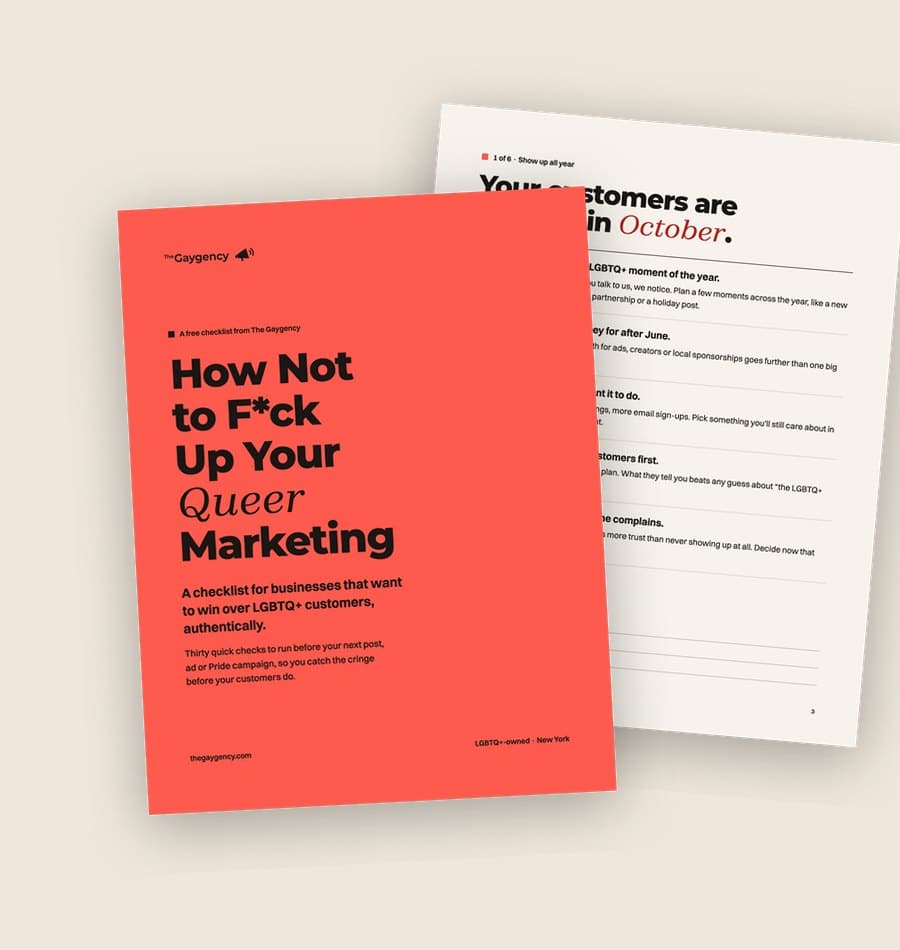
How not to f*ck up your queer marketing
A checklist for businesses that want to win over LGBTQ+ customers, authentically.
Thirty quick checks to run before your next post, ad or Pride campaign, so you catch the cringe before your customers do.
Delivered by email. No spam, ever.
Written by
The marketing and advertising agency for LGBTQ+ businesses and the brands that back them. Strategy, media buying, and brand systems with published results.
See the work