Brand Strategy
The Silent Sponsor Playbook
By The Gaygency · 07-22-26 · 8 min read
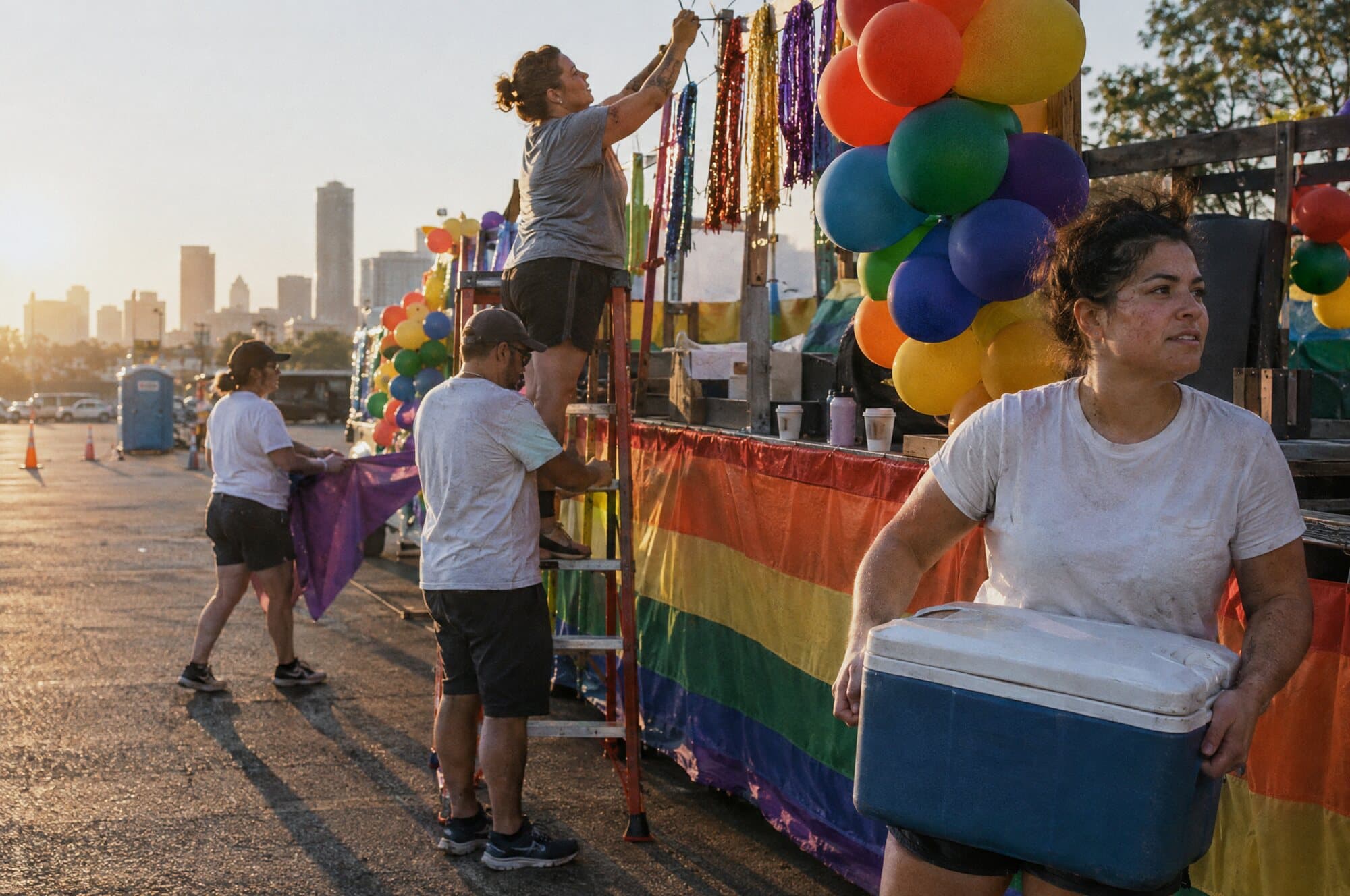
Target sponsored NYC Pride again in 2026. Its name was not on a float. Instead, per NYC Pride's media director, its support ran through quieter avenues, like providing water at events such as PrideFest rather than sponsoring a giant float, keeping the dollars moving while leaving the logo at home. Garnier and Mastercard ran a version of the same move in 2025: both kept funding Pride events they had sponsored for years, and both pulled their branding back from the public-facing parts of that funding. Mastercard has since dialed the volume back up, increasing its Pride spending and sending roughly 100 employees and executives to march in June 2026 (Insurance Journal, June 2026). None of these companies stopped supporting the community. They adjusted how loudly they announced it, and that dial turns in both directions.
This is not cowardice dressed up as strategy, or at least it is not only that. It is a rational response to a genuinely new cost structure. Sponsoring Pride loudly in 2026 comes with a political price that did not exist five years ago, and for some brands that price now outweighs the marketing benefit of the logo. The interesting part is that many of them found a way to keep funding the work while opting out of the fight over the announcement.
Why visible sponsorship got riskier
The numbers explain the shift. A Gravity Research survey of corporate executives in April 2025 found that 39% planned to reduce Pride engagement that year, and 61% of those cited pressure from the White House and the broader political environment as the primary driver. The Human Rights Campaign's 2026 Corporate Equality Index recorded a 65% drop in Fortune 500 participation, from 377 companies in 2025 to 131 in 2026, as employers weighed the exposure of a public scorecard against the political fallout of a high score. Several markets felt the pullback directly: NYC Pride turned to a peer-to-peer fundraising push after corporate shortfalls, leaning on small queer-owned businesses to help close the gap, Tampa Pride went on hiatus and a Grand Rapids Pride event was canceled after losing sponsors, and Arlington Pride was canceled after its city council declined to reinstate local LGBTQ+ protections.
Against that backdrop, a national ad campaign announcing Pride support is a target. A quiet local activation is much harder to organize a boycott around, because there is nothing publicly attributable to boycott. Bospar SVP Shaun Leavy called 2026 Pride the "gray area": the money is often still moving, the noise around it is not.
Large in-person events pose a related but distinct risk that reinforces the same logic. WorldPride DC drew an estimated 1.2 million attendees in 2025 against organizers' projection of 3 million, with Destination DC reporting a $310.7 million economic impact well short of expectations. Travel hesitancy tied to the broader political climate suppressed turnout in a way no single sponsor could have controlled. A brand that had put its name on a national campaign built around that event would have been publicly associated with a visible underperformance, on top of the political exposure. A brand that funded local, city-specific activations instead absorbs none of that particular risk, because there was no single national moment for the underperformance to attach to.
What quiet sponsorship looks like in practice
Quiet is not the same as absent, and it is not the same as rainbow washing run in reverse. The clearest examples share a pattern: the funding is real, verifiable, and often larger than what a branded campaign would have cost, but the public-facing branding is minimal or gone.
Target's unbranded water provision at NYC Pride is the clean example: infrastructure the event needs, funded without a name attached. Garnier's continued funding without prominent branding follows the same logic on the corporate-sponsor side, and Mastercard ran the same quiet play in 2025 before returning to visible sponsorship in 2026. On the more visible end of quiet, Lime ran its 2026 "Pride in Motion" campaign across more than 21 cities worldwide, including Albuquerque and Sydney, but structured it as locally led partnerships with more than 24 individual nonprofits rather than one national branded push. Albuquerque's activation supported Equality New Mexico specifically, Atlanta's supported Out Front Theatre, Chicago's supported Proud to Run Chicago and the Chicago AIDS Foundation, each pairing tailored to what that city's community needed rather than a single national message repeated in 21 markets. That structure decentralizes the political target even while the company's name is still attached to the work.
NYC Pride's own response to reduced corporate sponsorship points to the other side of this same shift. Facing a shortfall, the organization launched a peer-to-peer individual fundraising push with a $100,000 goal, leaning on small queer-owned businesses like BlissBomb Baked Donuts and Gilded Age Jewelry to help close the gap through in-store promotions rather than corporate checks. When corporate dollars go quiet, the burden of staying loud does not disappear. It shifts to the community itself, which is exactly the outcome a well-run silent sponsorship strategy is supposed to prevent.
The money did not leave. The press release did.
The common thread is decentralization. A hyper-local activation, funded and organized market by market, lets a brand support the communities it operates in without creating one national flashpoint for opponents to organize against. It also, not incidentally, tends to reach the people it is meant to help more directly than a national ad ever did.
The measurement problem with quiet
The obvious objection is the right one: if nobody sees the logo, how does anyone justify the budget internally next year? This is a real problem, and it is the reason quiet sponsorship strategies fail more often from bad measurement than from bad intent.
The fix is separating public visibility from internal proof. A brand does not need press coverage to know a program worked. It needs a measurement and analytics setup built around the outcomes that matter for a quiet campaign specifically: dollars committed and disbursed, community organizations reached, event attendance supported, and, where the brand chooses to measure it, shifts in sentiment and purchase intent among the LGBTQ+ consumers who do know the brand was there, even if the general public does not. None of that requires a logo on a float. All of it requires deciding what to track before the activation runs, not after someone in a budget meeting asks what the money bought.
Every retainer engagement we run includes Open Book, a live dashboard tied to revenue and reach rather than a quarterly deck that shows up after the moment has passed. For a quiet campaign specifically, that live view is what lets a brand team defend the budget internally without ever needing the public visibility a louder campaign would have generated. The dashboard becomes the proof; the silence stays intact where the brand wants it.
A campaign with no logo on it is not unmeasurable. It just cannot be measured by counting logos.
When quiet is the wrong call
Quiet is a tool, not a default setting, and treating it as the safe answer for every situation is its own kind of mistake. A company with LGBTQ+ employees who want to see their employer show up publicly, a brand whose core customer base is the community itself, or a moment where staying silent reads as retreat rather than discretion are all cases where quiet costs more than it saves. The enterprise brands we work with usually need a calibrated map of actions, from internal-only to fully public, with a clear sense of what triggers a move up or down that scale, rather than one fixed posture applied to every decision regardless of the moment.
Where to land on the visibility spectrum
- Internal only: benefits, policy, and resource groups. No public component needed.
- Local and unbranded: funding real infrastructure or organizations without a name attached.
- Local and named: a market-specific partnership with the brand publicly credited.
- National and branded: full public campaign, reserved for brands with the risk tolerance and audience alignment to pull it off.
Getting this right starts with an honest read of risk tolerance, audience overlap, and what the company can defend if asked directly. That is a campaign strategy conversation before it is a creative one, and it is exactly the kind of decision that benefits from outside judgment rather than an internal team arguing with itself in a vacuum.
Frequently asked questions
Is silent sponsorship the same thing as rainbow washing in reverse?
No. Rainbow washing is loud support with no substance behind it. Silent sponsorship is real substance with no loud support. The test is whether the money and the commitment are verifiable, not whether they are announced.
How do you measure a campaign that intentionally has no logo on it?
Track the outcomes that do not depend on public visibility: dollars committed, organizations funded, people reached, and, where relevant, sentiment among the specific audience that does know the brand is involved.
Should smaller businesses use this playbook too?
The logic scales down. A local business supporting its community without turning it into a marketing moment often earns more trust than one that does, because the absence of a press release reads as sincerity rather than a missed opportunity.
What if our own employees want to see us support Pride publicly?
That is a real cost of going quiet and should weigh into the decision. Internal support and external silence can coexist for a while, but a company that never shows up publicly for a community it employs eventually has to answer for that gap internally as well as externally.
Does going quiet mean giving up the marketing value entirely?
Not the way brands like Lime have run it. A campaign can be organized locally, with real community credit, and still put the brand's name on it at a scale calibrated to avoid becoming a national target. Quiet is a dial, not a switch.
Deciding where a brand belongs on that spectrum is a strategy question with a right answer for a specific company at a specific moment, not a guess. Book a call and we will work out where yours sits.
Free checklist
How not to f*ck up your queer marketing
A checklist for businesses that want to win over LGBTQ+ customers, authentically.
Thirty quick checks to run before your next post, ad or Pride campaign, so you catch the cringe before your customers do.
Delivered by email. No spam, ever.
Written by
The marketing and advertising agency for LGBTQ+ businesses and the brands that back them. Strategy, media buying, and brand systems with published results.
See the work