Growth Systems
Building Your First Marketing Funnel Without a Full Team
By The Gaygency · 06-11-26 · 9 min read

Most marketing advice assumes a team, a budget, and a quarter to spare. A founder running their own marketing has none of those, which is why most funnel content reads like it was written for someone else's company.
This guide strips the funnel to what a single person can build, in the order that protects the money, with benchmark numbers at each stage so you know whether your own results are healthy or broken. Nothing here requires software you do not already have or a hire you cannot afford yet.
The funnel without the jargon
A funnel is just the path from stranger to customer, cut into three stages. At the top, people discover you exist. In the middle, they decide whether to trust you. At the bottom, they buy.
It narrows because you lose people at every step. More people see an ad than click it, more click than sign up, more sign up than buy. That drop-off is physics, not failure. The work is making sure you are not losing people for fixable reasons: a page that does not answer their question, a form that asks too much, a signup that leads to silence.
Three stages, three builds:
- Awareness. The right people find out you exist.
- Consideration. They decide you are worth trusting.
- Conversion. They take the action, and the action gets confirmed.
The order you build them in is the whole trick, and it runs backward from how most founders spend.
Traffic is the last thing you buy, not the first. Every dollar spent on awareness before the bottom works is a dollar spent finding out the bottom does not work.
Stage 1: awareness
Your only job is showing up where your buyers already spend time or attention.
Organic search. Write content that answers questions your customer already types. It compounds: a specific post written this month can pull traffic for years. Specific beats broad every time. "How to price a freelance project" will outearn "marketing tips" for its entire life.
Paid social. Meta is the most accessible paid channel for most early-stage businesses, and $20 a day with a single ad set is a legitimate start. At this budget the goal is not sales, it is learning which message and which audience respond, cheaply. When there is real budget behind it, this is the machine that scales: our Nasty Pig program ran paid social to a 7.85x return on ad spend. That number came after the rest of the funnel worked, which is the point of this guide.
Do not turn either channel on until Stages 2 and 3 exist. Awareness pointed at a broken page is a paid tour of a dead end.
Sketch the whole funnel on one sheet of paper before you fund any part of it.
Stage 2: consideration
Someone found you. Now they are deciding whether to trust you, and your website is the interview.
This is where early-stage funnels die, and the industry-wide numbers show why. Unbounce's Conversion Benchmark Report puts the median dedicated landing page conversion rate at 6.6% across industries, with industry medians ranging from 3.8% to 12.3% (Unbounce Conversion Benchmark Report, 2024). If your page explains what the product does and skips the questions that decide the sale, you are competing for the bottom of that range, not the top. The three questions a buyer needs answered before they trust you: Who else has used this? What does it cost? What happens if it does not work for me?
Three builds:
A landing page that answers objections. Not a feature list. Find the thing your buyer is nervous about and answer it in plain text on the page. Selling a service? Show what working with you looks like week by week. Selling a product? Show it working for someone like them. A landing page is a sales conversation with the pauses removed. Form length matters more than most founders assume: every extra field adds friction and gives a hesitant visitor one more reason to quit, so every field you cut is a lever, not a nicety.
Specific social proof. Two or three testimonials with numbers in them beat a wall of praise. "I went from zero to 3,000 subscribers in 60 days with this template" does work that "highly recommended!!" never will.
An email capture with a reason. A checklist, a calculator, a discount, a template. Something with a before and after. A study of website popups found that generic email capture without an offer converted at 1.84% on desktop and 3.83% on mobile, while adding a specific lead magnet more than doubled both, to 4.7% and 7.73% (GetSiteControl website popup study, 2024). "Join our newsletter" is the 1.84% version. A specific, useful trade is the 4.7% one, on the same traffic.
Stage 3: conversion
Everything at the bottom is friction removal, and this is the stage with the most well-documented failure rate in all of marketing. The Baymard Institute has tracked online checkout abandonment for over a decade across more than 50 studies, and the average sits at just over 70%: roughly seven in ten people who start a checkout do not finish it (Baymard Institute, 2025). The leading causes include unexpected extra costs, slow delivery, being asked to create an account, and a checkout process that feels too long or complicated. Baymard's own testing found that a large e-commerce site can gain an average 35.26% increase in conversion rate through checkout redesign alone, with no change to the product, the price, or the traffic (Baymard Institute, 2025).
Two minutes, start to finish. Your checkout or contact flow should complete in under two minutes on a phone. Test it yourself, on your own phone, tonight. Every extra field and unclear step is a paid visitor walking out, and the Baymard data says roughly one in five of them will name the length of the process as the specific reason.
Confirm instantly. The moment someone buys or submits, they should know what happens next: a confirmation email, a next step, a calendar link. Silence after a conversion reads as a mistake, and refunds start in that silence.
Ask explicitly. "Buy now." "Book a call." "Start the trial." Not "Learn more." Nobody converts on an ambiguous button.
The compounding proof: when the consideration and conversion layers were rebuilt for Nasty Pig, site conversion went from 1% to 2.5%. Same brand, same traffic sources. That multiple applies to every visitor the awareness stage ever sends, which is why it gets fixed first.
The order of operations
- Fix the landing page until cold traffic converts at 3% or better, a realistic floor given Unbounce's 6.6% cross-industry median.
- Add the email capture and one automated welcome email.
- Then, and only then, buy traffic.
Run five real people through your site cold before spending a dollar on ads. Watch where they hesitate. Every hesitation is a fix that costs nothing now and multiplies everything later.
Doubling your conversion rate does the work of doubling your ad budget, and one of those is free.
When to hire help
Build it yourself until you hit a wall, then hire the specific person who fixes the specific wall. The thresholds where outside help reliably pays for itself:
Copywriting, immediately if writing is not your skill. One landing page from a strong copywriter is the highest-return purchase available at this stage. One page. Not a website. You are too close to your own product to hear how it sounds to a stranger.
Paid media management at $3,000 a month in spend. Below that, the tuition you pay learning ads yourself is worth more than the efficiency a manager adds. Above it, wasted spend costs more than management fees.
Email automation at 2,000 subscribers. A list that size with no welcome flow is quiet revenue. Nasty Pig's list reached 20,000 subscribers within a year of the funnel rebuild, and that owned channel reduces the paid budget it takes to hit the same number every month after. Building flows like that is exactly what our email and SMS team does.
What you should not hire yet: a generalist agency to "do marketing," or anyone who proposes starting with ads before reading your landing page. The funnel tells you who to hire by showing you where it leaks.
The honest summary
Build consideration, then conversion, then awareness. Measure one number per stage: qualified visits at the top, capture rate in the middle, conversion rate at the bottom. Fix the lowest one before touching the others, and check it against the benchmarks above rather than a gut feeling about what "good" looks like.
A funnel built this way runs on a founder's hours and a founder's budget. When it outgrows you, that is a good problem, and we work with founders at exactly that point.
Frequently asked questions
What is a marketing funnel, in plain terms?
The path a stranger takes to become a customer, broken into three stages: awareness, where they learn you exist; consideration, where they decide to trust you; and conversion, where they act. Most of what looks like a marketing problem is one of these three stages leaking people for a fixable reason.
What is a good landing page conversion rate?
Across industries, the median lands at 6.6%, with industry medians ranging from 3.8% to 12.3% (Unbounce Conversion Benchmark Report, 2024). Under 2.5% usually signals a real problem: message mismatch, a broken form, or the wrong traffic source, not merely room for polish.
Why do people abandon their cart or signup form?
The Baymard Institute's research across more than 50 studies puts the average online checkout abandonment rate at just over 70%, driven mainly by unexpected extra costs, forced account creation, and checkouts that feel too long (Baymard Institute, 2025). Most of these are fixable without touching price or product.
Should I fix my website before I start running ads?
Yes. Sending paid traffic to an unfinished consideration or conversion stage pays to discover problems you could have found for free by watching five people use the site. Fix the page until cold traffic converts reasonably, then buy traffic to scale what already works.
How much does it cost to build a funnel myself?
The awareness and consideration stages can be built with tools you likely already have and a few hundred dollars of testing budget. The real cost is time and a strong landing page, which is why hiring a copywriter for one page is usually the first paid help worth bringing in, well before a paid media manager or an agency retainer.
If your funnel has already outgrown a solo build, book a call and we will tell you which stage is leaking before recommending anything.
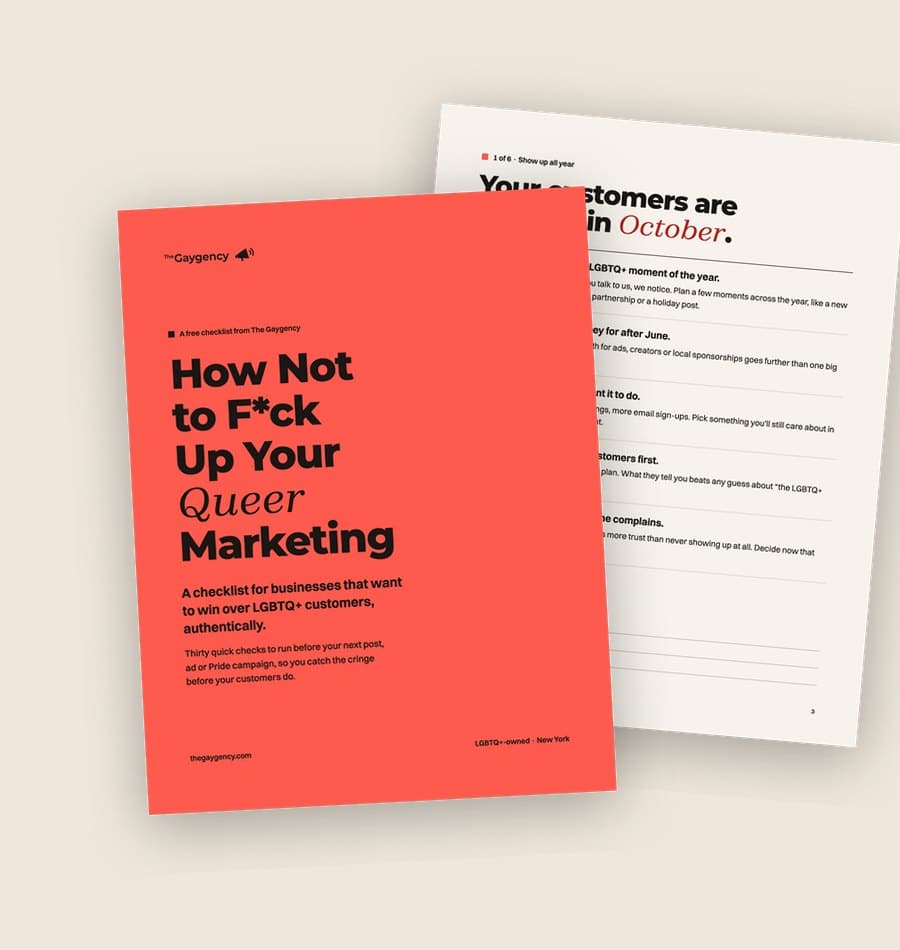
Free checklist
How not to f*ck up your queer marketing
A checklist for businesses that want to win over LGBTQ+ customers, authentically.
Thirty quick checks to run before your next post, ad or Pride campaign, so you catch the cringe before your customers do.
Delivered by email. No spam, ever.
Written by
The marketing and advertising agency for LGBTQ+ businesses and the brands that back them. Strategy, media buying, and brand systems with published results.
See the work