Enterprise Marketing
Your CEI Score Disappeared. Now What?
By The Gaygency · 07-28-26 · 7 min read

For years, a company's score on the Human Rights Campaign's Corporate Equality Index was a fixture of enterprise brand reporting. A high score went in the annual report. A dropped score, or a company's absence from the list entirely, was news. In 2026, absence became the norm. HRC's own research found Fortune 500 participation fell 65% in a single year, from 377 companies in 2025 to 131 in 2026. If a brand team is looking at a blank space where a familiar number used to sit, this is why, and here is what to do about it.
What happened to the Corporate Equality Index
The index itself did not change its methodology in any way that would explain a drop this size. What changed is the environment around it. Conservative activists, most visibly Robby Starbuck, spent two years pressuring large employers to distance themselves from diversity, equity, and inclusion programs, and the CEI became a specific, named target because it is public, scored, and easy to point to. Ford, Harley-Davidson, and Lowe's are among the companies that formally withdrew from participating, each citing a shift toward internal-only diversity work rather than public commitments. A broader list, tracked by the conservative group 1792 Exchange, counts 20 companies that have publicly ended their participation in the index, including Walmart, Charles Schwab, and Reynolds American.
HRC President Kelley Robinson framed the shift plainly: "Our research shows the strength and the strain of this moment on LGBTQ+ workers, consumers and the companies that count on us." Many of the companies that stopped participating hold federal contracts, which raises the plausible read that some of this is about regulatory exposure rather than a change of heart on inclusion itself.
The scale of what got abandoned is worth stating directly. The index launched in 2002 with 13 companies earning a perfect score. By the 2025 edition, that number had grown to 765 businesses, the result of decades of companies building public commitments on top of each other. The 2026 report still found 534 companies scoring 100, with nearly 6 million US employees covered by those policies. The index did not become worthless. It became smaller, and a specific set of large, federally exposed companies chose to stop being counted in it.
Why companies are opting out
Three separate pressures are pushing in the same direction, and any one of them alone might not have moved participation this much. Political pressure from an administration actively scrutinizing corporate DEI programs makes public disclosure a genuine legal and reputational risk for federal contractors specifically. Coordinated activist campaigns turn a public scorecard into a target list, since a company's exact score and category breakdown are both published and easy to cite in a pressure campaign. And two years of consumer boycotts on both sides of the issue, first against brands seen as too visible on Pride, more recently against brands seen as retreating, have made public commitment of any kind feel higher-stakes than it did five years ago.
None of these pressures argue that inclusion itself stopped mattering to LGBTQ+ employees or consumers. They argue that publishing a number about it stopped being worth the exposure for a specific set of companies, mostly the ones most exposed to federal contracts or the most prominent activist targets.
The measurement gap this creates
The practical problem for a brand team is not philosophical. It is that the CEI, whatever its limits, was one of the few standardized, third-party numbers a company could point to internally and externally as evidence of where it stood. Losing it, or choosing not to participate, does not remove the need for that evidence. It removes one specific source of it, and leaves the team that used to rely on it with a genuine gap.
That gap gets filled badly more often than it gets filled well. The default failure mode is quietly stopping the measurement altogether, on the logic that if the score is not public anymore, tracking it privately is not worth the effort either. That reasoning gets the actual value of the CEI backwards. The number was never the point. What the number stood in for, real signal about how LGBTQ+ employees and consumers experience a company, is still exactly as necessary to have as it was when the score was public.
What to track instead
The honest answer is that no single replacement index exists yet, and any brand waiting for one to appear before measuring anything is choosing not to measure for a while. A few sources of real signal do not depend on a public scorecard and do not create the same exposure a published index does.
Direct consumer research is the clearest substitute for the external half of the picture. HRC's own 2026 "Pride in the Marketplace" survey found that 71.5% of LGBTQ+ consumers buy less from brands they see as retreating from the community, and 69.5% increase spend with brands seen as staying supportive. That data exists independent of any single company's CEI participation and can be layered against a brand's own sales and sentiment data to see where it sits with this audience, rather than relying on a scorecard the company itself may no longer publish.
Internal, unpublished tracking covers the employee half without the exposure of a public number: resource group engagement, exit interview themes, and segmented retention data can all be tracked privately and reviewed by leadership without ever becoming a headline. First-party purchase and loyalty data, tied through a proper measurement and analytics setup, shows how this specific audience is behaving toward the brand, which is a more direct signal than a policy scorecard ever was. And for companies with supplier relationships to protect, NGLCC certification and LGBTBE procurement relationships, a network of more than 2,000 certified businesses within an LGBTQ+ business community that NGLCC says contributes nearly $2 trillion to the US economy, offer a quieter but still substantive way to demonstrate commitment through spend rather than through a published grade.
The CEI measured whether a company would say something publicly. It was never the only way to know whether a company was doing something real.
Our enterprise engagements start with exactly this kind of insight briefing: a category-specific read on how LGBTQ+ consumers view a brand, built from our proprietary dataset of 1M+ verified LGBTQ+ consumers rather than from a public index a competitor or an activist group can also read. It is built to walk into a board room, which a canceled scorecard entry cannot do.
A calibrated visibility framework rounds out the picture. Once a brand team knows where it stands with this audience internally and externally, the next decision is how publicly to act on that knowledge, from internal-only policy work up to a fully public campaign. That decision belongs with campaign strategy, not with whichever index happens to still be publishing scores that year.
Four things to measure that do not require a public scorecard
- Consumer sentiment and purchase behavior specific to this audience, tracked privately against category benchmarks
- Employee resource group engagement and retention, reviewed internally on a regular cadence
- Direct spend with certified LGBTBE suppliers, which demonstrates commitment through procurement rather than press
- First-party sales data segmented against a proprietary consumer dataset, rather than platform-reported estimates
Frequently asked questions
Does leaving the CEI mean a company stopped caring about LGBTQ+ employees?
Not necessarily. Some companies withdrew specifically because of legal and political exposure tied to federal contracts, while keeping internal policies unchanged. Others used the withdrawal to genuinely scale back. The withdrawal itself does not tell you which one happened; the company's actual internal policy does.
Is there a replacement index in development?
Not one with the standing the CEI built over two decades. Community Insights, the HRC Foundation's absorption of the former Community Marketing & Insights research firm, is the closest thing to a successor for consumer-side data, but it is framed for advocacy rather than as a corporate scorecard.
Should our company still submit to the CEI if we are not a federal contractor?
That is a real decision with real tradeoffs specific to the company's risk profile, audience, and existing public positioning. It is worth a direct conversation rather than a default answer either way.
What predicts LGBTQ+ consumer loyalty better than a public score?
Direct evidence of consistent behavior over time: whether the company shows up the same way in November as it does in June, and whether its policies match its public statements. A private, well-built measurement program tracks this more precisely than any external index could.
How fast can a company build this kind of internal measurement?
An insight briefing built on existing consumer data can be ready inside weeks. Building the ongoing internal tracking, resource group data, procurement reporting, and first-party sales analysis, into a standing process takes longer, but the initial read does not have to wait for the full system to be built.
A canceled scorecard entry does not have to mean a company stops knowing where it stands. Book a call and we will build the measurement that replaces it.
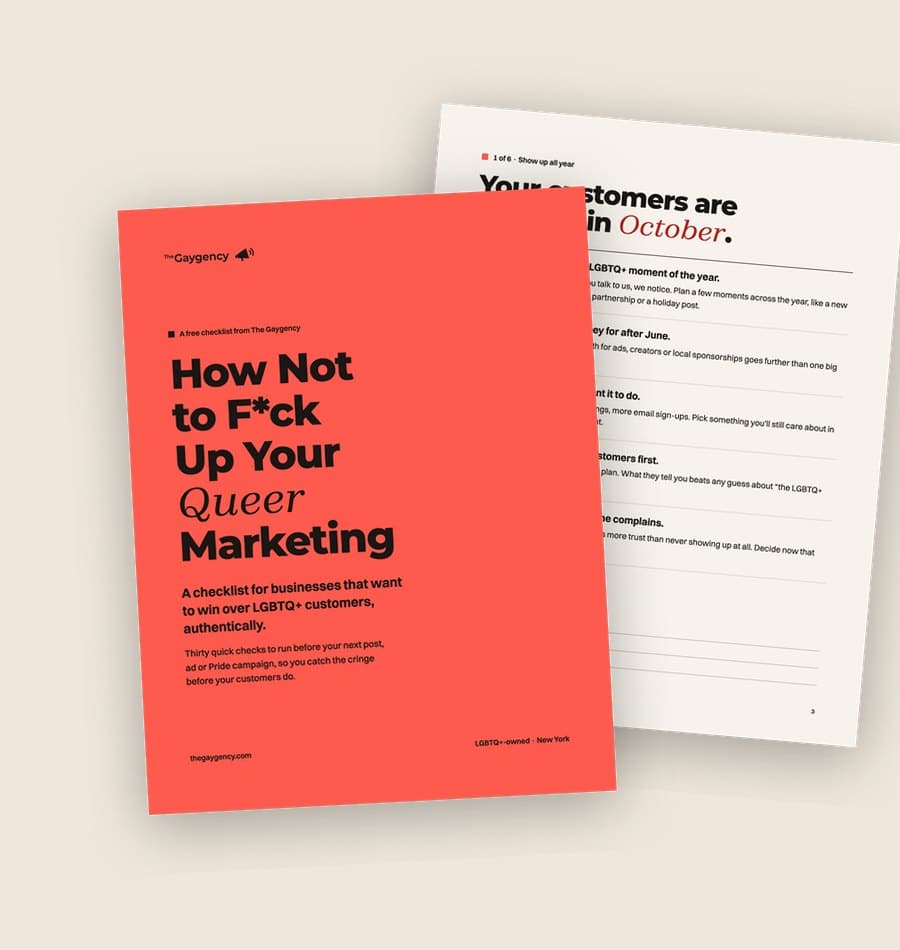
Free checklist
How not to f*ck up your queer marketing
A checklist for businesses that want to win over LGBTQ+ customers, authentically.
Thirty quick checks to run before your next post, ad or Pride campaign, so you catch the cringe before your customers do.
Delivered by email. No spam, ever.
Written by
The marketing and advertising agency for LGBTQ+ businesses and the brands that back them. Strategy, media buying, and brand systems with published results.
See the work