Paid Media
The 12-Point Inclusive Ad Campaign Checklist
By The Gaygency · 08-20-26 · 9 min read

Fewer brands are running visible inclusive campaigns right now, and the ones that do are getting watched more closely for it. Gravity Research's 2025 Pride Pulse Poll found 39% of large companies planned to scale back Pride-related engagement that year, up from just 9% the year before. The Human Rights Campaign Foundation's 2026 Corporate Equality Index recorded a 65% drop in Fortune 500 participation, from 377 companies in 2025 to 131 in 2026. Fewer campaigns in market means each one that runs gets more scrutiny, with a smaller crowd of peers to hide inside.
That scrutiny cuts both ways. HRC's Foundation "Pride in the Marketplace 2026" report found that 71.5% of LGBTQ+ consumers report buying less from companies they see as retreating from inclusion, and 69.5% say they spend more with companies they see as supportive. A campaign that gets the details right is doing real commercial work. A campaign that gets them wrong is doing the opposite, in front of an audience that is currently paying closer attention than it has in years.
This checklist is built to be run before a campaign ships, not after someone in the comments notices what the brief missed. It covers targeting, creative, budget, and the parts of the process that only become obvious once a campaign is already live.
Fewer campaigns in the market does not lower the stakes. Each one now runs exposed.
1. Name the specific audience, not the umbrella
"LGBTQ+ audience" is not a targeting brief. A gay man in his fifties, a bisexual college student, and a trans professional building a career do not share a media diet, a set of concerns, or a response to the same creative. Before anything else gets built, name the actual audience: who specifically, what do they care about, and why does this product or message matter to them in particular. Everything downstream, creative, channel, offer, gets sharper once the audience stops being a category and starts being a person.
2. Confirm what is replacing lost interest targeting
Meta removed detailed-interest categories including "LGBT culture" from its ad system in 2022, and eliminated detailed targeting exclusions entirely by March 2025. That means a brand cannot ask Meta to find this audience by stated interest anymore, only ask the platform to optimize toward whoever converts. Before the campaign launches, know what is doing the targeting work instead: a first-party list, a lookalike built from real customer data, a creator partnership, or a contextual placement. If the answer is "the algorithm will figure it out," the campaign is running blind on precision it used to have and no longer does.
3. Run the creative against the five rainbow-washing patterns
Before creative gets approved, check it against the patterns audiences have learned to spot: seasonal presence with no rest-of-year follow-through, products with no named beneficiary, donation language with no dollar figure attached, representation that exists only in the ad and nowhere else in the brand, and messaging that would not run the same way in every market the brand sells in. Our guide to rainbow washing walks through all five with the specific language patterns to flag. A single pass through that list, before the creative locks, catches most of what an audience would catch after launch.
4. Confirm the budget survives past the campaign window
If the media plan and content calendar both go quiet the week after the campaign ends, that absence is visible and it is remembered. Check whether spend, content, and any partnership named in the creative continue on a normal cadence afterward. A campaign that is the only inclusive thing a brand does all year reads exactly like what it is, regardless of how well the copy was written.
5. Name the number if the campaign claims to give back
"A portion of proceeds supports the community" is a sentence that invites the question it does not answer: which portion, of what, going where. If a campaign includes a donation or cause tie-in, put the dollar amount, the recipient organization, and the timeframe in the creative or the landing page. Five percent of twenty thousand dollars is one thousand dollars. Naming it costs nothing and answers the question before it gets asked publicly.
6. Check who wrote the brief as well as who appears in the ad
Representation in the casting is not the same as representation in the room where the strategy got decided. Before production, confirm that people from the audience being targeted had input on the brief, the concept, and the tone, at a real rate of pay, beyond appearing in front of the camera. This is the difference between a campaign that reads as informed and one that reads as a good-faith guess.
7. Match the landing page to the ad's exact promise
An ad earns a click by making a specific promise. If the page behind it is a general homepage, or makes a broader or vaguer claim than the ad did, the visitor notices the gap immediately and the conversion rate shows it. Confirm the landing page opens with the same message the ad made, offers one clear next step, and does not ask the visitor to do the work of finding what the ad already promised.
8. Get a read from someone outside the team
Before the campaign locks, have someone who was not in the room, ideally someone who shares the identity or experience the campaign is speaking to, look at the creative cold. Ask what reads as genuine and what reads as a guess. This is a cheap step that catches blind spots a team that has been staring at the same deck for three weeks will not see on its own.
A reviewer who was never in the room sees the campaign the way the audience will, without the context that made every internal choice feel obvious.
9. Check the language against the current vocabulary, not last year's
Terminology in this space moves. A term that was standard two years ago can read as dated or, in some cases, as a term the community itself has moved away from. Check copy and captions against a current reference rather than the brand's own style guide from the last campaign, and update the style guide itself once the check is done so the next campaign starts from the current version instead of repeating the audit from zero.
10. Build the response plan before the first comment arrives
Decide in advance what triggers a response, who signs off on it, and what the brand's actual position is if the campaign draws pressure from either direction. This is not a hypothetical: 61% of companies scaling back Pride engagement in Gravity Research's 2025 poll cited pressure from politically motivated critics as the driver, and that pressure lands on campaigns that are already live, not ones still in planning. A team that decides its position after the first hostile comment is reacting in public. A team that decided it during the brief is executing a plan.
11. Track this audience's numbers separately from the blended campaign report
If the results from this specific creative or audience segment get folded into one blended report with the rest of the campaign, there is no way to tell afterward whether the inclusive approach worked or whether it rode on the coattails of everything else running at the same time. Set up measurement that isolates this audience's performance from day one, so the next budget conversation has real evidence instead of a guess.
12. Decide now whether the campaign runs the same everywhere
Geographic selectivity, running a campaign in markets where it is safe and quietly pulling it in markets where it might draw pushback, is one of the most visible ways an audience notices a brand's support has limits. Decide before launch whether the campaign runs unchanged in every market the brand sells in. If the honest answer is no, that is worth knowing before launch, not discovering when someone screenshots the discrepancy.
A brand that decides its position during the brief is executing a plan. A brand that decides it after the first comment is reacting in public.
The two-minute version, before anything ships
- Does the creative survive the five rainbow-washing patterns?
- Does the budget and calendar continue after the campaign ends?
- Is there a name and a dollar figure behind any donation claim?
- Does someone know what happens if this draws attention, and who signs off on the response?
None of this requires a bigger budget. Most of it requires deciding things earlier than most teams currently do, and putting the decision in writing before a launch date is set. Brand teams working at this scale, where legal, comms, and marketing all need to sign off before anything ships, tend to need the response plan in item 10 the most. Enterprise teams we work with build that plan alongside the media plan from day one.
Frequently asked questions
Does this checklist apply to a single ad, or does it need a full campaign to be worth running?
It scales down. A single ad set still has an audience, a creative claim, and a landing page, which covers most of the checklist. The items about budget continuity and market consistency matter more the bigger the campaign gets, but nothing here requires a large media spend to be worth doing.
What if the campaign is not specifically an LGBTQ+-focused campaign, just a general campaign meant to be inclusive of everyone?
Run the same checklist. A general-market campaign that includes LGBTQ+ people in its casting or messaging is making the same claims a dedicated campaign makes, just with less specificity, which makes items 1, 3, and 6 matter even more. Vague inclusion invites the same scrutiny as a dedicated campaign that gets the details wrong.
How much does the targeting item matter if we are not running paid social?
It matters less for organic content and press, more for anything running through paid social or paid search, where Meta's targeting changes directly affect how precisely a campaign can reach this audience. If paid media is any part of the plan, know what is doing the targeting work before the budget goes live.
Who should own the crisis response plan in item 10?
Whoever has the authority to make a call fast, usually a named person in marketing or communications with a clear escalation path to legal, should own it, not a committee assembled after the fact. The plan should specify what response level matches what kind of pressure, decided in a calm room before launch.
Is a checklist like this overkill for a smaller brand or a single campaign?
No. Smaller brands have less room to absorb a misstep, since they do not have years of consistent behavior to point to if a single campaign gets criticized. A short, honest audit before launch costs an afternoon. Skipping it and fixing the fallout afterward costs considerably more.
Running this list before a campaign locks takes an afternoon. Skipping it and finding out what it missed after launch costs far more. Book a call and we will run your next campaign through it together before the budget goes live.
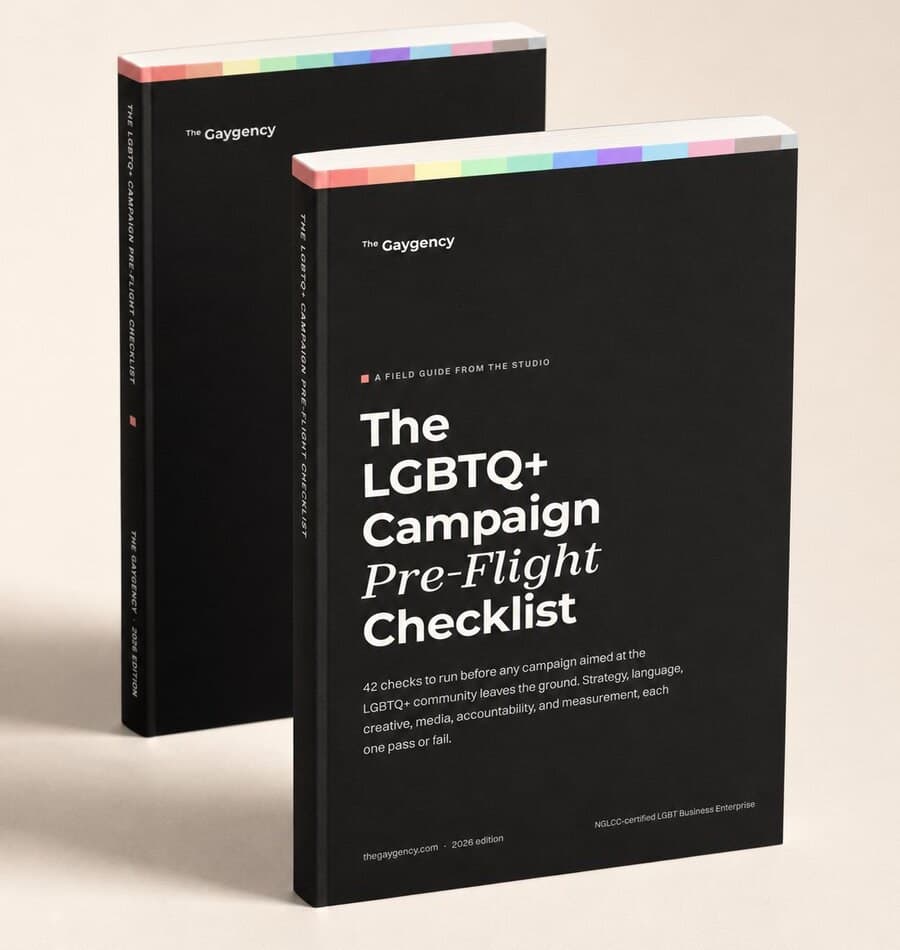
Free campaign guide
Would your campaign pass pre-flight?
The same 42 checks we run inside the studio before any campaign aimed at the LGBTQ+ community goes live.
Delivered by email. No spam, ever.
Written by
The marketing and advertising agency for LGBTQ+ businesses and the brands that back them. Strategy, media buying, and brand systems with published results.
See the work