Paid Media
Choosing the Right Ad Platform for Your Budget
By The Gaygency · 05-28-26 · 8 min read

The most expensive mistake in early-stage advertising is not picking the wrong platform. It is picking four platforms at once with a budget that cannot make any single one of them work. Every platform's algorithm needs a minimum volume of spend and conversions to learn who buys from you. Split $1,500 four ways and you have paid for four educations and completed none of them.
This guide covers what each major platform is built to do, current benchmark costs, the minimum monthly budget to run an honest test, what to measure at each stage, and the two questions that settle where to start. Where we cite a number from our own accounts, it is a verified client result. Where we cite an industry average, it has a named source and a year, so you can check it yourself.
A platform test you cannot afford to finish is not a test. It is a donation with reporting.
Meta: Facebook and Instagram
Built for: direct-to-consumer products, services with a visual component, and any business where the buyer is a person rather than a procurement committee.
Meta still has the deepest targeting infrastructure in consumer advertising: interests, behaviors, and lookalike audiences modeled on your existing customers. Its feed, Stories, and Reels formats reward brands that invest in creative, and it is the strongest engine available for demand creation: it puts your product in front of people who were not looking for it and makes them want it.
That is also its limitation. Nobody on Instagram is searching for anything. Your ad interrupts, so the creative has to do all the work. Weak creative on Meta does not underperform, it disappears.
Current benchmark trackers put average Meta CPMs somewhere between $6 and $15 across placements, with cost per click commonly landing between about $1 on Facebook and $3.35 on Instagram feed placements. Instagram typically costs more per click than Facebook because of stronger engagement and advertiser competition for the same inventory (Sovran Meta ads benchmarks, 2026). Those are starting points, not targets: what the platform can do with room to work is what matters. Our Out Adventures program generated 6,618 travel leads on roughly $28,000 of Meta spend, with cost per lead falling from $7.47 to $3.64 as the account learned, while click-through rate climbed from 2.26% to 4.34%. Costs dropping while volume grows is what a healthy Meta account looks like. It took consistent budget and months of creative iteration to get there, not a lucky ad.
Minimum honest test: $500 a month, held for a full quarter. Below that, the algorithm never exits its learning phase and every result is noise.
Measure: cost per click, click-through rate, and cost per purchase or lead. On cold audiences, a CTR of 1% to 2% is healthy; under 0.5% means the creative or the audience is wrong.
Google Search
Built for: capturing demand that already exists. If your customer types a search before buying, Google owns the moment of highest intent you can purchase.
Search does not create desire. It harvests it. "Emergency plumber near me" and "brand strategy agency for startups" are people trying to give someone money today. WordStream's 2026 benchmark report, built from more than 13,000 US Search campaigns running April 2025 through March 2026, puts the average cost per click at $5.42, average conversion rate at 8.18%, and average cost per lead at $66.69 across industries (WordStream, 2026). The spread by category is wide: the same report shows Arts and Entertainment averaging $1.63 a click and Attorneys and Legal Services averaging $9.87, so your own category matters more than the blended average.
If meaningful search volume exists for what you sell, paid search is usually the fastest path from spend to revenue. If nobody searches for your category yet, no bidding strategy can fix that, and a demand-creation platform has to come first.
The strongest accounts run both engines together. Across seven months managing Automic Gold, Meta and Google combined tracked $1.12M in revenue at a 6.77x blended ROAS: Meta introducing the brand to new buyers, Search catching them when they came back with intent. Neither channel posts numbers like that alone.
Minimum honest test: $1,000 a month. Competitive keywords run well above the cross-industry average, and you need enough clicks for conversion data to mean something.
Measure: cost per acquisition, conversion rate, and Quality Score on core keywords. A Quality Score below 5 says your ad and landing page are not answering the search.
Platform decisions get made by comparing cost per result across channels, not by comparing follower counts.
TikTok
Built for: awareness and demand creation with audiences under 35, for brands that can feed a video machine.
TikTok's distribution is among the cheapest attention in paid media right now. Benchmark trackers put average in-feed CPMs around $9 in 2026, roughly a third below comparable Meta placements, with cost per click near $1 (TikTok advertising benchmark data, 2026). Purchase intent is the trade-off: people open the app to be entertained, and buying is an interruption. Brands that win treat the platform's native grammar as a spec. Vertical, fast, lo-fi. Polished agency spots underperform a founder talking into a phone, and every ad wears out in weeks, so the real cost of TikTok is creative production, not media.
Minimum honest test: $500 a month, plus the capacity to produce new video weekly. Without fresh creative, the budget number is irrelevant.
Measure: CPM, video completion rate, CTR, and brand search volume over time. Rising branded search is TikTok working even when last-click reports say nothing happened.
Built for: B2B offers priced above roughly $5,000, where reaching the right job title is worth a premium.
LinkedIn is the only platform that reliably targets by title, seniority, company size, and industry, and it charges accordingly. The LinkedIn B2B Benchmark Report puts the average cost per click at $5.59, with three quarters of campaigns paying more than $6 a click and most landing between $5 and $9 (Impactable, 2026). Cost per lead swings widely with audience and offer, from well under $100 in cheaper international regions to $230 or more for North American targeting (The B2B House, LinkedIn ad benchmarks). Selling SaaS to HR directors at 500-person companies, that math works. Selling a $49 consumer product, it never will. Use it for lead generation into a longer sales cycle, not direct purchase.
Minimum honest test: $1,500 a month.
Measure: cost per lead, lead quality against your target titles, and pipeline influenced across the full cycle.
Minimum monthly budgets to test honestly
| Platform | Minimum to test | Reliable data begins |
|---|---|---|
| Meta | $500/mo | $1,500/mo |
| Google Search | $1,000/mo | $3,000/mo |
| TikTok | $500/mo | $1,500/mo |
| $1,500/mo | $3,000/mo |
Minimum monthly ad budgets by platform
Below the minimum, you will still collect data. It just will not be reliable enough to act on, and the usual outcome is abandoning a platform that would have worked at proper volume.
Two questions decide where to start
Is your customer already searching for what you sell? Yes: start with Google. No: start with Meta, because demand has to be created before it can be captured.
Is your buyer a consumer or a business? Consumer: Meta, adding TikTok if your audience skews under 35 and you can produce video. Business: LinkedIn, unless the decision-maker is an owner-operator, in which case Meta reaches the same person at a fraction of the click cost. Common for companies under 50 employees, which is also where most of the founders in our for startups work start this decision from scratch.
One platform, sixty days, before you consider a second. Every account we have ever audited that ran three platforms on a four-figure budget was underfunding all three.
Pick the platform that matches how your customer already behaves. Then fund it like you expect an answer.
What to measure at each stage
Days 0 to 30, testing: CTR, CPC, and whether bought traffic converts on your site at all. No clicks means creative or targeting is wrong. Clicks without conversions means the landing page is the problem, and no platform change fixes that.
Days 30 to 90, optimizing: cost per acquisition and ROAS by campaign. Lead-gen businesses should track cost per qualified lead, not raw lead count. Cheap leads that never close are expensive.
Day 90 onward, scaling: lifetime value against acquisition cost. A 2.5x ROAS can be excellent or fatal depending on margin and repeat purchase. Run the arithmetic on your own unit economics before declaring victory or quitting, and build measurement that survives contact with reality.
Every month of the Automic Gold run published a report built from the ad accounts themselves. That is the standard worth demanding from anyone who touches your budget, including us: numbers from the source, monthly, in writing.
Frequently asked questions
How much should I spend to test a new ad platform?
Enough to let the platform's algorithm exit its learning phase, which for most platforms means a minimum of $500 to $1,500 a month held for a full quarter. Below that threshold you will collect data, but not enough to separate a real result from noise.
Which is cheaper, Meta or TikTok ads?
TikTok generally runs cheaper on cost per thousand impressions, with 2026 benchmark data putting average in-feed CPMs near $9 against $7 to $15 for Meta placements. The savings only pay off if you can produce native-feeling video weekly, since TikTok creative wears out faster than Meta creative.
What is a good cost per click for Google Ads?
The 2026 cross-industry average is $5.42 per click, but the honest answer depends on your category: it runs closer to $1.63 in low-competition categories and above $9 in categories like legal services, where customer value is high enough to justify the bid (WordStream, 2026).
Should I run Meta and Google at the same time?
Once each is individually funded and working, yes. Meta creates demand and Google captures the people who come back to search for you by name, which is why our strongest client results, like the Automic Gold account, come from running both engines together rather than picking one forever.
How long before I know if an ad platform is working?
Give it a full quarter at the minimum honest budget before judging it. The first 30 days test whether traffic converts at all, the next 60 tell you the real cost per acquisition, and anything before that is the algorithm still learning who your buyer is.
If you would rather someone carried this whole decision for you, that is the job of our paid social and paid search teams, and the first call is where we tell you honestly which platform your budget can support. Book a call to start there.
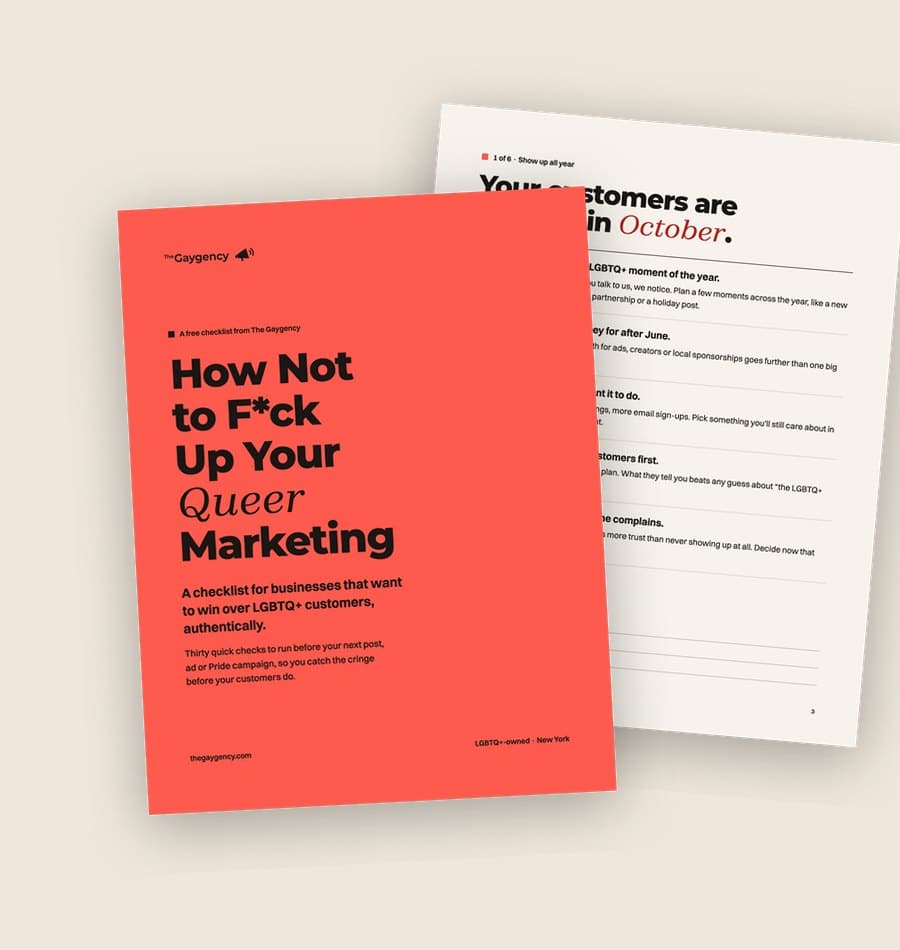
Free checklist
How not to f*ck up your queer marketing
A checklist for businesses that want to win over LGBTQ+ customers, authentically.
Thirty quick checks to run before your next post, ad or Pride campaign, so you catch the cringe before your customers do.
Delivered by email. No spam, ever.
Written by
The marketing and advertising agency for LGBTQ+ businesses and the brands that back them. Strategy, media buying, and brand systems with published results.
See the work