The complete guide
Marketing to LGBTQ+ Consumers in 2026: The Complete Guide
By The Gaygency · 07-10-26 · 14 min read

LGBTQ+ people made up 9.3% of U.S. adults, and 23.1% of Gen Z, in Gallup's 2024 data, and 9% of adults in its 2025 data (Gallup, 2024 and 2025 data). That is not a niche. It is a market larger than the Hispanic-American population was a generation ago, and it is growing every year as younger, more comfortable generations replace older ones in the survey data. Most companies still market to it like a seasonal campaign: a logo change in June, a press release, done. That approach was already weak. In 2026, with the ad platforms unable to target this audience with any precision and consumers actively tracking who shows up and who does not, it is a liability.
This guide is the plan we would hand a client starting from zero. It covers who this audience is, what changed on the platforms and in the culture over the past two years, and a framework for building a strategy that holds up whether you are a ten-person startup or a Fortune 500 brand team.
What LGBTQ+ marketing means
LGBTQ+ marketing is not a rainbow logo in June. It is the practice of building products, messages, and media plans that reflect an audience accurately, on purpose, all year, and defending that work when it gets tested. Done well, it looks like any other audience strategy: research, positioning, channel selection, measurement. The only difference is the audience.
Done badly, it becomes what critics call rainbow-washing: a company changing its branding to appear supportive of the LGBTQ+ community without matching internal policy, giving, or business practice. The tell is usually timing. Support that appears every June and disappears every July is not a strategy. It is a costume, and LGBTQ+ consumers can tell the difference. A brand that sponsors a local Pride event, gives to LGBTQ+ causes in December as easily as in June, and keeps its policies consistent when nobody is watching earns something a campaign cannot buy: trust that survives a bad news cycle.
That distinction matters more now than it did five years ago, because the audience is watching more closely, and because most of the LGBTQ+-specific data infrastructure the industry used to lean on has changed hands. Community Marketing & Insights, the research firm whose surveys underpinned a large share of the LGBTQ+ consumer statistics cited across the industry for three decades, was acquired by the HRC Foundation and folded into a new research effort in late 2025, and now trades as Community Insights. The neutral, marketer-facing annual consumer survey slot that firm used to fill is effectively open. That is part of why we built our own dataset, and part of why this guide leans on primary sources you can check yourself instead of secondhand statistics nobody can trace.
The size of the audience, and why it keeps growing
Gallup has tracked LGBTQ+ identification in the U.S. every year since 2012, and the trend line only moves one direction. In Gallup's 2024 data, 9.3% of U.S. adults identify as lesbian, gay, bisexual, transgender, or something other than heterosexual, up from 7.6% in 2023 (Gallup, 2024 data). Among Gen Z, the figure is 23.1%, compared with 14.2% of millennials (Gallup, 2024 data). Gallup's newer release, using 2025 data, puts the overall share at 9%.
Read that generational gradient carefully, because it is the whole business case in one sentence: this is not a stable niche audience. It is a demographic that compounds every year as older cohorts are replaced by younger ones with dramatically higher identification rates. A company that ignores this audience today is ignoring a market that will be measurably larger in five years, built on a customer base that is younger, on average, than the company's existing one.
The buying power attached to that population is not speculative either. The HRC Foundation's Pride in the Marketplace 2026 report puts LGBTQ+ consumer spending power in the United States at more than $1.4 trillion annually (HRC Foundation, 2026). Separately, the National LGBTQ+ & Allied Chamber of Commerce (NGLCC, formerly the National LGBT Chamber of Commerce) says LGBT business owners generate over $1.7 trillion in economic impact (NGLCC website, accessed 2026). Whichever number you anchor on, the conclusion is the same: this audience is not a rounding error in anyone's total addressable market.
What changed: the platforms stopped doing the targeting for you
For most of the last decade, marketers who wanted to reach LGBTQ+ audiences on Meta could build an interest-based audience around LGBT culture and community and let the algorithm do the rest. That option is gone. Meta removed LGBT-interest and sexual-orientation targeting categories in 2022, and in March 2025 it went further, removing detailed targeting exclusions from ad campaigns entirely, so advertisers can no longer even exclude by those categories to sharpen a broader audience (Meta Business Help Center, 2025).
The practical effect is that precise interest-based targeting toward this audience, the kind every performance marketer relied on for a decade, no longer exists as a platform feature. Anyone still running the old playbook is buying broad reach and hoping some of it lands on the right people. That is expensive, and it is also why first-party data has become the only precise lever left. A brand with its own verified audience list, whether built from a loyalty program, a CRM, or a licensed dataset, can build lookalike audiences the platforms themselves can no longer construct. That gap is exactly why we built our own dataset of more than one million verified LGBTQ+ consumers, held as a secure, hashed record set. It exists as an optional add-on to our paid media work at paid social and paid search, specifically because the platforms can no longer do this job on their own.
The media environment has shifted alongside the targeting tools. GLAAD's 2026 Social Media Safety Index scored the major platforms on LGBTQ safety, privacy, and expression, and none of them scored above 56 out of 100: TikTok led at 56, followed by Instagram at 41, Facebook at 40, Threads at 39, YouTube at 30, and X at 29 (GLAAD, 2026). At the same time, users are moving. Bluesky's first full transparency report showed the platform grew from 25.9 million to 41.4 million users over the course of 2025, a gain of nearly 60% (Bluesky Transparency Report, 2026). None of this means abandon Meta or Google. It means the assumption that any one platform is a safe, stable, precisely targetable home for this audience no longer holds, and a channel plan built in 2021 is due for a rebuild.
The platforms stopped doing the targeting for you. First-party data is now the only precise lever left, and most brands do not have any.
The buycott: consumers are already voting with their wallets
While targeting got harder, consumer behavior got more decisive. The same HRC Foundation report found that 71.5% of LGBTQ+ consumers report buying fewer products from companies they perceive as reducing inclusion commitments, and about 70% say they have increased spending with companies they view as genuinely supportive (HRC Foundation, 2026). CNBC's reporting on the same data named the companies most cited by consumers on each side: Target, Walmart, and Amazon among those losing support, and Costco, Apple, and Kroger among those gaining it (CNBC, June 2026).
This is not a boycott organized by an advocacy group. It is millions of individual purchase decisions responding to what companies do, tracked in real time by consumers who have more information about corporate behavior than they did five years ago. A company's Pride-adjacent choices, whether it shows up, whether it pulls back quietly, whether it keeps a policy after the parade ends, are now a measurable input to its revenue. That is the argument for treating this as a marketing and business function, not a communications afterthought.
Why specialist agencies outperform generalists here
The ANA's LGBTQ+ Marketing Inclusion Report found that 64% of brands doing LGBTQ+ marketing do not use a specialized agency at all. Among the ones that do, 75% chose a certified LGBT-owned shop (ANA, LGBTQ+ Marketing Inclusion Report, 2021). Read together, those numbers describe a market with real demand and thin, fragmented supply: most companies are handling this work in-house or through a generalist agency with no specific expertise in the audience, and the minority who do bring in outside help overwhelmingly prefer a certified specialist once they look for one.
That preference is not sentimental. A specialist agency brings a few things a generalist typically cannot: firsthand cultural fluency instead of secondhand research, an existing point of view on what reads as authentic versus performative, and in our case, a dataset built specifically for this audience rather than a general market tool retrofitted for it. We are an NGLCC-certified LGBT Business Enterprise, founded in 2022, based in New York, and we have generated more than $15 million in tracked client revenue since then. Our founder also designed, built, and shipped a dating app, Gaydar, now live on both the Apple App Store and Google Play, which is a different way of saying we build products for this audience as well as marketing for it.
A framework for getting this right
Whether you are launching your first campaign toward this audience or rebuilding a strategy that has coasted for years, the sequence is the same.
1. Get the positioning right before you write a single ad. Who you are to this audience, and why that answer holds up under scrutiny, has to be settled before creative starts. This is foundational strategy work, not a tagline exercise. See brand strategy for how we approach it.
2. Build one message architecture, not a Pride-only one. The language you use for this audience should trace back to the same core positioning you use everywhere else, translated for context, not invented fresh every June. A dedicated messaging framework keeps every channel, every writer, and every quarter consistent. See messaging framework.
3. Choose channels based on where the audience is, not where your media plan already lives. Organic and paid social still matter, but the targeting reality above means your plan needs first-party data, creator partnerships, and earned media working together, rather than one channel doing the whole job.
4. Fix your measurement before you scale spend. Attribution is harder in a post-targeting, post-cookie environment. Build a measurement plan that tells you the truth before you put real budget behind it. See measurement and analytics.
5. Decide your visibility posture on purpose, at every level of the organization, before a crisis forces the decision for you. Some brands can and should be loud. Others need a calibrated, tiered approach: internal support, community-level sponsorship, and mainstream-facing visibility handled as three separate decisions with three separate risk profiles. Waiting until a reporter calls is not a strategy.
Rainbow-washing, defined plainly: a company adjusts its branding, messaging, or visuals to appear supportive of the LGBTQ+ community during Pride season without matching internal policy, philanthropic giving, or business practice the rest of the year. The test is simple. Would the company still be doing this in October? If the honest answer is no, the campaign is a costume, not a strategy.
Marketing to LGBTQ+ consumers by business stage
The right first move looks different depending on where a business is.
Startups and founder-led businesses usually need foundational brand and message work before they need media spend, because without a clear position, every dollar of paid traffic is buying clicks for an unclear pitch. If that is where you are, for startups walks through how we price and sequence that work for early-stage budgets.
Established businesses with real revenue and a flat quarter usually have the opposite problem: enough brand recognition that the plateau is a systems problem, not a positioning problem. The fix is typically an integrated system across paid media, content, and lifecycle email, measured honestly, rather than another one-off campaign. See for established brands.
Enterprise and corporate brand teams are navigating a genuinely harder problem than either of the above: real spending power in this audience, real political risk attached to visibility, and often no reliable internal data to make the call. That calls for a calibrated, evidence-first approach before any creative gets made. See for enterprise.
Marketing to LGBTQ+ consumers by industry
Generic LGBTQ+ marketing advice tends to break down the moment it meets a specific industry, because the buying behavior, the trust signals, and the media habits are different in every category. A few examples from our own industry pages: travel and hospitality buyers plan trips around perceived safety and community as much as price, which changes what earns a booking (see travel and hospitality). Bars, nightlife, and event businesses live or die on local community trust and word of mouth before a single ad runs (see bars, nightlife, and events). Wellness and med spa buyers are making a decision about who they trust with their body, which makes provider credibility do more work than any promotional offer (see med spas and wellness). Nonprofits and community organizations are often marketing to the same audience they serve, which changes the entire tone of the ask (see nonprofits and community). If your category is not listed here, the same principle holds: start with what drives trust in your specific buyer, not with a generic template.
Common mistakes we still see in 2026
Treating Pride Month as the whole strategy. A single push in June, with no presence the rest of the year, reads exactly as calculated as it is. Consumers who track this closely notice the silence in July more than the noise in June.
Copying a competitor's campaign instead of building a position. LGBTQ+ audiences are not a monolith, and a message built for one brand's specific customer base rarely transfers cleanly to another. What worked for a fashion brand will not automatically work for a healthcare company or a financial services firm.
Outsourcing the work to a generalist agency with no track record here. Per the ANA data above, this is still the default for most companies, and it is exactly the gap that leads to tone-deaf creative, missed cultural context, and campaigns that read as translated rather than written.
Skipping measurement because the campaign "felt" successful. Vibes are not a KPI. If you cannot show what the campaign did to revenue, leads, or retention, you cannot defend the budget next year when someone asks whether it worked.
Making a visibility decision reactively, under pressure, instead of in advance. The brands handling this best in 2026 decided their posture before the pressure arrived, with a framework for how far to go at every level, rather than improvising an answer when a reporter or an activist group asks a hard question.
None of these five mistakes are exotic. Each one is what happens by default when this audience gets treated as a June checkbox instead of a market.
The specialist advantage, in practice
We built The Gaygency in 2022 specifically to close the gap the ANA data describes: real demand for LGBTQ+-competent marketing, and a market of generalist agencies that treat this audience as an afterthought. We are NGLCC-certified as an LGBT Business Enterprise, based in New York, and we have generated more than $15 million in tracked client revenue for the businesses we work with since founding. Our proprietary dataset covers more than one million verified LGBTQ+ consumers, held securely and offered as an add-on to paid media engagements precisely because the platforms cannot build that targeting on their own anymore. We also build the products this audience uses, alongside the ads aimed at them. Our team designed and shipped Gaydar, a dating app now live on the Apple App Store and Google Play, which means our understanding of this audience did not come from a slide deck.
The demand for specialist LGBTQ+ marketing is not the problem. The supply is fragmented, and most of it is unproven.
Frequently asked questions
What percentage of the U.S. population identifies as LGBTQ+?
9% of U.S. adults, based on Gallup's 2025 data. Its 2024 data gave 9.3%, up from 7.6% in 2023, and 23.1% among Gen Z specifically (Gallup, 2024 data and 2025 data).
How much spending power do LGBTQ+ consumers have?
The HRC Foundation's Pride in the Marketplace 2026 report estimates LGBTQ+ consumer spending power in the United States at more than $1.4 trillion annually (HRC Foundation, 2026).
Is Pride Month marketing still worth doing in 2026?
Yes, if it is one part of a year-round strategy rather than the entire strategy. Consumers actively track whether support disappears after June, and a June-only presence now reads as a warning sign rather than a positive signal to a meaningfully large share of this audience.
What is rainbow-washing, and how do I avoid it?
Rainbow-washing is adjusting branding to appear supportive of LGBTQ+ people during Pride season without matching internal policy or year-round practice. The way to avoid it is straightforward: keep your giving, your policies, and your messaging consistent across all twelve months, and be able to explain your involvement to a skeptical customer in October as easily as in June.
Do I need a specialist agency, or can my current agency handle this?
It depends on whether your current agency has a track record with this specific audience. The ANA's research found that most brands still do not use a specialist for this work, and among the ones that switch to one, the overwhelming preference is for a certified LGBT-owned agency (ANA, LGBTQ+ Marketing Inclusion Report, 2021). If your current partner cannot show you relevant experience and results, that is worth weighing against the cost of a switch.
If you want a plan built for your business specifically, not a generic template, book a call and we will walk through where you stand.
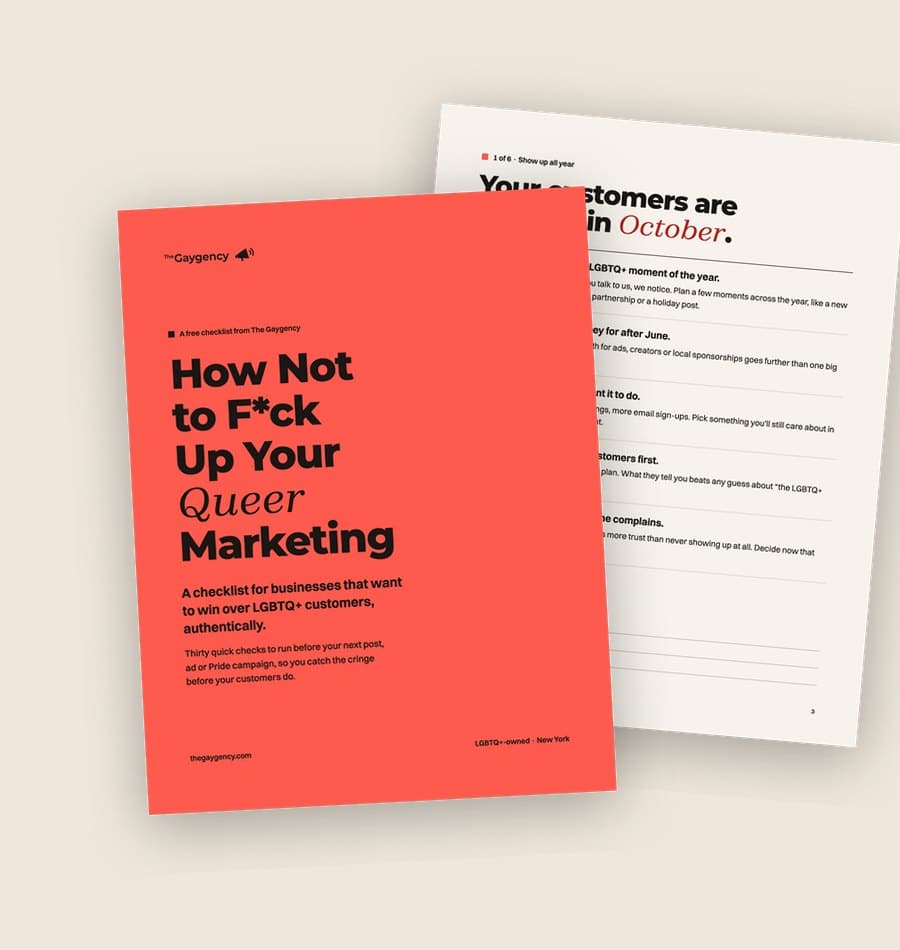
Free checklist
How not to f*ck up your queer marketing
A checklist for businesses that want to win over LGBTQ+ customers, authentically.
Thirty quick checks to run before your next post, ad or Pride campaign, so you catch the cringe before your customers do.
Delivered by email. No spam, ever.
Written by
The marketing and advertising agency for LGBTQ+ businesses and the brands that back them. Strategy, media buying, and brand systems with published results.
See the work