Pride Marketing
How to Debrief a Pride Campaign: Metrics That Matter
By The Gaygency · 08-06-26 · 7 min read
August is when most Pride campaigns get filed away unreviewed. The push shipped in June, the team moved on to the next quarter, and nobody opened the ad account again until someone asks what it delivered. That gap is not neutral. Two numbers from 2025 and 2026 explain why: Gravity Research found 39 percent of large companies cut back their public Pride engagement in 2025, and the Human Rights Campaign Foundation's "Pride in the Marketplace 2026" research, reported by CNBC on June 17, 2026, found 71.5 percent of LGBTQ+ consumers buy less from brands they see as retreating. A campaign that never gets debriefed is a campaign nobody can defend keeping, cutting, or repeating with evidence, right at the moment that decision carries real revenue risk in either direction.
This is the process we run with clients every August. It has six steps, and none of them is "count the likes."
Step 1: Pull the raw numbers before the platforms archive them
Ad platforms retain granular campaign data for a limited window, and organic reach data ages out of easy access even faster. Before anything else, export impressions, spend, click-through rate, conversions, and cost per result by channel and by creative, not the campaign-level rollup alone. If your measurement and analytics setup routes everything into one dashboard already, this step takes an afternoon. If it does not, this is the year to fix that before the next campaign, not after.
Step 2: Separate reach from revenue
Reach, impressions, and follower growth measure attention. They do not measure whether the campaign produced a customer, a lead, a signature, or a booking. Pull the actual conversion numbers tied to the campaign window and compare them against a normal month, not against last year's Pride numbers alone, since community sentiment shifted meaningfully between 2025 and 2026. A campaign with strong reach and flat conversion is a creative or targeting problem worth naming directly in the debrief, not a result to round up.
A campaign that reached a million people and converted the same number of customers as a quiet Tuesday is not a Pride win. It is a media buy that needs a different creative brief next year.
Comparing against a normal month matters because sentiment shifted enough between 2025 and 2026 that last June is no longer a clean baseline.
Step 2.5: Read the comments, not the count alone
Engagement rate tells you how many people interacted. It does not tell you what they said. Before you close the numbers portion of the debrief, pull a sample of comments, DMs, and any customer service tickets that referenced the campaign, and read them for sentiment, not volume. A campaign with modest reach and a comment section full of specific, personal thank-yous is doing something a campaign with ten times the reach and a comment section full of generic emoji reactions is not. If your team has an employee resource group or LGBTQ+ staff members who were willing to review the creative before launch, ask them for a second read now: did the campaign land the way it was intended to, or did something read differently to the people it was about than it did to the people who approved it.
Step 3: Run the November test
Rainbow washing is defined by what a brand does after Pride, not during it. A debrief that only looks at June is grading the campaign on half the evidence.
Rainbow washing is defined by what a brand does after Pride, not during it. Before you write the debrief, check whether the campaign's stated commitment is still visible: is the donation total published anywhere, is the product still for sale, is the partner organization still credited on the website. GLAAD's Social Media Safety Index 2026 scored the platforms most Pride content runs on as unsafe for LGBTQ+ users across the board, with Facebook at 40 out of 100, Instagram at 41, and only TikTok holding above 50 at 56, which means the content itself needs to survive on platforms that are not doing the community-safety work for you. If the answer to the November test is no, the debrief needs to say so before next year's plan gets written, not after.
The November test takes one evening to run, and it answers the question customers are already checking for themselves.
Step 4: Weigh the result against what is at stake
The Corporate Equality Index, HRC's long-running benchmark, saw Fortune 500 participation drop 65 percent, from 377 companies in 2025 to 131 in 2026 (HRC Foundation, 2026; CNBC, February 2026), with Ford, Lowe's, Harley-Davidson, and Molson Coors among the companies that stopped submitting, per Forbes reporting. Meanwhile NYC Pride's sponsorship dollars fell even as its partner count rebounded past 90, according to Campaign US in June 2026, and smaller-market Prides in cities like Tampa went on hiatus while NBC News reported in 2025 that some smaller Prides saw sponsorship drop 70 to 90 percent, with NPR reporting continued declines in May 2026. Your debrief should place your own campaign's performance against this backdrop: did showing up when others pulled back earn measurable attention or loyalty this year, and is that gap visible in your own numbers.
Step 5: Score the campaign against a written scorecard, not a gut check
Build the scorecard before you look at the numbers, not after, so the results do not get graded on a curve set by the outcome. A workable scorecard has five lines: reach versus a normal month, conversion versus a normal month, cost per result versus a normal month, whether the campaign's specific commitment is still visible three months later, and whether internal stakeholders, as well as customers, noticed a difference. Score each line, then write the readout from the scores, not from memory of how the launch week felt.
Weight the lines before you total them. A campaign whose only goal was awareness should weight reach and cost per result heavily and score the commitment-visibility line as a pass or fail rather than a percentage. A campaign built to drive a specific action, a signup, a donation, a booking, should weight conversion and cost per result above reach entirely, since a high-reach, low-conversion result on that kind of campaign is closer to a miss than a partial win. Deciding the weighting in the brief, before the campaign launches, keeps the scorecard from getting reverse-engineered to match whatever result came in.
Step 6: Write the readout and set next year's brief now
The debrief is only useful if it changes next year's plan. Close the document with three decisions: what gets more budget, what gets cut, and what specific commitment the brand is making publicly checkable this time, so next year's November test has a clear answer. That decision belongs in a campaign strategy brief, not a slide that gets filed and forgotten until next May.
A debrief that does not change next year's brief was not a debrief. It was a formality with a chart attached.
A Pride debrief is not complete until it answers all six of these in writing:
- What did reach cost, and what did a conversion cost, separately?
- Is the campaign's specific commitment still visible today?
- How did performance compare to a normal month rather than only last year's Pride?
- Where did the campaign run, and was that platform safe for the audience it targeted?
- What decision is this debrief making about next year's budget?
- Who outside marketing needs to see this readout?
Brand and marketing leaders navigating this decision at scale, where legal, communications, and the C-suite all want a say in what gets published, are exactly who our enterprise engagements are built for: the debrief becomes the evidence base for next year's risk calibration, not a document nobody outside the marketing team ever reads.
Frequently asked questions
What metrics should you track after a Pride campaign?
Track reach, conversion, and cost per result separately by channel, compared against a normal month rather than only last year's Pride numbers. Then add one metric most debriefs skip: whether the campaign's specific commitment, a donation, product, or partnership, is still visible three months later.
How long after Pride should you debrief a campaign?
Pull the raw data within four to six weeks, while ad platform reporting windows are still fully accessible. Run the full scorecard and readout by early autumn, in time to inform next year's budget planning cycle rather than getting rushed the following May.
What is the difference between Pride reach and Pride results?
Reach counts how many people saw the campaign. Results count how many people acted on it: a purchase, a lead, a booking, a signature. A campaign can score well on one and poorly on the other, and a debrief that only reports reach will miss that gap entirely.
How do you know if a Pride campaign built lasting loyalty?
Check the campaign's specific commitment against the calendar three and six months later. HRC's 2026 buycott research found that consumers reward consistency, not a single moment, so the honest test is whether anything the brand promised in June is still true in November.
Should Pride campaign budgets carry into the rest of the year?
The data argues for it. Brands that maintain visible commitments outside of June are the ones benefiting from the loyalty shift HRC documented in 2026, while brands treating Pride as a single seasonal push are the ones losing customers to competitors who stayed present.
Ready to build a debrief process your team will use next year. Book a call and we will set up the scorecard before your next campaign ships.
Free campaign guide
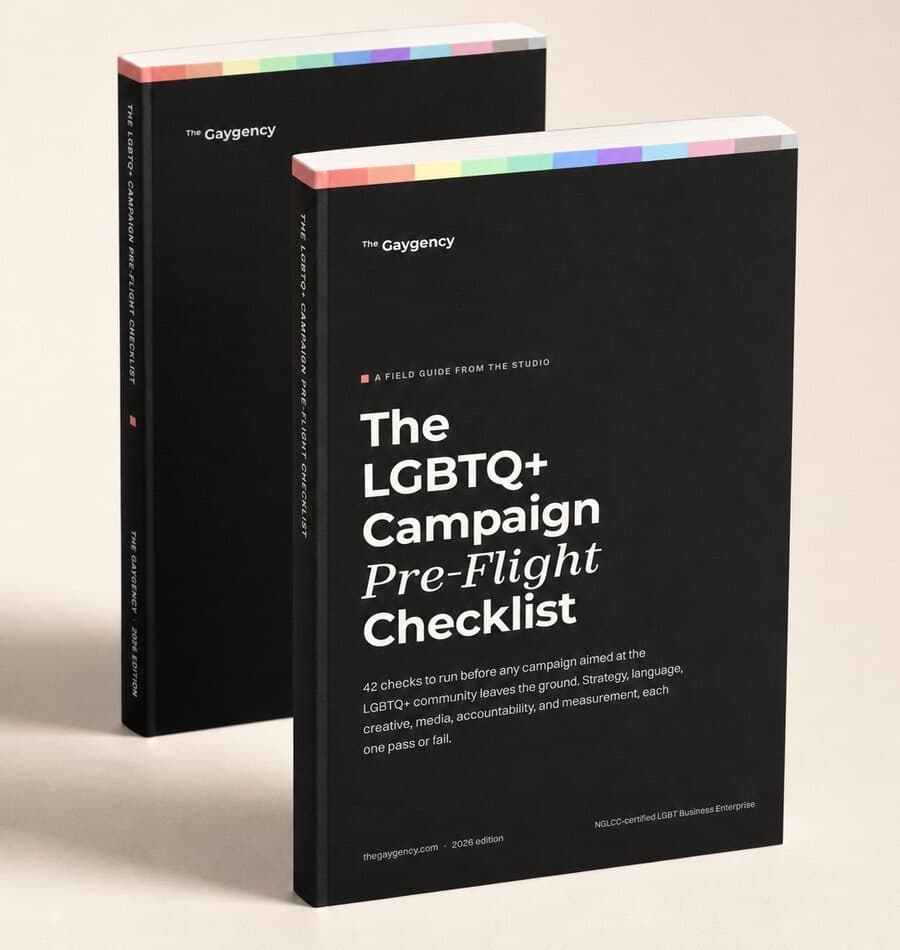
Would your campaign pass pre-flight?
The same 42 checks we run inside the studio before any campaign aimed at the LGBTQ+ community goes live.
Delivered by email. No spam, ever.
Written by
The marketing and advertising agency for LGBTQ+ businesses and the brands that back them. Strategy, media buying, and brand systems with published results.
See the work