Marketing Calendar
Q4 2026 LGBTQ+ Marketing Calendar: Every Date That Matters
By The Gaygency · 07-11-26 · 8 min read

June gets a campaign brief, a media plan, and a budget line. The eight LGBTQ+ observances that land in Q4, several of them inside a single ten-week stretch, usually get nothing at all, or a single social post written the morning of. That gap is worth closing for a simple reason: unlike Pride Month, most of these dates ask for something narrower and cheaper than a full campaign. A plan built now avoids the scramble in October.
Here is every LGBTQ+ observance that falls in Q4 2026, in order, with where each one came from and what a brand should do about it.
The calendar at a glance
- October 1 to 31: LGBTQ+ History Month
- October 11 (Sunday): National Coming Out Day
- October 15 (Thursday): Spirit Day
- October 21 (Wednesday): International Pronouns Day
- October 26 (Monday): Intersex Awareness Day
- November 13 to 19: Transgender Awareness Week
- November 20 (Friday): Transgender Day of Remembrance
- December 1 (Tuesday): World AIDS Day
Eight dates in ten weeks is a recurring quarter, and a brand that plans it in September, instead of reacting to it in real time, looks like it's been paying attention all year.
LGBTQ+ History Month: October
History Month was founded in 1994 by Rodney Wilson, then a high school history teacher in suburban St. Louis and a graduate student at the University of Missouri-St. Louis, which was among the very first colleges in the country to hold a Gay History Month event that first October. October was chosen deliberately: schools are in session, and the month already contains both National Coming Out Day and the anniversary of the first national march on Washington for lesbian and gay rights. GLAAD, HRC, the National Education Association, and the National Gay and Lesbian Task Force have all endorsed the observance since.
What to do: this is a month for depth, not a second Pride campaign. A short editorial series on a piece of LGBTQ+ history relevant to your own category, whether that's fashion, hospitality, medicine, or finance, does more than a rainbow-tinted logo held for four weeks. We cover the full framework for this in a separate guide on History Month campaigns.
National Coming Out Day: October 11
Psychologist Robert Eichberg and activist Jean O'Leary founded National Coming Out Day in 1988 and chose October 11 because it marked the first anniversary of the Second National March on Washington for Lesbian and Gay Rights in 1987. The day centers a personal act: telling the people in your life who you are. That framing is exactly where brands need to be careful.
What to do: don't ask customers or employees to "come out" publicly as a condition of a promotion or a contest. Point people toward resources instead. HRC has run its National Coming Out Project since 1996, and dating platforms including Tinder and eharmony have built October partnerships around resource access rather than public disclosure. Internal, ERG-led storytelling with real consent from participants is almost always the safer and more genuine option over a public brand statement.
Five of the eight observances land in October alone, which is why the drafting has to happen in September.
Spirit Day: October 15
GLAAD organizes Spirit Day on the third Thursday of every October, which falls on October 15 in 2026. It's the most visible anti-bullying observance in the LGBTQ+ calendar, built around wearing purple to show support for LGBTQ+ youth, especially transgender and nonbinary youth, who face disproportionate rates of bullying.
What to do: this is one of the lower-risk, higher-substance dates on the calendar. A visible show of support (going purple across your channels) paired with an actual donation or resource link to an anti-bullying organization reads as intentional. The same gesture with no follow-through reads as decoration.
International Pronouns Day: October 21
International Pronouns Day began in 2018 and lands on the third Wednesday of October each year, which is October 21 in 2026. Its purpose is narrow and practical: normalize asking, sharing, and respecting personal pronouns.
What to do: this is an internal-facing date more than a customer-facing one for most brands. Add a pronoun field to your email signature template, update your HR and intake forms to include an optional pronoun field (see our inclusive website audit for exactly how), and skip the public campaign. The action that matters here happens in your own systems, not on social media.
Intersex Awareness Day: October 26
October 26 marks the anniversary of the first public demonstration by intersex people in North America, staged in Boston in 1996 by the Intersex Society of North America and allies from Transexual Menace outside a medical conference. It is the least commercially visible date on this calendar, and that's appropriate.
What to do: for most consumer brands, the right move is restraint, not a public post. This date belongs to health systems, medical associations, and advocacy organizations more than retail marketing. If your business operates in healthcare or another clinical space, a genuine educational note or a donation to an intersex-led organization fits. A logo change does not.
The register shifts from participation to remembrance as the quarter moves from October into November, and the plan has to shift with it.
Transgender Awareness Week: November 13 to 19
GLAAD marks Transgender Awareness Week on fixed calendar dates, November 13 through 19 every year, and the week runs directly into Transgender Day of Remembrance. The week is built for education: sharing accurate information about who transgender people are and the discrimination and violence the community faces.
What to do: amplify trans-led organizations and trans voices directly rather than speaking for the community. This is a week for listening and resourcing, not for a product tie-in.
Transgender Day of Remembrance: November 20
TDOR is an annual observance on November 20 that honors transgender, nonbinary, and gender-expansive people whose lives were lost to anti-transgender violence that year. It is solemn by design.
What to do: nothing sales-related. A moment of acknowledgment, a donation matched for employees, or amplification of a trans memorial fund is appropriate. A discount code is not, and a brand that tries to attach one here will be remembered for it.
Not every date on this calendar needs a public post
- Intersex Awareness Day and Transgender Day of Remembrance are advocacy and remembrance days first. Silence plus a private donation often reads better than a public statement with nothing behind it.
- International Pronouns Day is mostly an internal systems fix: forms, signatures, and intake processes, not a campaign.
- Spirit Day and National Coming Out Day are the two dates built for visible, public participation, provided there's a real resource or partnership attached.
World AIDS Day: December 1
World AIDS Day has been observed globally on December 1 every year since the World Health Organization established it in 1988, which makes it the oldest global health awareness day of any kind. It closes out the Q4 calendar and opens directly into year-end giving season.
What to do: partner with an established HIV/AIDS organization rather than launching a standalone campaign. Red ribbon imagery with no organizational partner behind it has become background noise; a named partnership with a specific, disclosed contribution has not.
A calendar full of dates is not a strategy. The strategy is deciding, before October arrives, which of these eight moments deserve a public post, which deserve a quiet internal fix, and which deserve a donation and nothing else.
Building this into an actual calendar
Treat these eight dates the way you'd treat any other seasonal moment: draft content two to three weeks ahead, route anything customer-facing through the same review process as a product launch, and decide your posture on each date before the week it lands, not the morning of. Organic social and public relations are the two service lines that do the most work across this calendar. PR fits the partnership-driven dates like World AIDS Day and Spirit Day, where a real organizational tie gives a journalist something to cover. Organic social covers the lighter-touch, internal-facing dates like Pronouns Day.
For brand teams weighing how visible to be on each of these dates against real reputational and political risk, our enterprise engagements exist to answer that calibration question: a specific plan for each moment, matched to your actual risk tolerance, agreed before the date arrives instead of decided in a group chat the week of.
Frequently asked questions
Do these dates change every year?
Some do. Spirit Day and International Pronouns Day are tied to a specific weekday (the third Thursday and third Wednesday of October), so their calendar date shifts annually. National Coming Out Day, Intersex Awareness Day, Transgender Day of Remembrance, and World AIDS Day are fixed calendar dates that don't move.
Which of these dates has the most commercial upside?
None of them are built for a hard sell, and treating any of them that way tends to backfire. Spirit Day and LGBTQ+ History Month have the most room for a substantive brand presence because both are built around visible participation rather than remembrance or advocacy.
Should a small business participate in all eight dates?
No. A small team with limited capacity is better off picking two or three dates that connect authentically to the business and doing those well, rather than posting something thin on all eight.
What's the single biggest mistake brands make with this calendar?
Treating every date the same way. Posting the same tone and format for Transgender Day of Remembrance as for Spirit Day misreads the moment badly. Each date asks for a different register.
How far ahead should content for these dates be planned?
Two to three weeks is enough for most of these, since they're single-day or single-week observances rather than a monthlong campaign. LGBTQ+ History Month, spanning all of October, benefits from planning closer to a month out.
A calendar only helps if someone uses it before the date arrives. Book a call and we'll build the specific plan for which of these eight moments fit your brand and which don't.
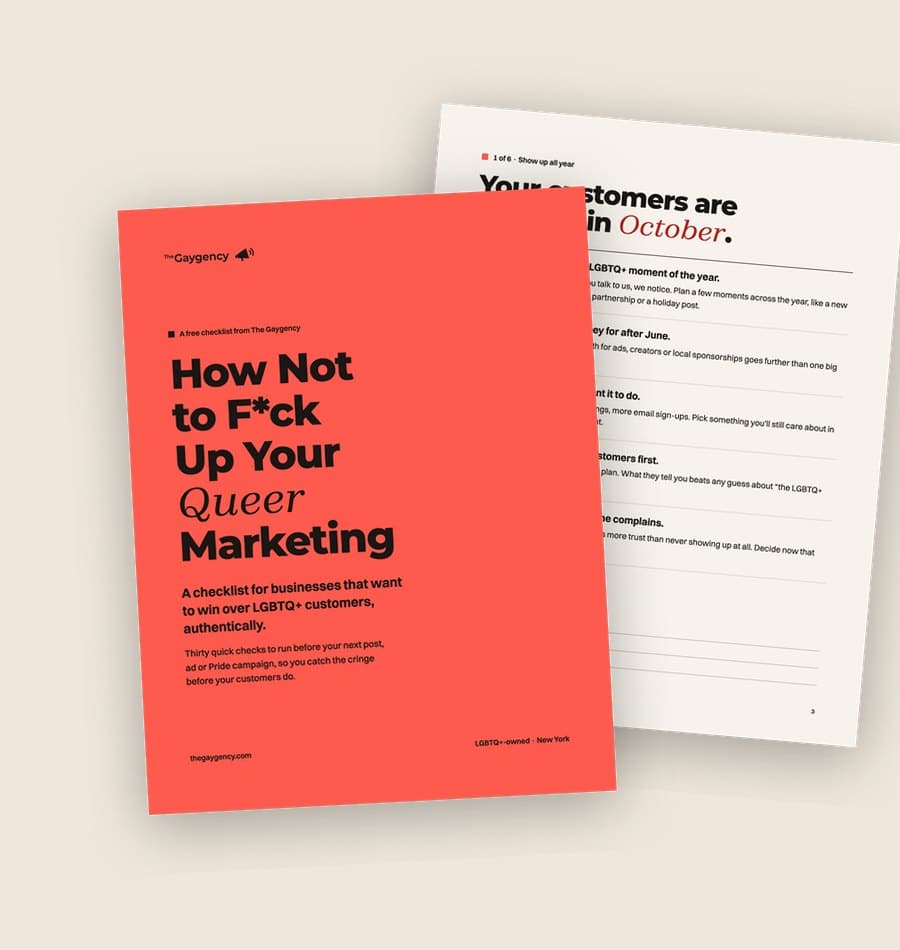
Free checklist
How not to f*ck up your queer marketing
A checklist for businesses that want to win over LGBTQ+ customers, authentically.
Thirty quick checks to run before your next post, ad or Pride campaign, so you catch the cringe before your customers do.
Delivered by email. No spam, ever.
Written by
The marketing and advertising agency for LGBTQ+ businesses and the brands that back them. Strategy, media buying, and brand systems with published results.
See the work