Media strategy
How to Reach LGBTQ+ Audiences After the Platforms Killed Targeting
By The Gaygency · 07-18-26 · 7 min read

For most of the last decade, a marketer who wanted to reach LGBTQ+ audiences on Meta could build an interest-based audience around LGBT culture and community categories and let the platform's targeting engine do the rest. That option does not exist anymore. Meta removed LGBT-interest and sexual-orientation ad targeting categories in 2022, and in March 2025 it went further, removing detailed targeting exclusions from ad campaigns entirely, so advertisers can no longer even exclude by those categories to sharpen a broader audience (Meta Business Help Center, 2025).
If your media plan was built before 2022 and never rebuilt, it is running on assumptions the platform no longer supports. Here is what changed exactly, and what a media plan built for the current reality looks like.
What changed, precisely
Two separate changes stacked on top of each other. First, in 2022, Meta removed the specific interest categories tied to LGBT culture and community from its ad targeting options, which had been the most direct, precise way to reach this audience on the platform. Second, in March 2025, Meta removed detailed targeting exclusions from ad campaigns across the board, which meant advertisers lost even the indirect workaround of building a broad audience and excluding categories to sharpen it (Meta Business Help Center, 2025). Existing campaigns using the old exclusions began showing warning banners and losing delivery as the change rolled out.
The result is that precise, interest-based targeting toward LGBTQ+ audiences is not harder on Meta. It is gone as a platform feature. Broad targeting plus creative that speaks clearly to this audience is now the default approach, which changes what "efficient" media buying looks like.
This did not happen in isolation. GLAAD's 2026 Social Media Safety Index scored all six major platforms it evaluated on LGBTQ safety, privacy, and expression, and none scored above 56 out of 100: TikTok led at 56, Instagram scored 41, Facebook scored 40, Threads scored 39, YouTube scored 30, and X scored 29 (GLAAD, 2026). Meanwhile, users are visibly moving. Bluesky's first full transparency report showed the platform grew from 25.9 million to 41.4 million users over 2025, a gain of nearly 60% (Bluesky Transparency Report, 2026). None of these platform shifts mean abandon your existing channels. They mean the assumption that any single platform is a stable, precisely targetable home for this audience no longer holds.
Anyone still buying media the old way is now spending on hope, not precision.
What still works
First-party data is now the only precise lever left. A brand with its own verified customer list, built from purchases, sign-ups, or loyalty data, can still build a lookalike audience. Meta and other platforms can construct lookalikes from a seed list you provide; what they can no longer do is build that seed list for you from an LGBTQ+ interest category. If you do not have a large enough first-party list of your own, a licensed dataset can fill that gap. This is exactly why we built a proprietary dataset of more than one million verified LGBTQ+ consumers, held securely and offered as an optional add-on to our paid social and paid search work: it exists specifically to give clients a seed list the platforms themselves can no longer generate.
Creator and community partnerships now do more of the targeting job. When a platform cannot hand you a precise audience, a creator whose actual audience already matches your target does that work instead. Our creator partnerships work is built around vetting creators for genuine audience fit, not follower count, which matters more now that interest targeting cannot verify audience composition for you.
Contextual and content-based reach matters more than it did five years ago. Publishing content that this audience searches for and shares, on your own site and through organic channels, puts you in front of the right people without relying on interest-category targeting at all. Our SEO and organic social work both lean on this shift.
Broad targeting with sharply written creative is now a real strategy, not a fallback. If the platform cannot filter for you, your creative has to do more of that filtering itself, speaking clearly enough to the right audience that the wrong audience self-selects out. This changes what a strong ad needs to do to earn its click, and it is a core part of how we approach paid social campaigns now.
Landing pages need to close the loop the ad can no longer target precisely. When the ad itself is reaching a broader audience by necessity, the landing page has to do more work to confirm the visitor is in the right place and convert the ones who are. See landing pages.
The dataset we use is a secure, hashed record of more than one million verified LGBTQ+ consumers. We do not build custom targeting profiles on individuals or expose personal data to any platform. It works as a seed list for lookalike audience modeling, the same way a client's own customer list would, at a scale most individual brands cannot match on their own.
What this looks like by business type
If you are a startup with a small existing audience, first-party data alone will not support a media plan yet. Lean on creative that speaks clearly to the audience you want and pair it with organic content that builds your own list over time. See for startups.
If you are an established business with real revenue and a flat quarter, you likely have more first-party data than you are using. Auditing what you already have, and pairing it with a licensed dataset where the gap is large, is usually the fastest way back to precise targeting. See for established brands.
If you are an enterprise brand team, this is a data and measurement problem as much as a media problem, and it usually needs to be solved before the creative conversation starts. See for enterprise.
If your business already serves this audience directly, categories like travel, wellness, and retail depend more than most on precise reach, because the cost of a wasted impression on the wrong audience is higher. See travel and hospitality and med spas and wellness for how we approach targeting in those categories specifically.
A brand's own customer list, paired with a dataset built for this audience, is doing the job interest targeting used to do. The tools changed. The need to reach the right person did not.
Frequently asked questions
Can I still target LGBTQ+ audiences on Meta or Instagram by interest?
No. Meta removed LGBT-interest and sexual-orientation targeting categories in 2022, and in March 2025 removed detailed targeting exclusions from ad campaigns entirely, eliminating the last indirect path to sharpening an audience by those categories (Meta Business Help Center, 2025).
What replaced interest-based LGBTQ+ targeting?
First-party data used to build lookalike audiences, creator and community partnerships with verified audience fit, and content that reaches this audience organically through search and social, rather than through platform interest categories.
Is TikTok a safer or more precise option for reaching this audience?
TikTok scored highest among major platforms in GLAAD's 2026 Social Media Safety Index at 56 out of 100, but that reflects platform safety policy, not targeting precision. No major platform currently offers interest-based LGBTQ+ ad targeting (GLAAD, 2026).
What is a lookalike audience, and how does it help without interest targeting?
A lookalike audience is a platform-built segment modeled on the traits of a seed list you provide, such as your existing customers. Platforms can still build lookalikes from a list you give them; what they can no longer do is generate that original list from an LGBTQ+ interest category, which is why owning or licensing first-party data matters more now.
What is the 1M+ verified LGBTQ+ consumer dataset, and is it safe to use?
It is a proprietary, securely hashed dataset of more than one million verified LGBTQ+ consumers that we offer as an optional add-on to paid media engagements. It works as a seed list for lookalike modeling and does not expose personal data to ad platforms or third parties.
If your media plan still assumes the old targeting tools exist, book a call and we will show you what our verified consumer dataset can do for your account instead.
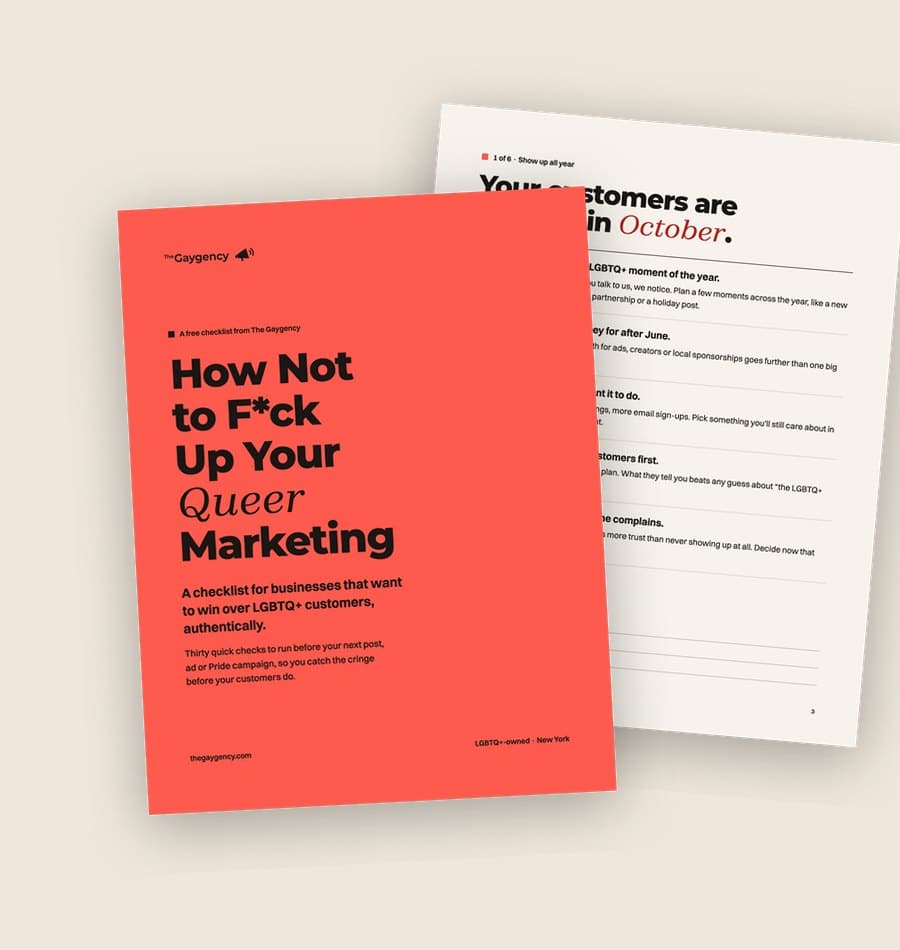
Free checklist
How not to f*ck up your queer marketing
A checklist for businesses that want to win over LGBTQ+ customers, authentically.
Thirty quick checks to run before your next post, ad or Pride campaign, so you catch the cringe before your customers do.
Delivered by email. No spam, ever.
Written by
The marketing and advertising agency for LGBTQ+ businesses and the brands that back them. Strategy, media buying, and brand systems with published results.
See the work