Media Strategy
Where LGBTQ+ Audiences Are in 2026
By The Gaygency · 07-20-26 · 8 min read

For a decade, the media plan for reaching LGBTQ+ audiences was mostly a targeting exercise. Pick the interest category, pick the platform, let the algorithm find the people. That plan does not work anymore, not because the audience moved to one obvious new place, but because the platforms holding them changed the rules and the people using them started leaving in measurable numbers.
GLAAD released its 2026 Social Media Safety Index, and no platform scored above 56 out of 100. Meta's ad-targeting restrictions, first enacted in 2022 and tightened again in 2025, mean interest-based targeting for this audience no longer exists on the platform that used to get most of the budget. And Bluesky, a platform that barely registered two years ago, added more than 15 million users in a single year. This is documented and dated, and it changes where the next dollar of media spend should go.
The 2026 platform scorecard
GLAAD's 2026 Social Media Safety Index scored six major platforms on 14 LGBTQ-specific indicators covering moderation, privacy, and product policy. Every platform except one dropped from its 2025 score, and none passed:
- TikTok: 56 (unchanged)
- Instagram: 41 (down 4 points)
- Facebook: 40 (down 5 points)
- Threads: 39 (down 1 point)
- YouTube: 30 (down 11 points)
- X: 29 (down 1 point, last place for the second year running)
TikTok holding steady while every other platform fell is not TikTok becoming safer. It is everyone else getting worse around it. GLAAD's report specifically names Meta and YouTube for maintaining 2025 policy changes that made their platforms more hostile to LGBTQ+ users, including changes to Meta's Hateful Conduct policy that now permit certain anti-LGBTQ rhetoric it previously prohibited, and the removal of trans and nonbinary theme options on Messenger.
GLAAD President and CEO Sarah Kate Ellis put it plainly: "Leading social media companies today do not meet basic best practices in content moderation, transparency, data privacy, and workforce diversity."
A platform score is not the same as a performance number, but it is a leading indicator of two things that matter for media planning: how much LGBTQ+ content and creators will be suppressed or removed on that platform, and how a brand's association with the platform reads to this audience. Both affect paid social and organic social results before a single ad runs.
YouTube's eleven-point drop is worth sitting with on its own, because it is the largest single-year decline in the report. GLAAD's methodology weighs 14 LGBTQ-specific indicators covering moderation, transparency, and product policy, and YouTube's fall reflects the same pattern GLAAD documented at Meta: a platform maintaining a 2025 policy shift into 2026 rather than correcting course. For a brand running video content or paid pre-roll aimed at this audience, that risk is a real input into where the content budget gets allocated, not a talking point.
What changed inside Meta specifically
Meta gets the largest share of most brands' social budgets, which makes its specific changes the most consequential for this audience. Two separate things happened, on two different timelines, and both matter.
First, in 2022, Meta removed detailed-interest targeting categories including "LGBT culture" and "same-sex marriage" from its ad system, citing concerns that such categories could be used to discriminate against the people they described. Whatever the intent, the effect was immediate: advertisers lost the ability to target this audience by stated interest.
Second, Meta eliminated detailed targeting exclusions entirely, with the change fully in effect by March 2025. This was a platform-wide simplification, not an LGBTQ+-specific policy, but it removed one of the last remaining tools advertisers had for shaping an audience with precision rather than relying entirely on Meta's automated Advantage+ systems.
The combined effect is that a brand cannot ask Meta to find LGBTQ+ people by interest anymore. It can only ask Meta to optimize toward whoever converts, and hope the algorithm finds the right people from the seed data it is given. That seed data is now the entire game, which is exactly why a proprietary dataset built outside the walled gardens has become a real asset rather than a nice-to-have. It is also why our Paid Social engagements include an optional add-on: our own dataset of 1M+ verified LGBTQ+ consumers, used to build lookalike audiences the platforms can no longer construct on their own.
Where people are moving instead
Bluesky is the clearest migration story with numbers behind it. According to Bluesky's own 2025 Transparency Report, the platform grew from 25.94 million users at the start of 2025 to 41.41 million by year's end, a gain of nearly 60% in twelve months. That growth was not evenly distributed across every kind of user, but LGBTQ+ users, journalists, and people leaving X over its moderation record make up a well-documented share of it.
This does not mean a brand should shift its whole paid budget to Bluesky. The platform's advertising infrastructure is not built out the way Meta's or TikTok's is, and a 41-million-user platform is still a fraction of the size of the ones losing share. What it does mean is that organic presence, community management, and press relationships increasingly need a Bluesky component, particularly for brands whose audience skews toward the people who left X and Meta on purpose rather than by accident.
The audience relocated to platforms that are smaller, harder to buy media on at scale, and considerably more trusted by the people now living there.
What this means for the media plan
The old plan assumed one or two dominant platforms would always hold the audience, and the job was picking the right interest category. The 2026 plan has to account for a fragmented, safety-conscious audience that is actively choosing where to spend its attention based on how a platform treats it, not on content alone.
That means three real shifts in practice. First, first-party and proprietary data now do the targeting work that platform interest categories used to do, which raises the value of any measurement and analytics work done to capture and structure that data properly. Second, TikTok's relative safety score does not mean TikTok is where every brand should concentrate spend. It means TikTok is currently the least likely platform to actively work against LGBTQ+ content, which is a different and lower bar. Third, creator partnerships matter more than platform-level targeting now, because a trusted creator's audience is a form of targeting that survives a platform's policy changes.
The cadence of the review matters as much as the channel mix itself. A platform's score, its ad tools, and its user base can all move meaningfully within a single year, which is exactly what happened between the 2025 and 2026 GLAAD reports and between Bluesky's user count at the start and end of 2025. A media plan reviewed once a year against this backdrop is reviewing data that is already stale by the time the next budget cycle starts. Building a standing check, twice a year at minimum, into the planning calendar is a smaller lift than most teams assume, and it is the difference between reacting to a platform's decline after the performance drops and reallocating before it does.
A platform score of 41 out of 100 is not a footnote. It is a description of the environment a brand's ad is about to sit inside.
Three questions to ask before the next media plan
- Does this platform's current safety record match what we are willing to have our name associated with when the audience checks?
- If Meta cannot target this audience by interest anymore, what first-party data are we using instead?
- Is our organic presence built for a platform we picked five years ago, or the ones the audience is on now?
Brands at an established stage usually feel this shift first, because their media budgets are large enough that a platform's declining safety score shows up in creative fatigue and rising costs before it shows up anywhere else. Enterprise brand teams feel it differently: a platform controversy involving LGBTQ+ users becomes a brand-safety question the moment their name appears next to it.
Frequently asked questions
Is Bluesky worth advertising on yet?
Not at meaningful scale for most brands, since its ad tools are still early. It is worth an organic presence and a place in the press and community strategy, especially for brands whose audience already migrated there.
Should brands leave X entirely?
That depends on the brand's risk tolerance and audience overlap. X's GLAAD score of 29 is the lowest of any platform measured, and a growing share of LGBTQ+ users have already left. A brand still active there should know exactly why and be prepared to explain it.
Does TikTok's higher safety score mean better ad performance for this audience?
Not automatically. Safety score measures policy and moderation, not conversion rate. TikTok scoring higher means it is currently less likely to actively suppress LGBTQ+ content and creators, which matters for organic reach and creator partnerships specifically.
If Meta removed interest targeting, how does anyone reach this audience precisely anymore?
Through first-party data, creator partnerships with built-in trust, and proprietary datasets built outside the platforms. This is the exact gap our 1M+ verified LGBTQ+ consumer dataset was built to close.
How often does this picture change?
Every year GLAAD's index has moved, and platform policy changes have landed on their own separate timelines. Treat the channel mix as something to revisit at least twice a year, not something to set once and leave alone.
The platforms are not going to get more predictable. A media plan built around where this audience spends time, and how safely they are treated once they are there, holds up better than one built around where the budget has always gone. Book a call and we will map the channel mix against your specific audience and category.
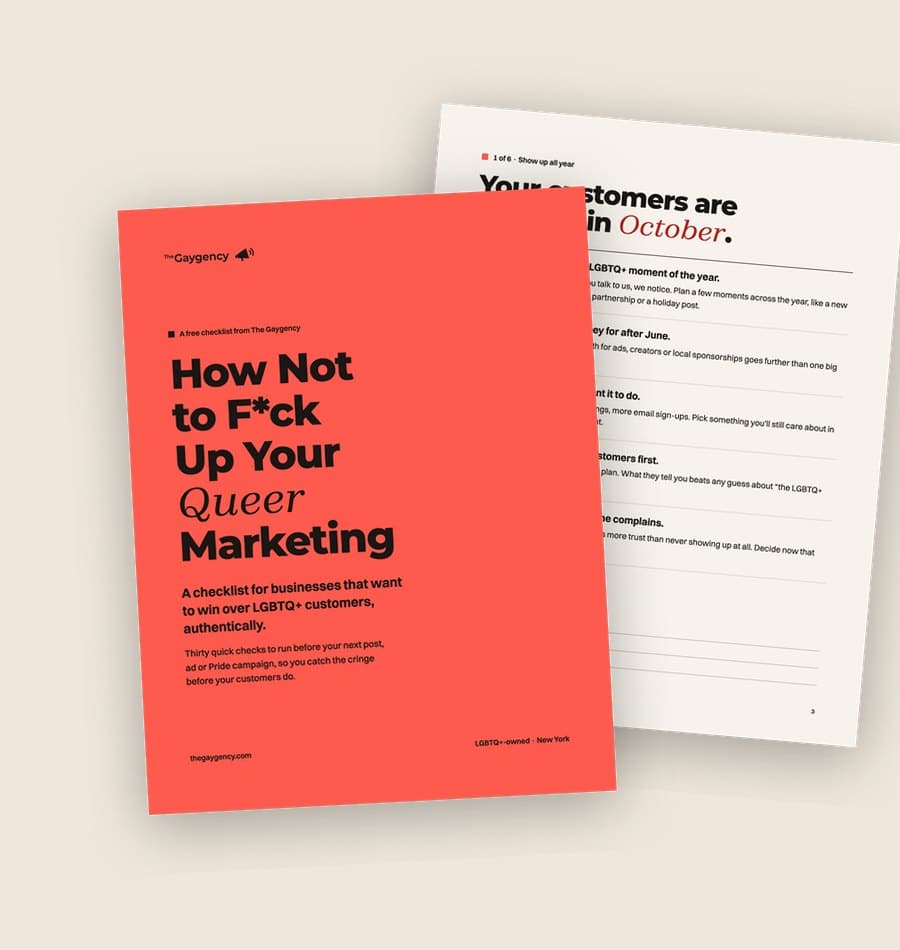
Free checklist
How not to f*ck up your queer marketing
A checklist for businesses that want to win over LGBTQ+ customers, authentically.
Thirty quick checks to run before your next post, ad or Pride campaign, so you catch the cringe before your customers do.
Delivered by email. No spam, ever.
Written by
The marketing and advertising agency for LGBTQ+ businesses and the brands that back them. Strategy, media buying, and brand systems with published results.
See the work