Culture
Gay slang and terminology: a plain-English guide to the words
By The Gaygency · 07-29-26 · 11 min read
Most gay slang glossaries online are a flat list of sixty words with one line each, written once and never touched again. That is not much help when the language moves this fast, when the same word means different things in different rooms, and when a few of these words can get you in trouble if you use them without knowing where they came from.
This guide is organized the way the language works: by what the words are for. Body and type words. Sex and role words. The ballroom and drag vocabulary that has quietly taken over mainstream slang. Identity labels. Gender language. And the reclaimed words that only some people get to use.
Every term below links to its full entry in our LGBTQ+ glossary, where you get the longer definition, where the word came from, and the sources we checked. There are more than 1,200 entries there; this guide is the map to the ones that come up most.
A note on why this matters commercially, since that is our day job: brands get this wrong in public constantly. Using a word from the wrong room, or a word that is only reclaimed in-group, is the kind of mistake that produces a screenshot. If you are writing copy for this audience, read the entry before you use the word.
Body and type words
This is the vocabulary most outsiders encounter first, because it is how a lot of gay men describe themselves in three words or fewer. These words are descriptive, not official, and plenty of people reject all of them.
A bear is a larger, typically hairier man, a look and a whole subculture with its own events and flags. An otter is the leaner, hairy equivalent. Cubs are younger bears. A wolf is hairy like a bear but leaner and more athletic, usually with a more assertive persona. A twink is young, slim, and typically smooth, and a twunk is what happens when a twink starts lifting. A jock is athletic and gym-built. A daddy is older and carries some authority, real or performed, and the word is about presence more than age. A muscle Mary is heavily gym-built and camp with it. A clone is a specific 1970s look, moustache and denim and flannel, and the word is historical as much as descriptive.
Attraction to a type gets its own word: a chubby chaser is drawn to bigger men. These are neutral in-community terms; treated as insults from outside, they land differently.
Sex and role words
These are the words people search for most often and the ones written about least carefully. All of them describe preference, not identity, and preference changes.
Top and bottom describe who penetrates and who receives. Vers, short for versatile, means comfortable either way. A power bottom bottoms assertively and drives the encounter. A side is a gay or bisexual man who does not do anal at all, either way, which is a more common position than the rest of the vocabulary implies and a relatively recent addition to the language.
Two of the more colourful ones: a blouse is a camp or feminine gay man who prefers to top, which cheekily inverts the assumption that femininity means bottoming. Pits refers to armpits as an object of attraction. And bussy is a portmanteau you can probably work out, common online and rarely said out loud in mixed company.
The words that describe how people arrange sex matter too, especially for anyone writing health copy. NSA means no strings attached. Discreet signals someone who is not out and wants privacy. PnP means party and play, which is sex involving drugs, and it is a harm-reduction topic rather than a slang curiosity.
Sexual health language you should get right
If you work in health marketing, these four are not optional and getting them wrong is a real harm.
PrEP is medication taken before exposure to prevent HIV, and on-demand PrEP is the 2-1-1 dosing schedule some people use instead of a daily pill. Poz means HIV-positive, a word the community reclaimed from clinical language. Undetectable means viral load suppressed below the level tests can measure, which also means the person cannot transmit HIV sexually. That last fact is the single most under-communicated piece of health information in this category.
Ballroom and drag: the vocabulary that took over
If you have heard "ate," "boots," or "the house down" in an advert, you have heard ballroom language being sold back to the people who invented it. Nearly all of it comes from Black and Latino queer and trans ballroom culture in New York, and most of it reached the mainstream through drag competition television.
Ballroom culture is the competitive scene where all of this originated. A house is a chosen family that competes together, led by a house mother. Vogue is the dance form, with vogue femme as one of its styles, and a death drop is the backward fall that gets the loudest reaction in the room. Realness is a judged category rewarding how convincingly a competitor reads as a given identity, a concept with much heavier stakes than its casual use suggests. Butch queen is one of the scene's own gender categories. Legendary children are the performers who earned lasting status.
Then the expressions. To read someone is to call out their flaws wittily, and shade is the more indirect version of the same thing. Boots is an intensifier tacked onto the end of a sentence. Gagged means stunned. Cunty is high praise for a sharp, confident, feminine presentation. To have ate is to have performed flawlessly. Serving is delivering a look convincingly, snatched means impeccably put together, ovah means beyond excellent, and yas is the enthusiastic yes that escaped into every brand caption on earth. Spill the tea is a request for gossip. A kiki is a gathering, a hangout, a heart-to-heart. Beat describes a flawlessly made-up face, and fish is drag praise for reading as conventionally feminine.
Drag queens and drag kings are the performers. To be clocked is to be recognized as trans or in drag when you did not intend to be, and that word carries real weight for trans people rather than being a performance term.
Identity labels
Slang describes; labels claim. These are the words people use for who they are, and the only rule that matters is that you use the one a person uses for themselves.
Gay, lesbian, and bi are the most established. Pansexual describes attraction regardless of gender. Asexual describes little or no sexual attraction, and aromantic little or no romantic attraction, which are separate axes and often confused. Queer is the broad umbrella many people prefer and some still hear as a slur, which is covered below.
Two words worth knowing for reasons of history rather than daily use: a friend of Dorothy was coded language for a gay man in decades when saying it plainly was dangerous, and camp is the deliberately theatrical sensibility that runs through most of the culture above.
Gender language
Transgender describes someone whose gender differs from the one assigned at birth, and cisgender describes someone whose does not. Non-binary covers genders outside the man-woman binary, and enby is the affectionate short form. Femme and masc, as in masc for masc, describe presentation rather than identity, though the second phrase carries a history of exclusion worth reading about before using.
The reclaimed words
Some words in this category were slurs first. Parts of the community took them back; other parts never will. The safe rule for anyone outside the group is simple: do not use these unless the person you are talking to used them first about themselves.
Dyke is widely reclaimed by lesbians and still thrown as an insult. Fag is reclaimed by some gay men in-group and remains one of the most wounding words in English elsewhere. Queer is now the standard academic and community umbrella, and there are still older people for whom it is the word that was shouted at them.
Brands do not get to reclaim words. That is the entire rule. A word being common inside the community is not permission for a company to put it on a T-shirt.
How this language changes, and what that means for your copy
Three patterns are worth internalising if you write for this audience.
The first is that words travel outward from the most marginalised rooms and get flattened on the way. Ballroom vocabulary invented by Black and Latino trans women arrives in a brand caption stripped of any of that, which is why the origin section above is longer than a glossary strictly needs.
The second is that words are regional and generational at once. Straight-acting reads as a neutral descriptor to one generation and as internalised shame to another. The same is true of much of the body vocabulary.
The third is that the sex and health language is the most consequential and the least carefully handled. Confusing poz and undetectable, or treating PrEP as interchangeable with treatment, is not a style error.
The practical version of all three: read the entry before you use the word, and if a campaign depends on a piece of slang, have someone from the community read the copy before it runs. That is a large part of what we do, and it is cheaper than the screenshot.
For the full reference, the LGBTQ+ glossary has more than 1,200 entries covering identity, gender, community slang, ballroom and drag, pride flags, sexual health, nightlife, and law, each with a plain-English definition. If you would rather have a checklist than a glossary, our free LGBTQ+ Campaign Pre-Flight Checklist runs 42 checks over language, creative, and media before a campaign goes live.
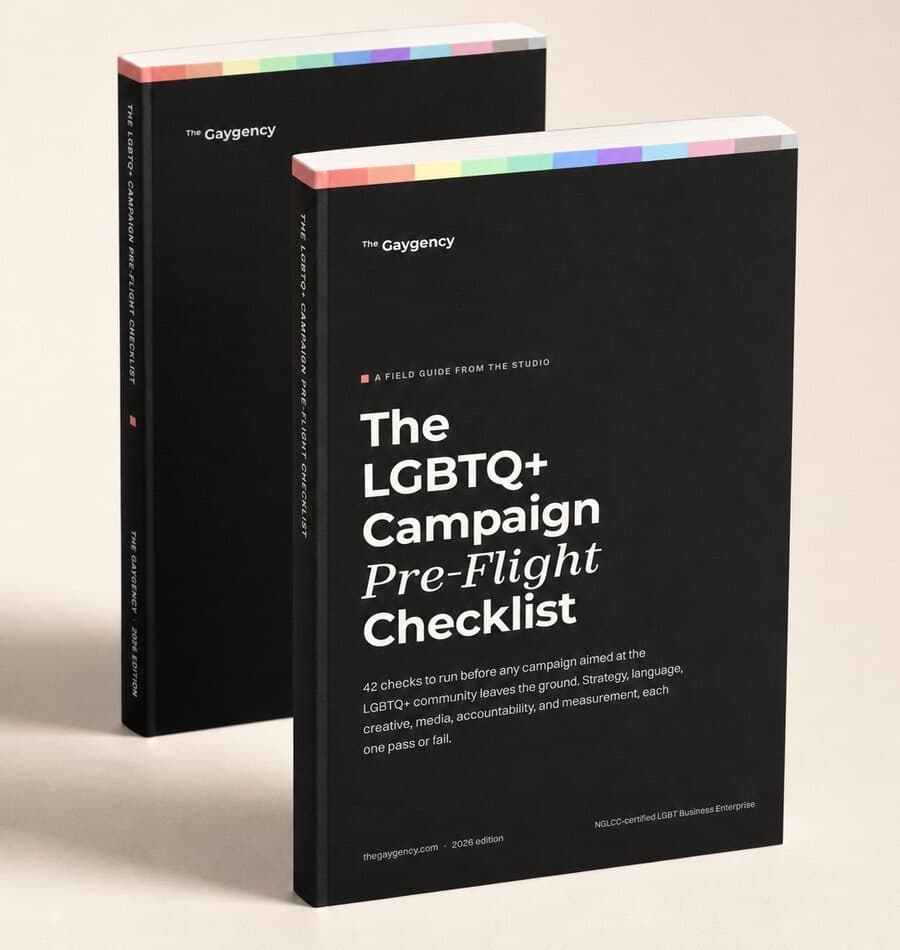
Free campaign guide
Would your campaign pass pre-flight?
The same 42 checks we run inside the studio before any campaign aimed at the LGBTQ+ community goes live.
Delivered by email. No spam, ever.
Written by
The marketing and advertising agency for LGBTQ+ businesses and the brands that back them. Strategy, media buying, and brand systems with published results.
See the work